
Jade Inclusions in Bracelets: What Photos Can and Cannot Prove
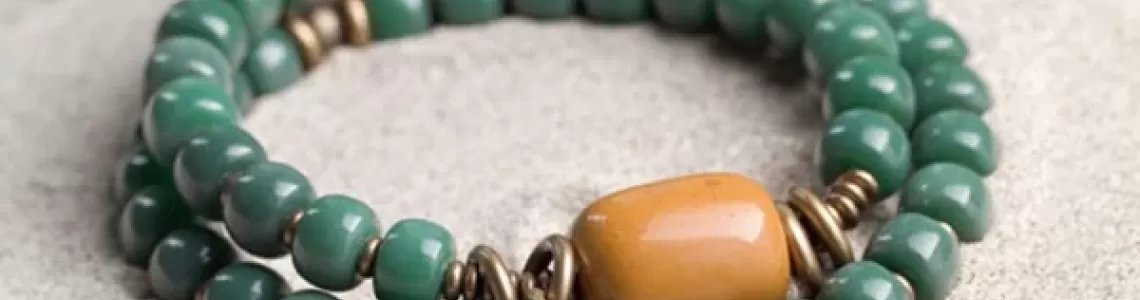
Answer first: Jade inclusions can be natural mineral grains, color zones, cloudy patches, healed features or other material trapped within an aggregate, but a spot or line in a bracelet photograph does not by itself prove natural jade. A visible line might be a grain boundary, polish mark, surface-reaching fracture, reflection, residue or image artifact. Likewise, smooth color does not prove treatment, and irregular color does not prove untreated stone. Use photographs to assess appearance and visible condition; use clear seller disclosure and, when identity or treatment materially affects price, an appropriate gemological report to support stronger claims.
This guide explains how to read jade inclusions, texture and surface features in online bracelet photos without turning visual clues into a false certificate. It is for buyers comparing jade-labelled beads, including mixed-material bracelets. It does not authenticate any sunMYLOVE product, grade jade, identify geographic origin, value a specimen or replace laboratory testing.
Research question and scope
The practical question is: What can a buyer responsibly learn from spots, clouds, lines and texture in jade bracelet photographs, and where does the evidence stop? The answer requires separating four things that shopping descriptions often compress into one word: material identity, internal features, surface condition and treatment status.
The broader jade terminology and treatment guide explains that “jade” can refer to jadeite or nephrite and that a color label alone is not a laboratory identification. This article is narrower. It focuses on the visible evidence a shopper encounters when inspecting beads, then provides a decision method for accepting ordinary variation, asking a seller for clarification or requesting stronger documentation.
Working definitions
- Inclusion: material or a feature enclosed within a gem. GIA explains that inclusions may be solid, liquid or gas and may form before, during or after the host material; their history is not always visually conclusive.
- Texture: the visual and physical expression of the material's constituent crystals or fibers. GIA describes jadeite texture as fine, medium or coarse depending on crystal size and variation.
- Grain boundary: the interface between neighboring crystals or mineral grains in an aggregate. It is not automatically a damaging crack.
- Fracture: a break or separation in the material. A fracture may be healed, partly healed or open to the surface, and its effect depends on position, extent and the finished object.
- Surface feature: a polish line, pit, scratch, residue, coating, wax, chip, drill-hole abrasion or other feature at the surface.
- Treatment: a human-applied process intended to alter appearance, stability or both, such as bleaching, polymer impregnation, dyeing, filling, coating or waxing.
These definitions matter because a shopper can see a pale line and incorrectly call it an inclusion, or see a dark spot and incorrectly call it proof of natural origin. Accurate buying language begins by describing the observation before naming the cause.
What gemological sources say about jade's internal appearance
Jadeite and nephrite are not simple, transparent single crystals. They are mineral aggregates with interlocking structures. GIA's jadeite quality-factor guide explains that jadeite texture can range from fine to coarse and that its tightly intergrown crystals contribute to exceptional toughness. The same source describes transparency from opaque to semitransparent and notes that cloudy patches can interrupt it.
GIA's more detailed The Jade Enigma identifies texture, surface luster, fracture surface, inclusions and distinctive surface features as useful visual clues. Crucially, it also explains that trained observers support visual suppositions with standard gemological tests. That evidence supports a careful distinction: an inclusion is not automatically a defect, but neither should every visible feature be romanticized as desirable “natural character.” Location, contrast, extent and structural significance matter.
Citation-ready fact block: Jadeite is a crystalline aggregate whose texture, transparency, inclusions and fractures can all affect appearance. Natural internal variation can occur, but a visible spot, cloud or line does not prove identity, untreated status, origin or value. Those conclusions require evidence beyond a photograph.
GIA's general review of inclusions in gemstones adds another limit. Gemologists classify inclusions by shape, size, transparency, color, luster, contrast, orientation and association with other features. Yet the timing and formation relationship cannot always be established by visual appearance alone. A phone photo is even more limited because lighting, compression, reflections, focus and white balance alter what the buyer sees.
Jade inclusions, fractures and surface marks: a buyer comparison
| Visible observation | Possible explanations | What a photo may support | What it cannot prove |
|---|---|---|---|
| Dark or colored spot inside a bead | Mineral inclusion, color concentration, stain, shadow, reflection or image artifact | There is visible contrast worth comparing across views | Natural origin, species, locality, age or untreated status |
| White cloud or diffuse patch | Fine intergrowth, lower transparency, scattering, fracture network, residue or lighting | The bead may have non-uniform transparency | That it is “cotton,” “snow,” a defect or a specific quality grade |
| Thin line beneath the polish | Grain boundary, healed feature, open fracture, color boundary or reflection | Its position and continuity can be documented | Whether it threatens durability without closer inspection |
| Line that reaches a drill hole | Drilling damage, pre-existing fracture, grain boundary or polish artifact | A reason to ask for a close-up and check for chips | Remaining service life or guaranteed failure |
| Concentrated color near pits or cracks | Natural zoning, dye concentration, residue or camera processing | A treatment question is reasonable | Dyeing without laboratory or seller evidence |
| Very smooth, even color | Fine material, matching, treatment, coating, diffuse lighting or editing | The seller selected a visually uniform set | That the beads are treated or untreated |
| Surface pits or rough drill-hole edges | Manufacturing finish, wear, impact, granular structure or residue | Visible condition and finishing can be assessed | Material identity or origin |
The most defensible first step is neutral description. Write “a pale line crosses one bead and appears to meet the drill hole,” not “the jade has a dangerous crack.” Write “several beads show darker internal spots,” not “the inclusions prove genuine untreated jade.” Neutral observation keeps the next question open.
Why treatments complicate visual interpretation
Jadeite treatments are well documented. GIA's gem treatment guide explains that acid bleaching may remove unwanted brown coloration and leave material porous or vulnerable along fractures; polymer impregnation is commonly used afterward to fill open spaces and improve appearance. Dye, coating and wax may also alter what the surface or internal network looks like.
The original GIA study on bleached and polymer-impregnated jadeite found that several gemological tests could help, but infrared spectroscopy provided conclusive evidence of polymer impregnation across the study samples. The useful buyer lesson is not that every purchase needs a laboratory. It is that visual confidence should be proportional to the claim. A low-cost fashion bracelet with clear, modest wording may be judged mainly on design, fit and condition; an expensive untreated-jade claim needs evidence proportionate to the premium.
Treatment also creates counterintuitive cases. A natural mineral inclusion can be mistaken for resin or a suspicious transparent patch. GIA has documented laboratory cases in which advanced testing was needed to distinguish natural included minerals from apparent treatment. Conversely, the absence of obvious dye concentrations or filler flashes in a product photo does not rule treatment out. “I cannot see treatment” and “the stone is untreated” are different statements.
The CIBJO Retailers' Reference Guide documents both jadeite and nephrite, their exceptional toughness and treatments such as dyeing and surface waxing. The FTC Jewelry Guides add the commercial boundary: jewelry marketing should truthfully represent type, quality, treatment, durability, origin and other material attributes. A buyer should therefore look for a specific treatment disclosure rather than infer it from a dramatic photo.
A seven-step photo review for jade-labelled bracelet beads
1. Start with the exact product wording
Record whether the listing says jade, jadeite, nephrite, yellow jade, red jade, jade color or jade-style. These phrases do not all make the same claim. Color modifiers can be catalog labels rather than independent gemological identification. If the distinction matters to the purchase, ask the seller what material the term represents and what documentation supports it.
2. Require more than one image
Compare front, side and close-up views under ordinary lighting. One hero image can hide reflections, drill-hole edges and bead-to-bead variation. Multiple images should be treated as evidence of appearance, not as laboratory data. Editing, compression and display calibration can still change color and contrast.
3. Separate internal from surface features
Look at whether a line changes when the angle changes. A moving bright line may be reflection; a fixed feature may be internal or at the surface. Check whether it intersects a pit or drill hole. Even then, do not perform a destructive scratch, impact, flame, solvent or needle test. Such tests can damage the bracelet and rarely prove the claimed identity.
4. Inspect drill holes and high-stress areas
Bead holes remove material and concentrate stress. Look for chips, radiating lines, rough edges, thin walls and cord abrasion. The site's hardness-versus-toughness guide explains why scratch resistance is not the same as resistance to chipping or breaking. Jade's exceptional toughness does not make a drilled bead indestructible.
5. Compare variation across the whole strand
Natural materials may vary, but variation is not an authenticity certificate. The natural stone bead variation guide explains how representative photos and honest range descriptions help buyers set expectations. Ask whether the photographed bracelet is the exact item, a representative sample or one variation from a batch.
6. Match evidence to price and claim strength
For ordinary fashion jewelry, clear material wording, treatment disclosure when known, representative photographs, dimensions and return terms may be enough. For a high-value claim such as untreated jadeite of a named origin or exceptional grade, seek an object-specific report from an appropriately qualified laboratory. A generic certificate image, seller assurance or online flashlight test is not equivalent.
7. Check fit, construction and policies
Even accurately identified beads can disappoint if the bracelet does not fit. Use the beaded-bracelet wrist measurement guide, then verify the product's size definition, bead diameter, cord or closure and adjustment range. Review delivery information and returns and refund terms before relying on an online image for a gift or a size-sensitive purchase.
Applying the method to real mixed-material bracelets
Start from the men's beaded-bracelet collection, then treat each product page as the controlling source for current wording and options. The Yellow Jade, Bodhi Root and Brass Bracelet combines a jade color/material label with plant-based beads and brass components. The Aquatic Onyx, Red Jade and Brass Bracelet combines several catalog materials in one strand.
These links establish that real products use the terms; they do not establish laboratory identity, treatment, origin or grade. Compare their real photographs for color distribution, bead matching, polish, drill-hole condition, spacer edges and overall construction. If a product-specific material claim affects your decision, ask for clarification rather than importing a conclusion from this guide.
Care when inclusions or treatment status are uncertain
GIA's jade care guidance describes jadeite and nephrite as exceptionally tough but notes that treatment can change durability and stability. The safest routine for an unknown mixed-material bracelet is conservative:
- Remove the bracelet before impact-heavy work, exercise, bathing, swimming and household chemical use.
- Wipe it with a clean, soft, slightly damp cloth; do not soak a mixed strand by default.
- Use no acid, bleach, solvent, abrasive paste or improvised dye test.
- Avoid steam and ultrasonic cleaning unless the maker or a qualified professional confirms suitability for every bead, metal, cord, adhesive and known treatment.
- Dry around drill holes and metal spacers, then store separately from harder or sharp-edged jewelry.
- Stop wearing a bead with a widening line, sharp chip, loose section or cord damage and seek an appropriate repair assessment.
This is an institution-informed conservative method, not a guarantee. Product-specific maker instructions control when they are available, and the most sensitive component sets the care limit for a mixed-material bracelet.
Common mistakes
- Calling every visible spot an inclusion. It may be surface residue, reflection, color concentration or an image artifact.
- Calling every line a fracture. Grain boundaries, polish lines and reflections can look similar in a photograph.
- Using variation as proof of natural origin. Natural materials vary, but manufactured, dyed and assembled materials can vary too.
- Using uniformity as proof of treatment. Fine material, careful matching and lighting can also create an even look.
- Diagnosing treatment from UV, flashlight, sound or temperature alone. These are clues at best and can be misleading.
- Ignoring the drill holes. A beautiful inclusion matters less to daily use than an active chip, rough edge or stressed cord path.
- Assuming “jade” proves jadeite. Jade can refer to jadeite or nephrite, while some retail color labels require clarification.
- Turning symbolism into medical evidence. There is not enough reliable evidence that wearing jade treats pain, circulation, sleep, anxiety, immunity, detoxification or disease.
Frequently asked questions
Do jade inclusions prove a bracelet is real?
No. Natural jade can contain mineral inclusions and other internal features, but imitations, treated materials and image artifacts can also show spots or lines. Identity requires stronger evidence than the presence of an inclusion.
Are white clouds inside jade always defects?
No. A white or cloudy area may reflect intergrowth, lower transparency, scattering, a fracture network or another feature. Whether it is acceptable depends on appearance, location, structural condition, disclosure and buyer preference.
How can I tell a jade crack from a grain boundary in a photo?
You often cannot do so conclusively. Multiple angles, macro views and drill-hole close-ups can help describe the feature, but a seller inspection or gemological examination may be needed to identify it and judge structural significance.
Does color around a crack prove jade was dyed?
No. Concentrated color can be a treatment clue, but natural zoning, staining, residue and photography can create similar appearances. Ask for treatment disclosure and use laboratory evidence when the claim affects value.
Can a phone flashlight prove jade is untreated?
No. Translucency depends on thickness, texture, lighting, polish and material. Some treatments are difficult to detect visually, so a flashlight cannot certify untreated jade.
Are jade beads with inclusions less durable?
Not necessarily. A contained mineral inclusion may have little practical effect, while an open fracture at a drill hole may matter more. Inspect the whole bead and construction rather than judging all inclusions the same way.
Should I avoid every treated jade bracelet?
No universal rule applies. Treatment can affect value, stability, care and expectations, so the key issue is truthful disclosure and price appropriate to the product. A treated fashion bracelet can still be attractive when represented honestly.
What evidence should I request for expensive untreated jade?
Request an object-specific report from an appropriately qualified independent gemological laboratory that addresses identity and relevant treatment testing. Confirm that the report number and item details match the bracelet being sold.
Method, evidence scope and references
This guide compared the latest available GSC query evidence with the live product catalog and existing sunMYLOVE articles. It then used professional gemological research, standards-oriented retail guidance and U.S. regulatory guidance to define what visible features can and cannot establish. It does not copy laboratory conclusions onto untested products.
- Gemological Institute of America — Jadeite Jade Quality Factors.
- Gemological Institute of America — The Jade Enigma.
- Gemological Institute of America — Identification of Bleached and Polymer-Impregnated Jadeite.
- Gemological Institute of America — An Introduction to Gem Treatments.
- Gemological Institute of America — Jade Care and Cleaning.
- Gemological Institute of America — Inclusions in Gemstones.
- CIBJO — Retailers' Reference Guide: Jade and Nephrite.
- U.S. Federal Trade Commission — Jewelry Guides.
Evidence scope: The sources support jadeite and nephrite terminology, aggregate texture, inclusion and fracture concepts, documented treatment methods, disclosure principles and conservative care. They do not identify, grade, value, date or establish the origin or treatment status of any individual sunMYLOVE bead.
Reviewed: 2026-09-01. sunMYLOVE editorial note: We separate visible observations, gemological facts, reasonable care inferences, seller descriptions and unsupported conclusions. Product pages control current item details; stronger identity, origin or untreated claims require evidence proportionate to the claim.
Leave a Comment