
What Does ‘Jade’ Mean in Jewelry? Jadeite, Nephrite, Treatments and Buyer Checks
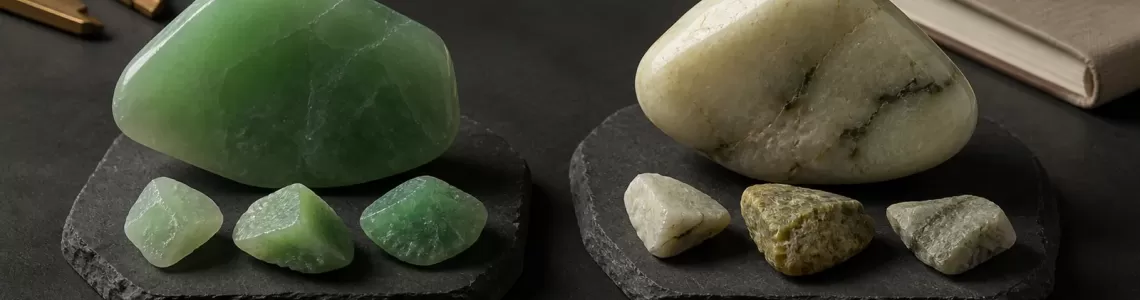
Answer first: In jewelry, jade is not one single color or one simple material name. Gemologists use the word mainly for two different gem materials: jadeite and nephrite; some professional references also recognize green omphacite under defined conditions. A label such as “green jade,” “yellow jade,” or “red jade” does not by itself tell you which material is present, whether the color is natural, whether the beads were dyed, bleached, impregnated, assembled, or imitated, or whether a laboratory has identified them. The safest buying method is to ask for the exact material name, treatment disclosure, bead dimensions, construction, care instructions, and return terms—then treat color and home observations as clues, not proof.
This guide explains what jade means in jewelry, how jadeite and nephrite differ, what color names can and cannot establish, and which questions matter when comparing bracelets and beads. It is a research-informed buying framework, not a laboratory report. It does not independently identify or certify any individual sunMYLOVE product.
Research question and scope
The central question is: What can an ordinary buyer reliably infer from a jade jewelry listing, and what still requires seller documentation or professional gemological testing? The scope covers bead bracelets and other finished jewelry sold to general consumers. It does not establish geographic origin, cultural age, monetary appraisal, medical effects, or the identity of a particular bead from a photograph.
Jade is an umbrella term, not a color test
The Gemological Institute of America describes jade as an umbrella term for jadeite and nephrite and, under particular conditions, green omphacite. Jadeite and nephrite are separate mineralogical materials with different structures and possible color ranges. Both have a long history in jewelry and carved objects, but a seller should not use their shared trade name to hide which material is being offered. GIA, Jade Description.
The distinction matters because the word “jade” has also been applied loosely to look-alike stones, trade names, assembled materials, glass, dyed stone, and other imitations. A green bead is not automatically jade, and genuine jade is not automatically green. Nephrite can appear white, gray, brown, yellow, black, and in green tones; jadeite also occurs in a broad range of colors. Therefore, color words are descriptions of appearance, not complete gemological identities.
| Listing term | What it may communicate | What it does not prove | Best follow-up question |
|---|---|---|---|
| Jade | A broad jewelry material claim | Whether it is jadeite, nephrite, or another permitted material; treatment; origin | “What is the precise gemological material?” |
| Jadeite | A specific pyroxene-group jade material | Natural color, treatment status, quality grade, or origin | “Has it been dyed, bleached, impregnated, coated, or assembled?” |
| Nephrite | A specific compact amphibole-group jade material | Natural color, mine source, treatment status, or value | “Is the color natural, and is an independent report available?” |
| Red jade / yellow jade | The visible or marketed color family | Material species, cause of color, natural origin, or absence of dye | “What material is behind the color name, and how was color determined?” |
| A jade / B jade / C jade | A trade shorthand often used for jadeite treatment categories | A universal legal grade, beauty, durability, origin, or value | “Please state the treatment in ordinary words and identify the reporting laboratory.” |
Jadeite vs nephrite: the buyer-relevant differences
Jadeite and nephrite are both exceptionally tough relative to many other gem materials, which helps explain their historical use in bangles, beads, tools, and carvings. Toughness is resistance to breaking and chipping; it is not the same as scratch resistance. GIA lists jadeite at about 6.5–7 on the Mohs hardness scale and nephrite at about 6–6.5, while emphasizing that both have exceptional toughness. That combination does not make a bracelet indestructible: scratches, impacts, drilled holes, thin sections, internal fractures, string wear, and treatments still matter. GIA, Jade Care and Cleaning.
For shoppers, the most useful distinction is not “which jade is always better?” There is no responsible universal answer. Quality depends on identity, color, transparency, texture, workmanship, treatment, condition, size, matching, documentation, and market context. GIA’s buyer guide notes that jadeite and nephrite are assessed differently and that jadeite can command very high prices in fine qualities, but material name alone does not determine the value of an individual bead. GIA, Jade Buyer’s Guide.
What do red jade and yellow jade mean?
“Red jade” and “yellow jade” are incomplete descriptions unless the listing also identifies the material and discloses treatments. They may refer to naturally colored jadeite or nephrite in some contexts, but similar names are also used for dyed materials, look-alikes, reconstructed products, or unrelated ornamental stones. A photograph cannot resolve those possibilities.
A careful seller description should separate four facts: the claimed material, the observed color, any treatment, and the basis for the claim. For example, “yellow nephrite, no treatment detected by Laboratory X” communicates more than “natural yellow jade.” Even that report has a scope: it applies to the tested item, at the time of examination, under the laboratory’s methods. It does not automatically apply to every bead in another strand.
For sunMYLOVE shoppers, the Yellow Jade Bead Bracelet with Bodhi Root and Brass and the Aquatic Onyx, Red Jade and Brass Bracelet illustrate why color names and mixed-material construction should be read together. These links show the seller’s current product naming and design; this article does not add an unstated laboratory identification, origin, treatment status, or certification.
Treatments: the disclosure that changes the decision
Gem treatments can improve color, clarity, apparent texture, or stability, but they can also affect value and care. GIA’s treatment reference explains that jadeite may be bleached to remove unwanted coloration and then impregnated with polymer because bleaching can make the material more porous or vulnerable along fractures. Jade and other porous gem materials may also be dyed, waxed, or impregnated. These processes are not interchangeable, and an appearance that looks “natural” in a photograph cannot exclude them. GIA, An Introduction to Gem Treatments.
In a common jadeite trade shorthand, “A jade” generally refers to jadeite that is untreated or only waxed by a traditional process; “B jade” commonly indicates bleached and polymer-impregnated material; “C jade” commonly indicates dyed material; and “B+C” combines treatment types. Buyers should still ask for plain-language disclosure because letter systems are not equally understood in every market, may be applied inconsistently, and do not replace the precise findings of a reputable report.
The US Federal Trade Commission advises consumers to ask whether a gemstone has been treated and explains that treatments can affect appearance, durability, care, and value. The FTC specifically lists bleaching as a treatment used for jade and pearls. Its guidance is about truthful consumer information, not a method for identifying a stone at home. FTC Consumer Advice, Buying Gemstones, Diamonds, and Pearls.
For sellers, the FTC’s business guidance says treatment information should be disclosed in circumstances where it is not permanent, creates special-care requirements, or significantly affects value. It also warns against using a natural gemstone name for an imitation without clear qualification. That framework supports a simple buyer rule: if treatment or identity would change your purchase decision, obtain the disclosure before buying. FTC, In the Loupe.
Can you identify jade at home?
You can notice inconsistencies, but no single non-destructive home test proves jadeite, nephrite, treatment status, or geographic origin. Many internet tests are overconfident.
- Color: useful for describing the object, not identifying the material. Natural and treated colors overlap.
- Temperature or “cool touch”: affected by room temperature, mass, conductivity, and handling. Glass and many stones can also feel cool.
- Sound: affected by shape, thickness, suspension, fractures, and contact point. Striking jewelry can damage it and does not prove identity.
- Weight: only meaningful with accurate dimensions and a valid comparison. Mixed beads, drill holes, and fittings complicate the result.
- Scratch tests: destructive, unreliable on finished objects, and unable to separate every look-alike or treatment.
- UV light: fluorescence can be a clue in professional examination but is not a stand-alone verdict.
- Phone-macro inspection: may reveal surface dye concentration, bubbles, seams, or damage, but absence of those features proves nothing.
Professional identification can combine microscopy, refractive index, specific gravity, spectroscopy, and other methods. Treatments may require Fourier-transform infrared or Raman spectroscopy and expert interpretation. The practical threshold is value and consequence: an inexpensive fashion bracelet may only require clear seller disclosure and a workable return policy, while a high-value jade purchase should justify a report from a recognized independent gemological laboratory.
A seven-step jade jewelry buying framework
1. Translate the listing into testable claims
Write down exactly what the seller claims: “jade,” “jadeite,” “nephrite,” “red jade,” “yellow jade,” “natural,” “untreated,” “A jade,” or “certified.” Each word creates a different question. “Certified” without the report issuer, report number, item description, and accessible verification is not enough.
2. Ask for the complete material description
For mixed bracelets, request the identity of each bead family, spacers, metal components, coatings, cord, and adhesives. A bracelet can contain real jade alongside glass, brass, dyed stone, polymer, or wood. One genuine component does not authenticate every component.
3. Ask about all treatments
Use ordinary words: dyed, bleached, heated, waxed, polymer-impregnated, coated, filled, assembled, or reconstructed. If the seller answers only “natural,” ask whether that describes geological origin, color, treatment, or all three. These are separate facts.
4. Evaluate matching without demanding artificial uniformity
Natural materials can vary, but variation alone is not proof of natural origin. Compare color distribution, translucency, texture, drill-hole edges, polish, bead diameter, and matching. The guide to natural bead variation explains why photographs should show a representative range rather than promise identical patterning.
5. Separate durability from identity
Jade’s toughness does not guarantee that elastic, cord, metal spacers, or drilled bead walls will last forever. Inspect the stringing path, knots, abrasion points, and whether heavy beads crowd the wrist. The hardness-versus-toughness guide explains why scratch resistance and break resistance are different.
6. Confirm fit using the finished bracelet, not bead count
Large beads reduce usable interior circumference because the wrist sits inside the strand, not along its centerline. Ask for finished inner circumference or a recommended wrist range. Use the wrist-measurement guide, then compare it with the seller’s actual sizing method.
7. Match the evidence level to the price
For ordinary fashion use, accurate description, close photographs, dimensions, treatment disclosure, care guidance, and a clear return policy may be a rational evidence package. For a substantial price premium based on jadeite quality, untreated status, origin, or rarity, obtain independent laboratory evidence that specifically covers those claims.
Care: conservative steps that protect both beads and stringing
GIA recommends warm soapy water and ultrasonic or steam cleaning only for untreated jade, while warning that treated material can require more caution. Because a finished bracelet may combine jade with elastic, cord, adhesive, wood, pearl, brass, or coated parts, the safest whole-piece routine is usually gentler than the most aggressive method allowed for an isolated untreated stone.
- Ask about treatment and mixed materials before choosing a cleaner.
- After wear, wipe beads and metal parts with a soft dry cloth.
- For light soil, use a barely damp soft cloth and dry promptly.
- Avoid household chemicals, bleach, acids, abrasive powders, and unknown metal polish.
- Do not soak elastic, knots, glued components, porous beads, or mixed-material bracelets.
- Remove jewelry before pools, hot tubs, strenuous exercise, and cleaning work.
- Store separately from harder jewelry and away from sustained heat and direct sunlight.
- Inspect cord, knots, drill holes, and bead edges periodically; restring before failure.
Cultural meaning: attribution, not universal fact
Jade has held important meanings in multiple societies and periods, especially in parts of East Asia, Mesoamerica, and the Pacific. Those meanings are specific to culture, object type, date, ritual context, and language. It is inaccurate to compress them into a universal claim that “jade means luck” or “jade protects everyone.” A modern bracelet may be inspired by a tradition without inheriting the status, consecration, age, or meaning of a historical object.
Traditional symbolism is also not clinical evidence. No adequate evidence shows that wearing jade treats pain, improves circulation, balances hormones, removes toxins, prevents disease, or changes immunity. A buyer may value personal or cultural symbolism, but that preference should be labeled as such and not converted into a medical claim.
Common mistakes to avoid
- Assuming green means jade. Many natural, treated, and artificial materials can be green.
- Assuming genuine jade must be green. Jadeite and nephrite occur in other colors.
- Reading “natural” as “untreated.” A naturally formed stone can still be dyed, bleached, impregnated, or coated.
- Treating A/B/C as a universal quality grade. The shorthand mainly concerns treatment categories and does not replace plain disclosure.
- Using a scratch or sound test on finished jewelry. Damage is possible and the conclusion remains weak.
- Assuming a report covers the whole bracelet. Verify what item or sample the report identifies.
- Ignoring cord and drill holes. The strongest bead is only one part of the bracelet system.
- Turning symbolism into health evidence. Cultural meaning and clinical efficacy are different categories.
Frequently asked questions
Are jadeite and nephrite the same?
No. They are different gem materials that share the traditional umbrella name jade. Both can be tough and suitable for jewelry, but they differ mineralogically and are evaluated in different market contexts.
Does “red jade” prove the bead is jadeite?
No. A color trade name cannot by itself establish material identity, natural color, treatment, or origin. Ask for the precise material and treatment disclosure.
Does “yellow jade” mean the color is natural?
No. Yellow can occur in jade materials, but a listing must still explain identity and treatment. Photographs cannot exclude dye, coating, or look-alike materials.
What is A jade?
It is trade shorthand generally used for jadeite that is untreated or traditionally waxed. Ask for the treatment in plain language and do not treat the letter as a universal quality or value grade.
Can a phone flashlight prove jade is real?
No. Translucency and internal texture may provide clues, but lighting, bead thickness, polish, dye, glass, and other stones can create similar appearances.
Is jade safe to wear every day?
The answer depends on the whole item: bead condition, treatments, cord, metal components, fit, activities, and skin sensitivity. Remove mixed-material bracelets for pools, chemicals, impact work, and prolonged moisture.
Can jade jewelry improve health?
There is not adequate clinical evidence that wearing jade treats or prevents disease, improves circulation, reduces pain, detoxifies the body, or changes immunity.
When should I request a gemological report?
Request one when price or purchase intent depends on exact identity, untreated status, origin, or exceptional quality. Confirm that the report is independent, verifiable, and describes the item being sold.
Method
sunMYLOVE reviewed the live product catalog, 38 existing blog posts, current public search-result intent, and authoritative gemological and consumer-protection sources. Candidate topics were tested for product relevance, search intent, uniqueness, evidence availability, counter-evidence, and commercial usefulness. Reliable search volume was unavailable and is recorded as UNKNOWN. No sunMYLOVE bead was laboratory-tested for this article.
References and evidence scope
- Gemological Institute of America: Jade Description.
- Gemological Institute of America: Jade Buyer’s Guide.
- Gemological Institute of America: Jade Care and Cleaning.
- Gemological Institute of America: An Introduction to Gem Treatments.
- US Federal Trade Commission: Buying Gemstones, Diamonds, and Pearls.
- US Federal Trade Commission: In the Loupe—Advertising Gemstones and Pearls.
- CIBJO: The Gemstone Book—Terminology and Classification.
- The Journal of Gemmology: nephrite jade mineralogy and source-characterization limits.
Evidence scope: These sources support jade terminology, mineralogical distinctions, treatment disclosure, care principles, and the limits of visual identification. They do not identify, grade, value, date, or establish the origin or treatment status of an individual sunMYLOVE product. Reviewed August 17, 2026.
sunMYLOVE editorial note: This research-informed buying guide is designed to help readers ask better questions. It is not a gemological certificate, appraisal, medical opinion, or guarantee about a specific product.
Leave a Comment