
Gemstone Hardness vs Toughness: What Makes a Bead Bracelet Durable?
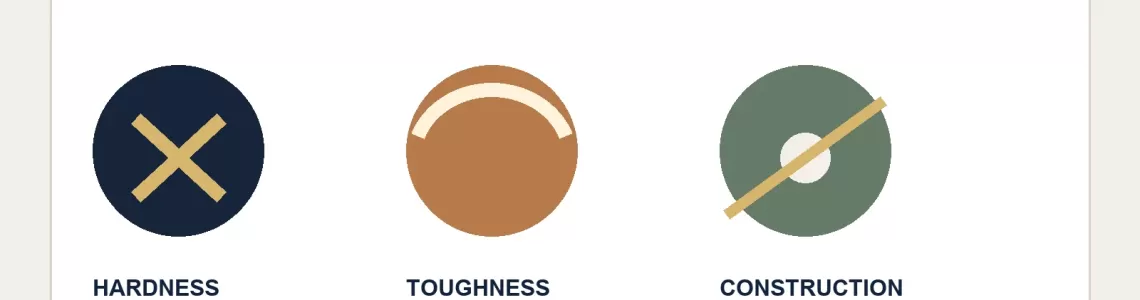
Answer first: gemstone hardness and gemstone toughness are not the same. Hardness describes resistance to scratching; toughness describes resistance to chipping, cracking or breaking. A high Mohs number can help a bead resist surface scratches, but it does not guarantee that the bead will survive a hard knock. For a durable beaded bracelet, buyers should evaluate hardness, toughness, cleavage or fracture, bead shape, drill-hole quality, construction and intended use together.
This distinction is especially important online, where a single Mohs number is often treated as a complete durability score. It is not. The Gemological Institute of America (GIA) explains that gem durability has three components: hardness, toughness and stability. Stability concerns resistance to heat, light, chemicals and humidity. A practical purchase decision therefore requires more than asking whether one stone is “harder” than another.
Research question, scope and evidence
The research question is: What actually makes a gemstone bead bracelet durable in everyday wear, and how should a buyer interpret Mohs hardness without overestimating it? This guide covers mineral and natural-glass beads used in bracelets. It does not identify an unknown stone from a photograph, predict the life of an individual bracelet, or certify a seller's material claim. Natural materials vary, treatments can change care requirements, and construction quality can dominate the outcome.
The evidence framework uses the GIA durability model, the U.S. Geological Survey Mohs scale, mineral descriptions from the USGS Natural Gemstones overview, and GIA care pages that demonstrate why stones with similar hardness can behave differently. These sources describe material properties; they do not prove that a particular product has been laboratory tested.
Five terms that prevent durability mistakes
| Term | Meaning | What it does not mean |
|---|---|---|
| Hardness | Resistance to scratching or abrasion, commonly compared on the Mohs scale | Resistance to every impact or break |
| Toughness | Resistance to chipping, cracking and breaking when force is applied | A numbered continuation of the Mohs scale |
| Cleavage | A tendency to split along particular crystallographic planes | Ordinary surface wear |
| Fracture | The way a material breaks when it does not separate along cleavage planes | Proof that a bead is fake |
| Stability | Resistance to heat, light, chemicals and environmental change | Immunity to cleaners or ultrasonic equipment |
What the Mohs scale can tell you
Friedrich Mohs created a relative scratch-resistance scale using ten reference minerals. Talc is 1 and diamond is 10. The USGS gemstone bulletin stresses that the numbers indicate increasing hardness, not equal numerical intervals. In other words, a mineral at 8 is not simply twice as scratch-resistant as a mineral at 4.
For jewelry, hardness helps answer a narrow question: how readily might a polished surface be scratched by common contact? It can help compare materials, but the result is directional and conditional. Dust may contain quartz; metal findings, tabletops and other jewelry can cause abrasion; and a polished bead can show wear differently from a faceted stone. A published range also may represent a mineral group rather than every specimen.
The Mohs scale should not be used as an at-home authentication test. Scratching a bead with a knife, file or another stone can permanently damage the polish, create a chip near the drill hole, transfer material, or produce an ambiguous result. A non-destructive professional examination is safer when identity matters.
Why toughness changes the answer
GIA's care guidance provides useful counterexamples. Sunstone is a feldspar with hardness around 6.5 to 7.2, yet GIA describes poor toughness because of cleavage. Garnet commonly falls around 6.5 to 7.5 and has fair to good toughness depending on type. Sapphire has hardness 9 and excellent toughness. The useful lesson is not that one material is always “better”; it is that hardness and toughness are separate properties that must be read together.
Obsidian makes the distinction even clearer. Obsidian is volcanic glass rather than a crystal with repeating mineral structure. It can take an attractive polish, but its conchoidal fracture is the same property that allowed people to make extremely sharp edges. In a bracelet, a rounded bead is safer than a thin edge, yet a sharp impact can still chip glassy material even if normal rubbing has not scratched it.
Durability is a system, not a stone score
| Factor | Buyer question | Why it matters |
|---|---|---|
| Material identity | Is the material named precisely, and are treatments disclosed? | Care advice depends on what the bead actually is |
| Hardness | How vulnerable is the polished surface to abrasion? | Frequent contact can dull or scratch softer surfaces |
| Toughness and cleavage | Is the material prone to chips or directional splitting? | Impacts may matter more than rubbing |
| Bead geometry | Are edges rounded, walls thick and drill holes centered? | Thin sections concentrate stress |
| Stringing system | What cord, wire, knot, clasp and spacer design is used? | A durable bead cannot compensate for a failing connector |
| Wear environment | Will it be worn at a desk, gym, workshop, beach or during sleep? | Impact, chemicals and repeated flexing differ by use |
How bead design affects breakage risk
A drilled bead is not a solid sphere. The hole removes material and creates two openings where impacts, friction and drilling defects can concentrate stress. Very large holes leave thinner walls. Holes drilled close to the surface, rough internal edges and pre-existing chips can shorten useful life. A glossy finish can make a bead look perfect in a photograph while a tiny drill-hole fracture remains hard to see.
Shape matters too. Rounded beads distribute contact more evenly than sharp corners. Flat discs can knock edge-to-edge. Carved motifs may contain thin projections. Multi-strand designs introduce more bead-to-bead contact. Metal spacers can protect or abrade depending on their shape, alignment and surface finish. These are engineering considerations, not a claim that every round bead is durable or every carved bead is fragile.
When comparing the sunMYLOVE beaded bracelet collection, use product photos to inspect geometry and construction, then read each product's material and care information. A 12 mm black obsidian and brass bracelet has a different impact profile from a smaller mixed-material strand. The listing itself, not this general guide, controls the current product specifications.
A practical durability decision framework
- Define the wear job. Separate occasional dress wear from daily wear, manual work, sport, bathing and sleep.
- Verify the material name. Distinguish a mineral, volcanic glass, organic gem material, imitation, composite and trade name.
- Read hardness as scratch resistance only. Do not convert the Mohs number into an impact guarantee.
- Find toughness, cleavage and stability guidance. Prefer gemological institutions, geological agencies or product-specific laboratory reports.
- Inspect vulnerable geometry. Look at drill holes, corners, thin carvings, bead-to-bead contact and heavy charms.
- Inspect the stringing system. Check whether the product is elastic, wire, cord, clasped or adjustable and whether replacement is possible.
- Choose care compatible with the least tolerant component. A bracelet may combine stone, silver, brass, adhesive, coating and cord.
- Accept residual uncertainty. Natural inclusions and manufacturing variation mean no online checklist can guarantee an individual bead's future.
Care decisions by risk, not by marketing label
Remove a beaded bracelet before impact-heavy work, weight training, contact sport or tasks where it may strike stone, steel or tile. Put it on after cosmetics, fragrance and household chemicals have dried. Store it separately so harder jewelry does not rub against softer beads. Do not drop it into a shared dish with rings and chains.
For routine cleaning, start with the maker's instructions. A soft dry cloth is the lowest-intervention option for many pieces. Water, detergent, steam and ultrasonic cleaning are not universally safe because porosity, dye, coatings, fracture filling, adhesives, metal and cord differ. The safest method for a composite bracelet is governed by its most sensitive component.
If the bracelet contains obsidian, the obsidian cleaning and storage guide explains why gentle handling and separation matter. For natural variation and buyer expectations, see why natural stone beads vary. These guides address different questions and should not be treated as identity certificates.
The Alashan agate buyer’s guide applies the same evidence boundary to a trade-name bead: color and a listing name do not by themselves prove treatment or precise origin.
What can and cannot be inferred from product photographs
Clear photographs can show bead shape, approximate polish, obvious chips, the placement of drill holes, metal spacers and overall construction. They cannot reliably prove mineral identity, treatment, toughness, internal fractures, cord condition or long-term durability. Lighting and editing can also change apparent color and surface detail.
Ask for the current material description, bead diameter, construction, size definition and care instructions. If treatment would affect value or care, ask whether it is dyed, coated, impregnated, stabilized or assembled. The U.S. Federal Trade Commission jewelry guidance explains why material and treatment disclosures matter in marketing; it does not authenticate an individual product.
Worked example: comparing three hypothetical bead bracelets
Consider three hypothetical products. Bracelet A uses a relatively hard mineral in thin carved beads with sharp corners. Bracelet B uses a moderately hard material in thick rounded beads, separated by smooth knots. Bracelet C uses a high-hardness stone, but the drill holes show chips and a heavy charm repeatedly strikes the strand. A hardness-only ranking would favor A or C. A system-level durability review may favor B for daily low-impact wear because geometry and construction reduce stress. This example is not a product test; it shows why the decision cannot be reduced to one number.
Now change the use case. For occasional formal wear, the carved design may be reasonable with careful handling. For warehouse work, all three may be inappropriate because snagging and impacts dominate. For a gift, repairability and size flexibility may matter more than marginal differences in scratch resistance. Durability is always material property plus design plus exposure plus maintenance.
Questions worth sending to a seller
- What exact material name and treatment disclosure applies to this variant?
- What is the nominal bead diameter, and are carved or thin sections present?
- Is the selectable size a wrist range, inside circumference or finished strand length?
- What stringing material, closure and spacer design are used?
- Can the bracelet be restrung or repaired if the cord wears?
- Which cleaning methods are specifically prohibited for the complete piece?
- Are natural inclusions or drill-hole variations visible in the actual item?
Clear answers reduce uncertainty but do not become a lifetime guarantee. Keep the seller's response with the complete original order record so future care, insurance, resale and repair decisions are always based on the product as sold.
Common mistakes
- Calling the Mohs scale a universal durability scale.
- Assuming a high-hardness bead cannot chip.
- Assuming a lower-hardness bead is unsuitable for all jewelry.
- Testing hardness by scratching a finished product.
- Ignoring cleavage, drill holes and thin carved sections.
- Using steam or ultrasonic cleaning because the stone name sounds durable.
- Wearing elastic jewelry during repeated high-load or chemical exposure.
- Letting harder jewelry rub against softer beads in storage.
- Interpreting natural inclusions as either automatic proof of authenticity or automatic defects.
- Confusing traditional meanings with physical performance.
Frequently asked questions
Is a higher Mohs number always better for a bracelet?
No. It usually indicates greater scratch resistance, but the bracelet's toughness, cleavage, stability, bead geometry and construction can be equally important. Suitability depends on the intended wear.
Can a hard gemstone still break?
Yes. Hardness and toughness measure different behavior. A material can resist scratches yet chip or split under a sharp impact.
Does Mohs 7 mean twice as hard as Mohs 3.5?
No. The Mohs scale is ordinal and uneven. The numbers rank reference minerals by scratch resistance; they are not equal units of absolute hardness.
Can I test a bracelet with a steel knife?
Do not use destructive scratch tests on finished jewelry. Results can be ambiguous, and the test can permanently damage polish, coatings or drill-hole edges.
Why do beads chip near the hole?
The drilled opening reduces wall thickness and concentrates stress. Rough drilling, hidden fractures, hard impacts and bead-to-bead contact can all contribute.
Are natural inclusions a durability problem?
Sometimes, but not automatically. Type, location, orientation and extent matter. A photograph cannot reliably determine whether an inclusion threatens structural integrity.
Should I wear a stone bracelet in the shower or pool?
Only if the maker explicitly states that every component is compatible. Water, chlorine, cleaners and repeated wet-dry cycles can affect cord, metals, dyes, coatings, adhesives or porous materials.
How should I choose between two bracelets with similar stones?
Compare material disclosure, bead geometry, drill-hole finish, cord or clasp design, replaceability, size method, care instructions and intended use. Do not decide from hardness alone.
Method and evidence limits
Before ordering, confirm fit with the wrist-measurement guide and review the returns and refunds policy so that material durability, sizing and purchase expectations are considered together.
We reviewed geological and gemological definitions, care guidance and consumer-disclosure principles, then translated them into a bracelet decision framework. We did not perform laboratory identification, impact testing, abrasion testing or treatment analysis on sunMYLOVE products. Material properties describe tendencies, not guaranteed outcomes for an individual bead.
References and evidence scope
- GIA: Diamond Care and Cleaning — definitions of hardness, toughness and stability.
- USGS: Mohs Hardness Scale — official educational reference.
- USGS: Natural Gemstones — mineral groups and hardness context.
- GIA: Sunstone Care — hardness and poor toughness example.
- GIA: Garnet Care — hardness and toughness range example.
- GIA: Sapphire Care — high hardness and excellent toughness example.
- Smithsonian: Gems and Minerals — mineral and gem context.
- FTC: In the Loupe — truthful naming and treatment disclosure.
Reviewed: August 7, 2026. sunMYLOVE editorial note: this is an evidence-bounded buying guide. It separates physical material properties from traditional symbolism and makes no medical, therapeutic or durability guarantee.
Leave a Comment