
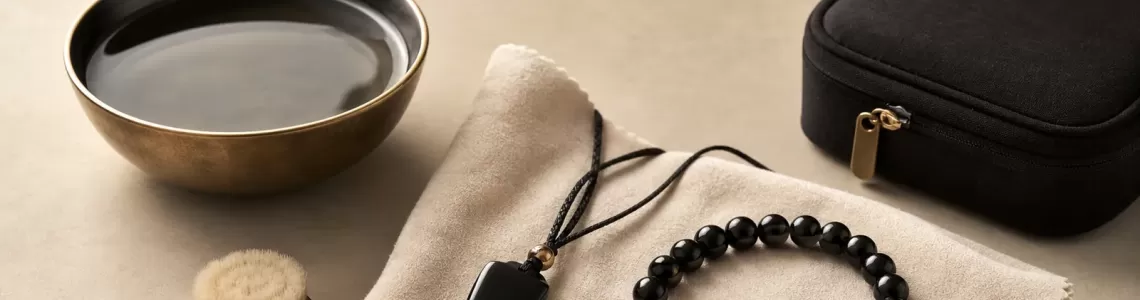
Answer first: To clean sound, polished obsidian jewelry, begin dry: inspect the piece, remove loose dust with a clean soft brush, then wipe it with a damp, non-abrasive cloth. If more cleaning is genuinely needed and every component is water-safe, use lukewarm water with only a tiny drop of mild dish soap, rinse briefly, blot dry and allow the piece to dry completely before storage. Do not use an ultrasonic cleaner, steam, bleach, acids, abrasives or sudden temperature changes. Store each piece separately in a padded pouch or compartment so the volcanic glass cannot strike metal, stone or another bead.
That short method is deliberately conservative. Obsidian is natural volcanic glass. The glass itself may tolerate careful contact with water, but a finished bracelet or pendant is a composite object: cord, elastic, adhesive, wood, metal fittings, coatings and surface treatments may be less tolerant than the obsidian. The correct care method therefore depends on the most vulnerable component, not only the black bead or cabochon that catches the eye.
Research question and scope
This guide asks: what is the lowest-risk routine for cleaning, drying and storing wearable obsidian jewelry at home? It applies to intact, modern jewelry with polished obsidian beads, pendants or inlays. It does not provide restoration instructions for archaeological glass, flaking surfaces, cracked stones, detached settings, unknown coatings or valuable historic objects. Those cases need a qualified conservator or jeweler.
The recommendations are adapted from geology and preventive-conservation sources, including the U.S. Geological Survey (USGS), the Canadian Conservation Institute (CCI) and the U.S. National Park Service (NPS). Museum guidance is intentionally cautious; a daily-wear bracelet is not a museum artifact, but the same physical principles—brittleness, impact risk, abrasion, dust control and composite construction—remain useful. Where a source discusses glass generally rather than obsidian jewelry specifically, this guide identifies the recommendation as a conservative application, not direct product testing.
What obsidian is—and why that matters for care
The USGS defines obsidian as dense volcanic glass, usually rhyolitic in composition, formed when lava cools so rapidly that crystals do not have time to grow. It commonly has a glassy texture and conchoidal fracture. “Glass” is the important care word: a polished surface can look durable and feel hard, yet the material can chip or break when struck. A curved fracture can also leave a sharp edge. Avoiding drops and collisions is therefore more important than aggressive polishing.
Obsidian is not a crystal in the mineralogical sense, and the word “black” does not describe every specimen. Natural inclusions, flow banding, tiny bubbles and color variations can occur. Those features should not be scrubbed away. Equally, a bright shine does not prove authenticity, and a cloudy surface does not automatically mean dirt. Buyers who are evaluating identity rather than care should read the separate guide to assessing an obsidian bracelet; cleaning cannot authenticate a material.
Four risks to assess before cleaning
1. Impact and edge damage
CCI guidance for glass and ceramic objects describes them as hard but brittle and warns that impact can cause cracking or breakage. For jewelry, the highest-risk moments are often ordinary ones: cleaning over a stone sink, dropping a pendant on tile, allowing several bead strands to knock together, or pulling a bracelet against a metal faucet. Work over a folded towel or a shallow padded basin, keep only one piece in the work area and never clean while standing over an open drain.
2. Abrasion
Dust can contain harder particles. Rubbing a dusty surface immediately may drag those particles across a polish. Remove loose material first with a soft brush or air puffer used gently at a distance. Avoid toothpaste, baking soda, scouring powders, polishing compounds, magic erasers and rough paper towels. “Natural” does not mean non-abrasive.
3. Water-sensitive components
A solid obsidian bead is only one part of a bracelet. Water can remain inside drill holes, beneath bead caps or between a cabochon and its setting. It can soften some adhesives, swell unfinished wood, accelerate tarnish on certain metals, discolor cord or shorten the life of elastic. NPS guidance treats jewelry as a composite object whose materials can react at different rates. When the construction is unknown, a barely damp surface wipe is safer than soaking.
4. Existing damage or unstable decoration
Before any moisture, look for chips, cracks, whitening around drill holes, loose knots, stretched elastic, corrosion, lifting coatings or a moving stone. CCI recommends inspecting glass before cleaning and avoiding treatment when deterioration is present. Do not “test” a suspected crack by tapping or flexing jewelry. Stop, photograph the condition and ask a professional to examine it.
A decision table: choose the least intensive method
| Condition | Recommended action | Avoid |
|---|---|---|
| Clean-looking, intact piece | Leave it alone or wipe gently with a dry microfiber cloth | Cleaning simply to create more shine |
| Loose surface dust | Use a soft, clean brush; support the jewelry on a towel | Hard brushing or compressed air at close range |
| Fingerprints on polished obsidian | Use a clean cloth lightly dampened with water, then blot dry | Abrasive polish, alcohol or household spray |
| Body oils on an all-water-safe, intact piece | Brief lukewarm wash with highly diluted mild dish soap, followed by a brief rinse and complete drying | Soaking, hot water, ultrasonic or steam cleaning |
| Wood, cord, elastic, adhesive, coating or unknown assembly | Clean locally with a barely damp cloth; keep joints and holes dry | Immersion |
| Cracked, chipped, loose, corroded or flaking piece | Stop and consult a jeweler or conservator | Home repair, glue or experimental solvents |
Step-by-step: the conservative home method
Step 1: Prepare a safe work surface
Clear a stable table and cover it with a freshly washed, lint-free towel. Close the drain if you must work near a sink. Remove rings and watches that could strike the obsidian. Prepare a soft artist’s brush or jewelry brush reserved for this purpose, two clean non-abrasive cloths, a small bowl of lukewarm water and, only if needed, one drop of plain mild dish soap. Keep chemicals and metal polish out of the area.
Step 2: Inspect the entire object
Use good light and look from several angles. Check bead holes, stringing material, clasps, jump rings, prongs, glued joints and the edges of pendants. Confirm that the surface is polished rather than intentionally matte, etched, painted or coated. If you cannot tell how the piece is assembled, select the dry or barely damp method.
Step 3: Remove dust before rubbing
Support the piece rather than holding it in the air. Sweep the brush lightly across the surface and around fittings; do not force bristles into drill holes or beneath a loose setting. NPS stone-care guidance recommends dust control because accumulated dirt can darken porous surfaces, while CCI advises soft brushing for sound glass. The practical jewelry lesson is to remove particles with minimal pressure before using a cloth.
Step 4: Wipe fingerprints locally
Dampen a corner of the cloth with clean water and wring it thoroughly. The cloth should not drip. Wipe the obsidian with straight, gentle passes, turning to a clean area frequently. Keep moisture away from wood, elastic, cord knots, adhesives and unknown metal coatings. Follow immediately with the dry cloth.
Step 5: Wash only when construction permits
If the piece is intact and every component is known to tolerate water, mix a drop of mild dish soap into a bowl of lukewarm water. Briefly move the piece through the solution or clean the obsidian locally with the damp cloth. Do not leave it soaking. CCI permits washing robust, sound glass in lukewarm water with a small amount of mild dish soap, but that guidance is not a blanket approval for every jewelry assembly. A wood-and-obsidian pendant, for example, should be treated according to the wood and cord, not immersed because the stone appears sound.
Step 6: Rinse briefly and dry completely
Remove soap residue with a second cloth dampened in clean water or a brief gentle rinse if the entire object is water-safe. Blot rather than rub. Lay the piece flat on a clean dry towel in a shaded, ventilated room. Turn beaded jewelry once so moisture cannot remain beneath it. Do not accelerate drying with a hair dryer, heater, direct sun or hot air; rapid temperature change and heat can stress glass and harm stringing or adhesives.
Step 7: Reinspect before wearing or storing
Confirm that holes, knots, clasps and settings are dry. Check that no soap film remains and that a stone has not loosened. If elastic feels different, metal shows new discoloration or a setting moves, stop wearing the piece until it can be inspected.
Care by construction
Beaded bracelets
Beads can collide with each other, and moisture can hide in the holes. Do not stretch an elastic bracelet over a large bottle or pull individual beads apart to clean between them. Roll the bracelet gently over the hand when putting it on. After a damp wipe, dry both sides and allow extra time before storage. Browse the beaded bracelet collection to compare constructions, then follow the individual product page rather than assuming every strand uses identical cord or fittings.
Pendant necklaces
Support a pendant by its body during cleaning; do not let it swing from the cord or chain. Wipe the bail and attachment point separately. If the pendant combines ebony, brass and obsidian, use a local method and keep water away from joints. The sculpted ebony wood and obsidian pendant and the broader pendant necklace collection illustrate why “clean the whole necklace the same way” is an unsafe shortcut.
Obsidian with brass or other metals
Metal-care products are formulated for metal, not volcanic glass, cord or coatings. Apply no polish unless the product maker confirms it is compatible with the exact assembly, and never allow residue to collect around beads. For a mixed piece such as a black obsidian and brass beaded bracelet, separate goals: remove dust from the whole piece, clean the obsidian locally and seek specific guidance before treating the brass. Patina is not automatically damage, and aggressive removal can change the intended finish.
How to store obsidian jewelry
Storage should prevent contact, dust, tension and accidental falls. CCI recommends padded, separate storage for brittle glass, while NPS guidance advises individual bags or boxes for small stone objects. At home, use a soft-lined compartment, a clean pouch placed inside a rigid box, or an individual acid-free box with non-abrasive padding. The enclosure should be large enough that the piece lies naturally without sharp bends.
- Store one piece per compartment or pouch; do not allow obsidian to touch chains, rings or other stones.
- Lay bracelets flat and relaxed. Do not hang elastic strands under tension.
- Fasten chains before storage and keep them loosely arranged to reduce tangling.
- Keep jewelry away from direct sun, heaters, air-conditioning vents, bathrooms and cleaning chemicals.
- Do not place a heavy item on top of a beaded bracelet or pendant.
- Inspect a travel pouch for grit before use, and put the pouch inside a rigid travel case.
For shipping expectations and time away from home, consult sunMYLOVE’s delivery information. If a newly received item does not match its description or arrives damaged, do not attempt to polish or repair it before reviewing the returns and refunds policy and contacting support.
Common mistakes and what to do instead
- Soaking overnight: long immersion adds little cleaning benefit and increases risk to cord, adhesive and metal. Use brief, local cleaning.
- Using toothpaste or baking soda: these can abrade a polish. Use a clean soft cloth and minimal pressure.
- Choosing ultrasonic cleaning because the stone is “hard”: vibration can exploit cracks and loosen settings. Use the manual method.
- Using alcohol, perfume or household glass cleaner: these may affect coatings, adhesives, cord or metals. Apply personal products before putting jewelry on and let skin dry.
- Polishing away every irregularity: inclusions and banding may be natural features. Stop if the appearance does not change with gentle cleaning.
- Storing several strands together: bead-to-bead and metal-to-glass contact can cause abrasion and chips. Separate them.
- Repairing a chip with household glue: adhesive can stain adjacent surfaces and complicate professional repair. Isolate the piece and ask a jeweler.
A 60-second after-wear routine
- Remove the piece before showering, swimming, exercising heavily or applying cleaners.
- Check the clasp, cord and bead holes under good light.
- Wipe skin oils with a clean dry microfiber cloth.
- Allow any moisture to evaporate fully in shade.
- Return the piece to its own padded compartment.
This routine reduces the need for deeper cleaning. Preventive care is usually safer than repeatedly trying to restore a mirror-like shine.
Frequently asked questions
Can obsidian jewelry get wet?
Brief contact with clean water is generally less important than the construction around the obsidian. Wood, elastic, cord, adhesives, coatings and metals may be water-sensitive, and moisture can remain in drill holes. When construction is unknown, use a barely damp cloth and dry immediately rather than immersing the piece.
Can I shower or swim with an obsidian bracelet?
Removing it is the lower-risk choice. Repeated wetting, soap, chlorine, salt, heat and stretching can affect the stringing and fittings even if the polished obsidian itself appears unchanged.
Can I use an ultrasonic jewelry cleaner?
This guide does not recommend it. Hidden fractures, drilled beads, glued settings and composite construction make vibration an unnecessary risk. Ask a qualified jeweler who can inspect the exact piece if professional cleaning is needed.
Why does my obsidian look cloudy?
Possible causes include fingerprints, soap film, fine scratches, a coating, natural texture or surface damage. Begin with dust removal and a damp-cloth test on a small inconspicuous area. If cloudiness remains, do not escalate to abrasives or chemicals.
Does oil improve obsidian?
Oil may temporarily change surface appearance, but it can attract dust, migrate into cord or joints and make later treatment harder. Do not oil jewelry unless its maker provides a product-specific instruction.
How often should I clean it?
There is no universal schedule. Wipe after wear when needed and perform wet cleaning only when visible soil remains after dry methods. Frequent unnecessary cleaning increases handling risk.
What should I do if a bead chips?
Stop wearing the piece because a fresh glassy edge may be sharp. Place it alone in a padded container, retain any fragment and contact a jeweler. Do not test the edge with a finger or attempt a glue repair.
Is this method proof that my jewelry is genuine obsidian?
No. A cleaning response is not an authentication test. Material identity requires documented sourcing or appropriate examination; care advice cannot establish it.
Method, evidence limits and editorial note
sunMYLOVE reviewed public geology definitions and preventive-conservation guidance available on 25 July 2026. The sources establish that obsidian is volcanic glass and support cautious handling, dust removal, minimal cleaning and padded separate storage for glass or stone objects. They do not test each sunMYLOVE product, cord, adhesive, coating or metal finish. Therefore, product-specific instructions take priority, and uncertainty is resolved in favor of the least intensive method. This article makes no health, spiritual, therapeutic or durability guarantee.
If you need construction details for a particular piece, use the contact page before cleaning. A useful question includes the product URL, the component you want to clean and a clear photograph of the condition.
References and evidence scope
- U.S. Geological Survey — Yellowstone’s tool-making lava flows. Supports the definition and formation of obsidian as volcanic glass.
- U.S. Geological Survey — Volcano Hazards Program Glossary. Supports the concise geological definition.
- Canadian Conservation Institute — Basic care: glass and ceramic objects. Supports inspection, soft-brush dusting, conservative washing of robust sound glass and avoidance of harsh dishwasher cleaning.
- Canadian Conservation Institute — Preventive conservation guidelines for ceramics and glass. Supports padded handling, separation, dust protection and impact prevention.
- Canadian Conservation Institute — Care of ceramics and glass. Supports stable, padded storage and protection from heat and direct sunlight.
- U.S. National Park Service Museum Handbook, Appendix P — Curatorial care of ceramic, glass and stone objects. Supports individual storage and dust control; museum-level recommendations are conservatively adapted here for jewelry.
Reviewed: 25 July 2026. Editorial identity: sunMYLOVE. Educational care guidance only.
Leave a Comment