Quick answer: Natural obsidian is volcanic glass, but an ordinary glass or resin bead can look similar after polishing. Color, shine, temperature and a phone flashlight cannot authenticate a bracelet on their own. A useful assessment starts with a precise seller description, clear photographs, consistent bead construction and a written return policy; conclusive identification may require gemological testing. Buy an obsidian bracelet for its documented materials, design and fit—not for unverified promises about healing, protection, detoxification or luck.
What obsidian is—and what the word does not prove
The U.S. Geological Survey defines obsidian as dense volcanic glass, usually rhyolitic in composition, formed when lava cools so rapidly that crystals do not have time to grow. That glassy structure explains the smooth polish and dark, reflective appearance buyers associate with obsidian beads. It also explains why obsidian can fracture along curved surfaces and produce very sharp edges when broken.
“Volcanic glass” does not mean that every glossy black bead is obsidian. Manufactured glass is also amorphous, and resin or coated beads can be made to imitate a black glassy surface. The Gemological Institute of America notes that identifying black opaque gem materials is difficult because many minerals, rocks and manufactured substances can be fashioned into nearly identical dark objects. In other words, the label matters, but the label is not laboratory evidence.
This guide uses obsidian for naturally occurring volcanic glass and imitation for another material made or selected to resemble it. It does not treat a visual resemblance as proof of deception: a seller may use glass, resin or a composite intentionally, provided the material is described accurately.
Natural obsidian, manufactured glass and resin at a glance
| Material | What it is | What a buyer may observe | What observation cannot prove |
|---|---|---|---|
| Natural obsidian | Silica-rich volcanic glass formed by rapid cooling | Glassy polish; black, brown, grey or patterned appearance; occasional inclusions or flow features | Color and shine alone do not establish origin |
| Manufactured glass | Human-made non-crystalline glass formulated and shaped for products | Can be uniform or intentionally patterned; may contain bubbles or molded features | Uniformity does not automatically mean “fake,” and bubbles are not a conclusive test |
| Resin or acrylic | Polymer material that can be colored, coated or molded | May be lighter for its size and can show mold seams or surface coating wear | Weight and temperature impressions are subjective and not definitive |
| Composite or coated bead | Material assembled from more than one substance or covered with a surface layer | Color may concentrate near drill holes, chips or worn areas | A coating is not improper if it is disclosed accurately |
The Federal Trade Commission advises sellers not to use an unqualified gemstone name for an imitation and to disclose treatments when they significantly affect value, care or durability. For buyers, the practical lesson is simple: ask what the bead is, whether it is natural, manufactured, coated or treated, and whether special care is required.
Why common “real obsidian tests” are unreliable
Online guides often offer a three-second authenticity test: hold the bead, shine a phone light through it, tap it, scratch it or judge how quickly it warms. These shortcuts may feel decisive, but most do not separate natural obsidian from all possible substitutes.
- Temperature: the first touch depends on room conditions, bead size, metal components and how long the item was handled. Glass and stone can both feel cool.
- Flashlight transparency: thickness, surface finish, inclusions and lighting affect what passes through. Some obsidian is opaque in bead-scale sections; some manufactured glass is dark but translucent at an edge.
- Weight: density can help a trained comparison using equal dimensions, but a hollow component, different bead diameter or mixed materials makes a hand estimate unreliable.
- Bubbles: bubbles may suggest manufacture in some contexts, yet natural volcanic glass can also preserve gas-related structures. Their presence or absence is not a universal verdict.
- Scratch tests: they can permanently mark a polished bead, damage a finish and still fail to distinguish materials with overlapping hardness.
- Flame, hot needle and chemical tests: these are unsafe for jewelry, cords, coatings and skin and should not be used.
A useful home inspection is non-destructive: look for chips, cracks, worn coating, irregular drill holes, stretched cord and differences between the delivered item and the written description. It can identify condition or disclosure problems; it cannot issue a gemological certificate.
What evidence is useful before buying online
A strong product page should make the purchase decision easier without asking the customer to become a geologist. Before ordering, record the following:
- Exact material statement. “Obsidian and brass” is more useful than “black stone.” If the seller knows the variety or treatment, the wording should be specific and consistent.
- Photographs of the actual design. Look for front, side and close views showing bead surfaces, drill areas, spacers and closure or cord construction.
- Bead and wrist measurements. Confirm whether the listed size is wrist circumference, bracelet inner circumference or finished length.
- Construction information. A bracelet is a system: bead weight, cord, knot, spacers and metal edges all affect wear.
- Care limits. The page should say whether water, cleaners, impact or polishing can affect the materials.
- Return and customization terms. Save the product description and understand whether a made-to-size item is returnable before payment.
The FTC’s consumer guidance recommends keeping sales paperwork that records the origin, size, treatment and care information on which a buyer relied. That record is more useful in a dispute than a destructive home test performed after delivery.
When professional identification is justified
For an everyday bracelet, the cost of full laboratory work may exceed the value of the item. Professional identification becomes more reasonable when a piece is expensive, represented as rare, sold with an important geographic origin, offered as an antique, or involved in an insurance or resale decision.
A qualified gemologist can combine magnification with optical and physical measurements and, when needed, spectroscopy or chemical analysis. No single observation is guaranteed to identify every black opaque material. GIA’s published discussion of black opaque gems emphasizes a systematic procedure because the possible materials include minerals, rocks and manufactured products.
Ask what question the report will answer. “Natural glass,” “obsidian,” “manufactured glass,” treatment and geographic origin are different conclusions requiring different evidence. A seller’s supplier invoice may support traceability but is not the same as an independent laboratory report.
How obsidian’s glassy structure affects bracelet wear
Obsidian can take a high polish, but it is still glassy and brittle. GIA describes obsidian as hard yet brittle and notes its strong conchoidal fracture. The same property that made obsidian valuable for sharp tools also means a bead can chip or break when struck against tile, stone, metal equipment or another hard bracelet.
Inspect drill holes because that is where the cord changes direction and stress concentrates. A rough or chipped hole can abrade elastic or thread. Large beads also carry more momentum during an impact. For stacked wear, keep obsidian away from diamond, corundum and other harder jewelry surfaces that can scratch or batter the polish.
Historical importance does not make the material indestructible. The National Park Service documents Obsidian Cliff in Yellowstone as a major Indigenous source used for toolmaking for more than 11,000 years. That evidence supports obsidian’s long material history; it does not turn a modern bracelet into an archaeological object or prove the source of its beads.
Conservative care for an obsidian bead bracelet
Government conservation guidance for glass emphasizes preventing impact, abrasion and uncontrolled cleaning. A wearable bracelet is not a museum collection, but the low-risk principles translate well when a piece combines glassy beads, metal and cord.
- Remove the bracelet before exercise, manual work, showering, swimming or sleeping.
- After wear, wipe the beads and metal gently with a soft, clean, dry cloth.
- Do not use ultrasonic or steam cleaners on a mixed-material bracelet unless the maker explicitly confirms that every component is compatible.
- Avoid acids, abrasive pastes, household cleaners and prolonged soaking; they may affect brass, coatings, cord and adhesives even if a plain glass surface tolerates water.
- Store the bracelet in a padded compartment so beads cannot strike harder jewelry.
- Stop wearing it if a bead is cracked, sharply chipped, loose or cutting the cord. Broken obsidian can produce a sharp edge.
- Follow product-specific instructions when they are more restrictive than general advice.
The Canadian Conservation Institute recommends careful handling and padded storage for glass because chips, cracks, scratches and breakage commonly result from physical force. It also warns that mixed or decorated objects need more caution than plain, stable glass. That is why “wash it like a drinking glass” is not suitable general advice for a bracelet with brass and flexible stringing.
Fit and construction matter as much as bead identity
A genuine material does not rescue a poorly fitting or weakly assembled bracelet. Measure the wrist at the intended wearing point, keep the tape comfortably snug and choose the seller’s listed circumference rather than adding an arbitrary allowance. The wrist measurement guide explains the process and centimetre/inch conversion.
Check whether the bracelet stretches over the hand, opens with a clasp or uses an adjustable knot. Elastic should not remain visibly overstretched after normal fitting. Metal spacers should not present sharp edges against the cord. If the design is made to the selected circumference, choose the actual wrist measurement and follow the product’s option wording.
When comparing mixed-material designs, the men’s beaded bracelet materials guide provides a broader framework for stone, wood, organic and metal components. Use that guide for construction questions, then return to the exact product page for its stated materials.
How to compare sunMYLOVE obsidian designs responsibly
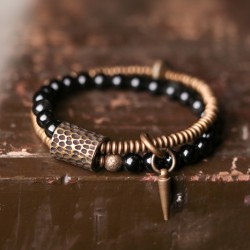
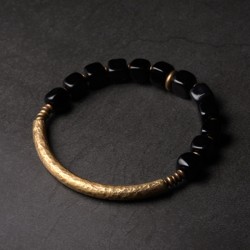
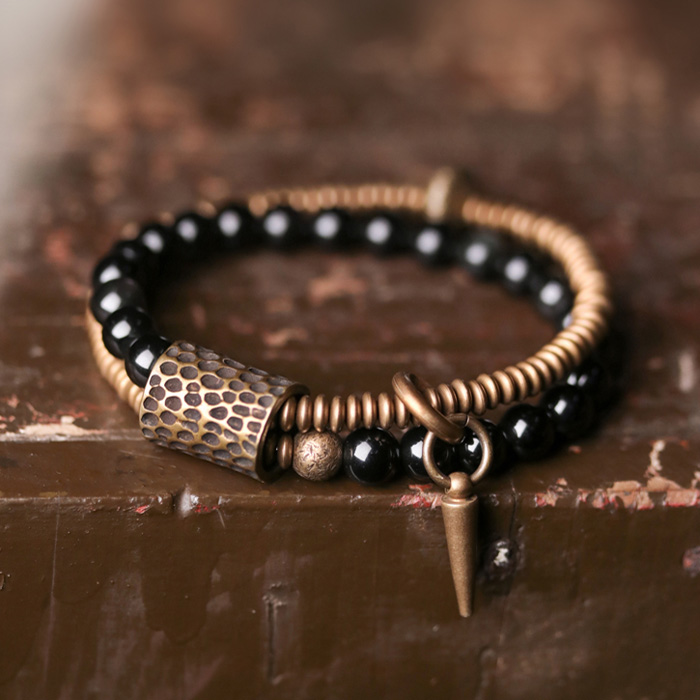
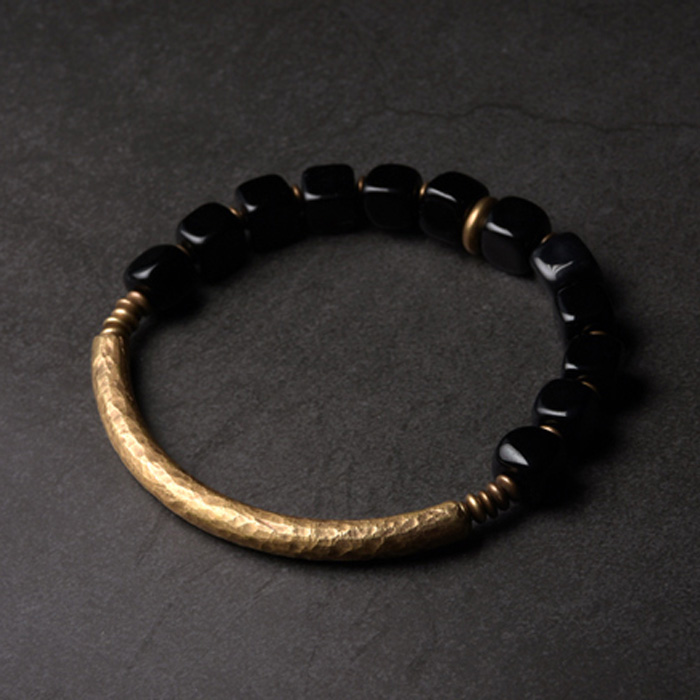
sunMYLOVE currently uses obsidian terminology in designs that pair dark beads with brass. The Double-Layer Obsidian & Brass Bead Bracelet uses a layered composition, while the Obsidian & Brass Bead Bracelet presents a single-strand alternative. The links document the listings that were live when this guide was reviewed.
These product pages state their materials and sizing options; this editorial guide does not convert that commercial description into a claim of independent laboratory testing or geographic provenance. Compare photographs, bead proportions, brass placement, wrist options and the intended wearing style. Browse the full beaded bracelet collection if another material or color better fits the wearer.
Before ordering, review delivery information and the returns and refunds policy. Customized goods may have different return eligibility, so resolve size and material questions in writing first. For the store identity and editorial accountability behind this guide, see Our Brand.
Symbolism and health claims: keep meaning separate from evidence
Obsidian has a documented history as a tool and exchange material in multiple societies. Modern jewelry communities may associate black obsidian with protection, grounding, boundaries or self-reflection. Those meanings can be personally or culturally significant, but they are not universal material properties and should not be sold as guaranteed outcomes.
There is no adequate clinical evidence that an obsidian bracelet treats pain, improves circulation, removes toxins, changes immunity, reduces anxiety or protects the wearer from physical harm. A bracelet can serve as a personal reminder or meaningful object without being a medical device. Symptoms, skin reactions and mental-health concerns belong with qualified health professionals, not gemstone marketing.
The same boundary applies to “energy tests,” magnet reactions and testimonials. A personal experience may explain why someone values a bracelet, but it does not authenticate the material or establish a therapeutic effect.
A practical pre-purchase checklist
- The listing names obsidian and every major secondary material.
- Natural, imitation, manufactured, composite and treated terms are used clearly.
- Photographs show the actual design and important construction details.
- The bracelet sizing convention is clear and matches your measured wrist.
- Care instructions cover beads, metal, cord, coatings and adhesives.
- No health, detoxification, protection or guaranteed-luck promise is used as purchase evidence.
- Delivery, customization and return terms are understood before payment.
- For a high-value provenance claim, the evidence is proportionate to the price and claim.
Continue with the sunMYLOVE bracelet guide library for evidence-based material, sizing and care articles.
Frequently asked questions
Is obsidian a crystal?
Not in the strict mineralogical sense. Obsidian is natural volcanic glass with an amorphous structure rather than the ordered crystal lattice that defines a mineral crystal.
Is all black obsidian completely opaque?
No universal visual rule applies. Thickness, inclusions, color and lighting affect transmission. A thin edge may behave differently from a polished bead, so flashlight appearance is not proof by itself.
Can a phone flashlight prove an obsidian bracelet is real?
No. It can reveal color or internal features in some beads, but natural and manufactured materials can overlap in appearance.
Should I scratch an obsidian bead to test it?
No. A scratch test can damage the finish and still may not identify the material. Use written disclosure and professional testing when certainty is necessary.
Are air bubbles proof that obsidian is fake?
No. Bubbles or cavities must be interpreted in context. Natural volcanic glass and manufactured glass can both contain features related to gas or production.
Can obsidian bracelets get wet?
Brief water contact may not harm a plain polished bead, but a bracelet also contains cord, brass, coatings or adhesives. Avoid soaking and follow the specific product instructions.
Does obsidian have medical or protective benefits?
No reliable clinical evidence establishes therapeutic or physical-protection benefits from wearing an obsidian bracelet. Symbolic meaning should be described as tradition or personal interpretation.
What should I do if an obsidian bead chips?
Stop wearing the bracelet and inspect it carefully. A glassy fracture can be sharp and may cut skin or cord. Ask the seller or a jewelry repair professional whether safe replacement is possible.
References and evidence scope
- U.S. Geological Survey — Volcano Hazards Program Glossary: obsidian
- U.S. Geological Survey — Yellowstone’s tool-making lava flows
- Gemological Institute of America — “Bubble Obsidian” from Armenia
- Gemological Institute of America — Identifying black opaque gem materials
- U.S. National Park Service — Obsidian Cliff
- Canadian Conservation Institute — Caring for ceramic and glass objects
- U.S. Federal Trade Commission — Advertising gemstones and imitations
Evidence limits: The geology sources explain natural obsidian; the gemological sources explain why dark materials can be difficult to identify; conservation sources support cautious handling; and FTC sources address truthful commercial description. None of them authenticates a specific sunMYLOVE bead from a photograph. The two product images and product links document store listings, not independent geological testing.
Editorial note: Prepared by the sunMYLOVE product content team using the published product specifications and the sources listed above. We do not invent laboratory reports, mine origin, professional credentials, therapeutic benefits or search volume. Last reviewed: July 21, 2026. This guide is educational consumer information and is not medical, gemological or legal advice.