
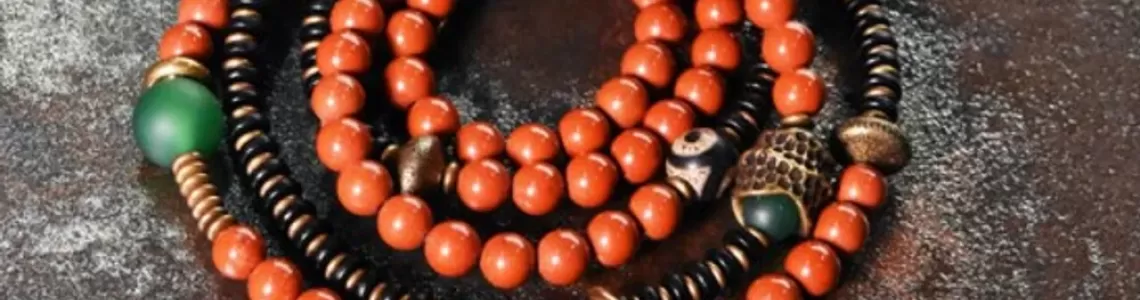
Answer first: a red agate bracelet is best evaluated as a chalcedony-family bead bracelet whose red color, treatment status, fit, cord, wood and metal components all need separate checks. Agate can naturally range into reddish-brown tones, but bright, uniform or unusually saturated red beads may be dyed or otherwise treated. That does not automatically make the bracelet unsuitable; it means the seller should describe the material plainly, disclose important treatments, avoid implying laboratory proof that is not supplied, and give care instructions that protect color, cord and metal finish. A buyer should ask four practical questions before ordering: what exactly is claimed as agate, whether color treatment is disclosed or unknown, which other materials touch the skin, and whether the bracelet size and construction fit the intended use.
This guide is written for shoppers comparing sunMYLOVE pieces such as the red stone, ebony and agate bead bracelet, the aquatic agate, ebony and brass bracelet, and the weathered Bodhi root, agate and brass bracelet. It also links to broader men's beaded bracelets for comparison. It does not authenticate any individual bead, identify mine origin, certify natural color, promise healing, or claim that red agate brings protection, courage, luck, circulation benefits or emotional change.
Research question and evidence scope
The research question is: what can a buyer safely infer from the phrase red agate bracelet, and which claims need stronger proof? The safe answer is narrower than many marketplace descriptions. Agate is a term for a banded form of chalcedony, which belongs to the fine-grained quartz family. Red or reddish-brown colors can occur in agate, but color alone does not prove natural origin or untreated status. Bead photographs are useful for design comparison, not for definitive gem identification. A product page can responsibly sell an attractive red bead bracelet while still leaving treatment, exact variety and origin as unknown unless documented.
For this article, the authority sources are gemological, regulatory and trade-oriented. GIA explains that gems are frequently treated after mining to alter color or clarity, and that treatments may be hard to recognize without training. The U.S. FTC Jewelry Guides, as published in 16 CFR Part 23, set expectations for disclosing gemstone treatments when they are not permanent, require special care, or significantly affect value. Gem-A discusses the practical problem of recognizing dyed stones and explains that tests are not always infallible. AGTA summarizes chalcedony care in ordinary jewelry terms. FTC business guidance reinforces the broader rule that jewelry claims should be truthful and non-deceptive. These sources support buyer caution; they do not prove a specific sunMYLOVE bead is dyed, natural, synthetic or untreated.
Key definitions for a red agate bracelet
| Term | Evidence-safe meaning | What it does not prove |
|---|---|---|
| Agate | A familiar chalcedony variety often used for beads, carvings and cabochons | Untreated color, exact locality, laboratory identification or rarity |
| Red agate | A retail color-and-material phrase for red or reddish agate/chalcedony-style beads | That every bead is naturally red or undyed |
| Dyed agate | Agate or chalcedony whose color has been changed or strengthened with dye | That the bracelet is bad; it changes disclosure and care expectations |
| Red stone | A less precise catalog phrase for red bead appearance or product styling | Exact mineral identity unless the listing separately states it |
| Ebony, Bodhi root or brass accents | Other bracelet components that affect care, skin contact and style | Anything about agate treatment or authenticity |
Why red color needs a treatment check
Agate and chalcedony are attractive in bracelets because they can take a polish, show translucency or banding, and stand up to normal bead use better than many softer ornamental materials. That durability is one reason agate appears repeatedly in beaded jewelry. But durability does not answer the color question. GIA's treatment guide describes dyeing as the introduction of color into porous or fractured gems, and it lists chalcedony among materials that can be dyed. It also notes that some dyes can be affected by solvents or prolonged sunlight. For a buyer, that makes treatment disclosure practical rather than academic. If a bracelet is dyed, it may still be a fair purchase, but it should be cleaned and stored with dye stability in mind.
The color itself can give clues, not proof. Reddish-brown, orange-red and iron-toned beads can look plausible in natural agate contexts. Very bright cherry red, perfectly even color across many beads, color concentration in cracks, or color visible around drill holes can raise a reasonable treatment question. None of these signs is final. A seller with no lab report should not upgrade the claim to "natural untreated red agate" merely because the beads look convincing in photos. The safer phrasing is "red agate beads" with treatment status either disclosed, documented, or left as unknown.
Disclosure is a buyer protection, not a defect label
The FTC Jewelry Guides are useful because they focus on material information. A gemstone treatment should be disclosed when it is not permanent, creates special care requirements, or significantly affects value. That framework helps buyers avoid two opposite mistakes. The first mistake is assuming every dyed bead is dishonest. Dyed chalcedony and agate have long existed in jewelry markets; clear disclosure lets the buyer judge appearance, price and care. The second mistake is ignoring treatment because the bracelet is inexpensive. Even an everyday bracelet can disappoint if a buyer expects stable natural color and receives a dye-sensitive bead that should avoid solvents and prolonged sun.
The same logic applies to imitation and simulated terms. If a bead is glass, resin, dyed howlite, composite or another material sold to resemble agate, the product can still be useful fashion jewelry if the description makes that clear. Problems start when a listing uses unqualified gem names, cultural labels or "natural" language in a way that changes buyer expectations without evidence. A modest, accurate product page is more valuable than an exaggerated story.
How to inspect a red agate bracelet online
1. Read the exact material line
Start with the product title and specification table, then compare that wording with the photos. A bracelet may combine red agate, black ebony, brass spacers, green accent beads, cord, elastic and small metal charms. The red bead may be the visual center, but another component may be the part that affects skin sensitivity or care. If the page says "red stone" rather than "red agate," treat the exact identity as less certain. If the page says "agate," check whether treatment is mentioned. If the page says nothing about treatment, record that status as unknown rather than assuming untreated.
2. Compare color distribution
Look at bead-to-bead variation. Natural ornamental stones often vary in tone, translucency, small markings and banding. Dyed material can also vary, so variation alone is not proof. Uniform color across every bead, intense surface color at pits, or darker dye traces around drilled holes can justify asking a follow-up question. Product photos on a retail site are not gemological instruments; they are only a starting point.
3. Check construction before symbolism
A bracelet has to survive ordinary handling. Inspect whether the product is a stretch bracelet, wrap bracelet, knotted cord, multi-strand design or fixed-size piece. Large round beads can make a measured wrist circumference feel tighter than expected. Wood and Bodhi-root elements should be kept away from soaking. Brass can darken and may react differently depending on skin chemistry and moisture. Use the bracelet buying guide to compare wrist fit before choosing a size, and do not buy a bracelet purely because a color story sounds meaningful.
4. Match care to the weakest component
AGTA's chalcedony care summary points toward warm water and mild dish soap for chalcedony, but a mixed bracelet is not a loose gemstone cabochon. Cord, elastic, brass, wood, bone or coatings may be more sensitive than the agate itself. A conservative care plan is safer: wipe with a clean dry cloth after wear, avoid soaking, avoid ultrasonic cleaners, keep perfume and sanitizer away, and store the bracelet dry and separate from abrasive jewelry. If dye is known or suspected, avoid acetone, alcohol, harsh solvents and prolonged sunlight because color stability can depend on the dye and treatment process.
Decision table: what the listing says versus what to ask
| If the listing says | Safer buyer reading | Question to ask |
|---|---|---|
| Red agate bracelet | Agate or agate-style red beads are claimed | Is the color natural, dyed, heat-treated, or unknown? |
| Red stone bracelet | Color is clear; mineral identity may be less specific | What material are the red beads? |
| Natural red agate | Higher-evidence claim than plain red agate | What supports natural color and untreated status? |
| Dyed agate | Disclosed treatment, not automatically a failure | What care protects the color? |
| Agate, ebony and brass | Mixed-material bracelet | Which components touch skin and what care does each need? |
How this applies to sunMYLOVE products
The red stone, ebony and agate bead bracelet should be evaluated as a mixed-material bracelet: red beads for color, ebony for dark contrast, and metal accents for warmth and structure. The buyer should not infer independent lab certification or natural red color from the product photo alone. The aquatic agate, ebony and brass bracelet is useful for comparing how agate language changes when the dominant color and visual effect are different. The weathered Bodhi root, agate and brass bracelet adds an organic bead component, so water and humidity care become even more important. For broader material comparison, the gemstone treatment disclosure guide explains why heat, dye, filling and coating should be separated in buyer language.
There are also nearby topics that should not be merged carelessly. The Alashan agate guide deals with a different commercial label and should not be treated as proof about every red agate bead. The Dzi-style bead bracelet guide focuses on pattern, imitation and cultural-meaning boundaries, not on red color specifically. Keeping these topics separate helps avoid keyword cannibalization and keeps buyer advice more precise.
Common red agate buying mistakes
- Assuming that "red" means naturally red and untreated.
- Treating a product photo as a laboratory identification.
- Ignoring dye disclosure because the bracelet is inexpensive.
- Using "red agate," "red jasper," "carnelian" and "red stone" as interchangeable terms.
- Forgetting that wood, cord, brass or elastic can set the real care limit.
- Believing health, luck, protection or energy claims that are not supported by reliable evidence.
- Choosing a tight bracelet without considering bead diameter and wrist movement.
Red agate, red jasper and carnelian are not interchangeable
Retail listings sometimes blur red ornamental stone names. Agate, jasper and carnelian are all associated with silica-rich materials in jewelry markets, but their names carry different appearance and structure expectations. Agate is commonly associated with banding or chalcedony structure; jasper is usually more opaque; carnelian is a reddish-orange chalcedony variety. A bracelet seller should use the term that matches the product evidence available. If the source information simply says red stone and agate, do not turn that into carnelian, jasper, natural red chalcedony or untreated gem material without documentation.
This distinction matters for search and AI visibility as much as for buyers. A page that answers "red agate bracelet" should not overreach into every red gemstone. It should help the buyer understand a specific purchase decision: color treatment, disclosure, care, fit and mixed-material construction. That is also why this guide avoids metaphysical claims. Some shoppers personally associate red stones with vitality, courage, grounding or protection. Those meanings can be personal symbolism, but they are not material facts and they do not establish medical benefit.
Care checklist for daily wear
- Put the bracelet on after perfume, sunscreen, moisturizer and sanitizer have dried.
- Remove it before showering, swimming, exercise, sleep or heavy hand work.
- Wipe beads and metal gently with a clean, soft, dry cloth after wear.
- Do not soak mixed wood, cord, elastic or brass components.
- Avoid acetone, alcohol and harsh solvents, especially when dye status is known or unknown.
- Keep the bracelet away from prolonged direct sunlight and humid storage.
- Store it separately so harder beads and metal charms do not scratch other jewelry.
- If color rubs off on cloth or skin, stop wearing it and ask the seller for treatment and care information.
FAQ
Is red agate always dyed?
No. Reddish and reddish-brown agate colors can occur, but bright or uniform red beads may be dyed. Without seller documentation or lab testing, treatment status should be treated as unknown.
Is dyed agate a bad material for bracelets?
Not automatically. Dyed agate can be attractive and wearable when disclosed honestly and priced appropriately. The buyer should follow care instructions that protect dye stability.
Can I tell red agate from red jasper or carnelian by photo?
A photo can suggest color and pattern, but it cannot reliably identify every bead. If exact gem identity matters, ask for documentation or choose a seller who describes uncertainty clearly.
Does red agate have proven healing benefits?
No reliable clinical evidence proves that wearing a red agate bracelet treats, prevents or improves disease, pain, circulation, immunity, anxiety, sleep or emotional health. Treat such language as personal symbolism, not medical fact.
How should I clean a red agate bracelet with ebony and brass?
Use a dry soft cloth for routine care. Avoid soaking, ultrasonic cleaning, alcohol, acetone and harsh detergents because the mixed materials and possible dye or finish treatments may be sensitive.
What should I check before buying one as a gift?
Confirm wrist size, bead diameter, clasp or elastic style, delivery timing, return terms and whether the recipient is sensitive to brass or prefers untreated natural stones.
Method and evidence boundary
This article reviewed sunMYLOVE's public product and category pages, existing internal guides, and publicly accessible gemological and regulatory sources. It uses the phrase red agate bracelet for buyer navigation and product comparison, not as independent laboratory certification. Where treatment, origin, exact mineral variety or natural color are not documented, the article says unknown rather than inventing proof. Before ordering, review current delivery information and returns and refunds.
References and evidence scope
- GIA, An Introduction to Gem Treatments - treatment, dyeing, care and disclosure context for gem materials including chalcedony.
- FTC Jewelry Guides, 16 CFR Part 23 - U.S. treatment disclosure and imitation/simulated gemstone language.
- Gem-A, How to Recognise Dyed Gemstones - dye recognition limits and correct labeling responsibility.
- AGTA, Chalcedony - chalcedony trade summary and conservative care guidance.
- FTC, In the Loupe: Advertising Diamond, Gemstones and Pearls - truthful and non-deceptive jewelry advertising guidance.
Review date: 2026-08-25. Editorial note: sunMYLOVE uses this guide to keep red agate bracelet language evidence-bound: material, color, treatment, construction and care claims need documentation; symbolism and style preferences must not be presented as medical, protective or guaranteed outcomes.
Leave a Comment