
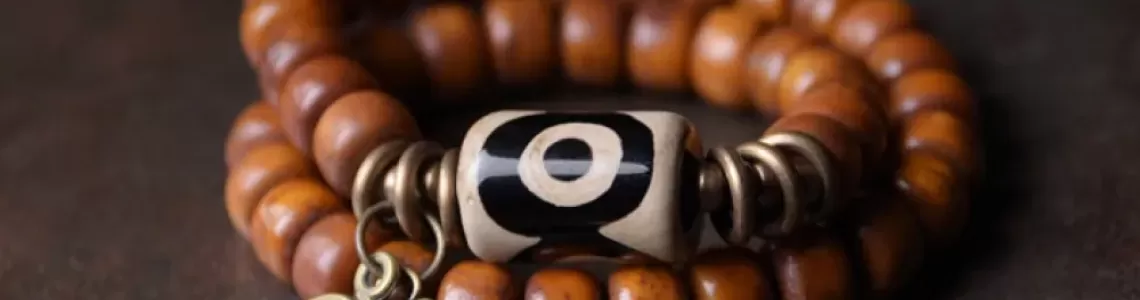
Answer first: a Dzi-style bead bracelet should be read as a patterned jewelry design unless the seller gives specific, verifiable evidence for antique age, Himalayan cultural source, bead material and treatment status. Many modern bracelets use the visual language of Dzi beads because the dark-and-light eye, stripe and geometric patterns are recognizable. That can be attractive, but it is not proof that the bead is an ancient Tibetan dZi, natural untreated agate, a religious object, or a protective charm. For a buyer, the practical checks are simple: separate material from style, ask whether the bead is agate, glass, resin or another material, look for treatment or imitation wording, check cord and metal components, and avoid any health, luck or protection promise that cannot be evidenced.
This guide is for shoppers comparing modern fashion bracelets such as Dzi-style, bone and brass bead bracelets, Dzi-style, ebony and mixed-gem bracelets, Bodhi root and Dzi-style bead bracelets, and broader men's beaded bracelets. It does not authenticate any individual antique bead. It also does not claim that a bracelet can prevent misfortune, improve health, attract wealth, cure anxiety, change luck, or replace professional gemological or cultural expertise.
Research question and scope
The research question is: what can a buyer safely infer from the phrase Dzi-style bead bracelet, and what should remain unproven unless the seller documents it? The answer matters because a single listing can mix at least four kinds of language: material words such as agate, glass, bone, brass or ebony; design words such as eye bead, stripe, etched, antique-style or Dzi-style; cultural words such as Tibetan, Himalayan, amulet or talisman; and commercial words such as handmade, good luck or protective. These categories should not be collapsed into one claim.
Real ancient dZi beads are a specialist subject. The British Museum catalogues agate beads allied in shape, form and material to Tibetan dZi beads, which is useful evidence that bead form and agate material are historically connected. The museum records also show why collection context, documented acquisition history and specialist examination matter when age or origin is claimed. Those records support careful language; they do not let a retailer identify a modern bracelet as ancient or sacred from a product photo.
Key definitions
| Term | Evidence-safe meaning | What it does not prove |
|---|---|---|
| Dzi-style | A bead pattern inspired by Dzi visual conventions such as eyes, stripes or geometric contrast | Antique age, Tibetan origin, blessing, protection or cultural authority |
| Agate | A variety of chalcedony, a fine-grained quartz material often used for beads and ornaments | Untreated color, ancient origin or cultural authenticity |
| Etched or patterned bead | A bead whose decoration may be produced by surface or color processes | Hand antiquity, rarity or supernatural power |
| Good-luck bracelet | A symbolic or gift-oriented product phrase | Guaranteed outcome, medical benefit or objective protection |
| Imitation or simulated | A material made to resemble another gem or style | Lower usefulness as fashion jewelry; it only changes disclosure expectations |
Why material and style must be separated
Agate is a familiar jewelry material because it is durable enough for beads, takes polish well and can show strong bands or color zones. Gem-A describes agate as a banded variety within the chalcedony family and explains that chalcedony is a microcrystalline quartz material. That helps explain why agate is plausible in bead jewelry. It does not prove that every Dzi-style bead is agate, or that a dark bead with white patterning is natural and untreated agate.
The GIA treatment guide gives an important caution for chalcedony: it can be dyed in many colors. The FTC Jewelry Guides also require treatment disclosures in specific cases, including when a treatment is not permanent, creates special care requirements, or significantly affects value. For a buyer, this means the words natural, dyed, treated, imitation, glass, resin, agate and Dzi-style should each be read literally. A listing that says Dzi-style glass bead is not making the same claim as untreated agate bead. A listing that says Dzi-style bead without material detail is incomplete for a buyer who cares about material.
What a product photo can and cannot show
A photo can show approximate color, bead size, pattern placement, bracelet rhythm and how the focal beads relate to brass, bone, ebony, Bodhi root or other components. It can show whether a bracelet looks matte, glossy, symmetrical, rustic or highly polished. It may reveal obvious chips, poor drilling, frayed cord or mismatched bead sizes if the image is clear.
A photo cannot reliably prove ancient age, geographic origin, blessing history, exact mineral identity, dye stability or whether a pattern was produced by a historical technique. Even close-up images are limited because lighting, compression and editing can exaggerate color and contrast. The more valuable or culturally specific the claim, the stronger the evidence should be. A modern fashion bracelet can be honestly sold as Dzi-style, patterned, symbolic or inspired without pretending to be an antique bead.
Six buyer checks before choosing a Dzi-style bracelet
1. Read the material line before the romantic name
Start with the actual materials. On a mixed bracelet, the skin-contact experience may come from brass spacers, bone beads, ebony, elastic cord, waxed cord, thread, knots and bead holes as much as from the focal patterned bead. Use the bone bead material and care checks when a listing includes bone or horn language, and the ebony wood buyer checks when dark wood beads are present. If you have metal sensitivity, the brass or alloy element may matter more than the patterned bead. If you are buying for rough daily wear, the cord system may fail before a hard bead does.
2. Look for style wording
Words such as Dzi-style, antique-style, tribal-style, Tibetan-style or good-luck are design or symbolism cues unless the listing gives specific documentation. They can be useful because they tell you the visual intention, but they should not be treated as proof of antique, ethnic, ritual or religious status. The safer language is: patterned focal bead inspired by Dzi visual motifs.
3. Treat symbolism as symbolism
Some buyers like eye, stripe and geometric bead patterns because they are associated with protection, watchfulness or blessing in modern retail language. That can be a valid personal preference or gift story. It should not become a factual promise. A bracelet may symbolize good wishes; it is not evidence that an outcome will occur. For health questions, there is not sufficient reliable clinical evidence that wearing a Dzi-style bead bracelet treats, prevents or improves disease, anxiety, pain, circulation, immunity, sleep or bad luck.
4. Ask better questions
Instead of asking whether the bead is real in a vague sense, ask: what is the bead material, is any color or surface treatment disclosed, is the bead modern or antique-style, what is the bead diameter, what is the bracelet length range, what cord or elastic is used, and what metal touches the skin? These questions produce answers a seller can reasonably provide without inventing a provenance story.
5. Check construction and fit
For bracelets, fit is not only circumference. Large patterned focal beads can change how the bracelet sits on the wrist. Bone, wood and brass mixed with hard stone or glass can also change weight distribution. If the bracelet is elastic, look for smooth bead holes and enough stretch without overextension. If it is corded, inspect knots, sliding closure and whether bead edges rub the cord. Compare the bracelet against your measured wrist, use the site's bracelet buying and fit guide, and allow comfort room rather than forcing a tight symbolic piece into daily wear.
6. Match care to the most sensitive component
Agate or chalcedony may be relatively durable, but a mixed bracelet is only as care-resistant as its most sensitive part. Bone can dislike prolonged soaking. Ebony and other woods can dry, swell or crack with repeated water exposure. Brass can patinate and may leave marks on skin depending on moisture, chemistry and finish. Dyed or coated beads may have special care requirements. Use a dry soft cloth after wear, avoid ultrasonic cleaning, avoid solvents unless the seller explicitly says they are safe, and store the bracelet away from prolonged dampness and strong sunlight.
Comparison framework
| If the listing says | Safer buyer reading | Question to ask |
|---|---|---|
| Dzi-style agate bead | Patterned bead claimed as agate; style does not prove age | Is the agate dyed, etched or otherwise treated? |
| Dzi-style glass bead | Imitation or style bead, acceptable if clearly disclosed | Is it sold for appearance rather than natural-stone identity? |
| Ancient Dzi | High-evidence antique claim | What documentation, chain of custody or specialist report supports this? |
| Good luck bracelet | Symbolic gift phrasing | Does the page avoid guaranteed outcome and health claims? |
| Bone, brass and Dzi-style | Mixed-material bracelet | Which material touches skin and what care does each component need? |
How this applies to sunMYLOVE products
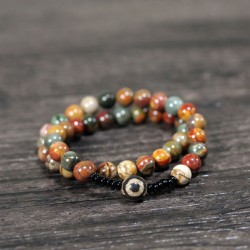
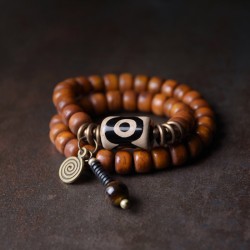
For the Dzi-style, bone and brass bracelet, read Dzi-style as pattern language and read bone and brass as material language. For the Dzi-style, ebony and listed alexandrite bracelet, separate the patterned bead from the ebony and any listed gemstone component. For the Bodhi root and Dzi-style bead bracelet, care must respect the organic bead material and cord, not only the focal pattern. If you want a broader comparison, start from the beaded bracelet category and compare material, size, closure and skin-contact metal. Before ordering, review the current delivery information and returns and refunds policy rather than assuming every destination or fit issue is handled the same way.
Common mistakes
- Assuming every Dzi-style bead is antique agate.
- Reading good-luck language as a promised result.
- Ignoring brass, cord, bone or wood care because the focal bead is the visual center.
- Using photo color as proof of natural or untreated material.
- Confusing cultural inspiration with verified cultural provenance.
- Buying a tight bracelet because the bead pattern feels meaningful, then damaging cord or bead holes during wear.
Authentication red flags for modern retail listings
The highest-risk listings are not the ones that clearly say imitation, glass, resin, modern or Dzi-style. Clear style disclosure lets the buyer decide whether the look, price and construction are acceptable. The risky listings are the ones that use high-value words without evidence: ancient, temple, blessed, Tibetan, old mine, natural agate, medicine bead, protector, wealth bead or guaranteed luck. Those words can materially change a buyer's expectation. If the product is inexpensive, mass-produced, newly listed and sold in many identical copies, the safest assumption is modern style jewelry unless stronger evidence is provided.
Strong evidence would be more than a dramatic story. It might include a specialist report, documented collection history, clear macro photographs, material analysis, a seller who explains uncertainty, and a price that reflects the claim. Even then, a fashion buyer should ask whether they need an authenticated collectible or simply want a wearable pattern. For everyday jewelry, a well-described modern bead may be the more practical choice because the buyer is paying for design, fit and honest materials rather than unverifiable rarity.
Gift and styling guidance
A Dzi-style bracelet can be a good gift when the message is framed modestly: protection as a wish, luck as a blessing, and pattern as a design preference. It is better to write a gift note such as "a symbolic bracelet for daily focus" than "this will protect you." The first sentence is personal and honest; the second makes an outcome claim. If the recipient follows a specific Buddhist, Tibetan, Himalayan or other cultural tradition, avoid assuming that a retail pattern carries the same meaning within that tradition. Let the recipient define the meaning.
For styling, Dzi-style beads work best when the rest of the bracelet does not fight the focal pattern. Dark ebony can make a brown-and-white bead look quieter; brass can warm the palette; bone or ivory-like colors can make the pattern more visible; black obsidian or onyx can make the bracelet feel heavier and more graphic. Buyers who want subtle daily wear may prefer one focal bead with simple spacers. Buyers who want a statement piece may prefer repeated eye or stripe beads, but should check weight, bead diameter and wrist comfort before choosing the boldest version.
FAQ
Are Dzi-style beads always agate?
No. Historical dZi discussions often involve agate, and museum examples can connect similar forms with banded agate, but modern Dzi-style fashion beads may be agate, glass, resin, other stone or composite material. The listing should say.
Can I authenticate an ancient Dzi bead from a bracelet photo?
No. A photo can support visual comparison, not reliable authentication. Antique age, origin and treatment questions require specialist evidence and, in some cases, laboratory analysis.
Is a Dzi-style bracelet disrespectful?
It depends on language, sourcing and use. A fashion product should avoid claiming sacred status, protected cultural authority or guaranteed spiritual effects unless those claims are specific, sourced and appropriate. Pattern inspiration should be labeled as style.
Does a Dzi bracelet bring luck?
It may carry personal or gift symbolism for a buyer. There is no reliable evidence that wearing the bracelet objectively changes luck, health or protection outcomes.
How should I clean a mixed Dzi-style bracelet?
Use a dry soft cloth after wear. Avoid soaking, ultrasonic cleaners, solvents and harsh detergents unless every component is documented as safe for that method. Store dry and separate from abrasive jewelry.
What matters most for daily wear?
Material disclosure, wrist fit, bead-hole smoothness, cord quality, brass contact and care needs matter more than mystical wording. A beautiful bracelet still needs practical construction.
Method and evidence scope
This article used publicly accessible museum, gemological, regulatory and materials sources. It distinguishes documented material facts from cultural symbolism and buyer preference. It does not authenticate any individual sunMYLOVE bead, certify origin, verify antique age, or provide medical, spiritual or investment advice.
References and evidence scope
- British Museum, amulet/bead record A_1880-4105-h — example of banded agate bead allied to Tibetan dZi form.
- British Museum, bead record A_1880-3699-e — related bicone agate bead reference.
- GIA, An Introduction to Gem Treatments — treatment and dyed chalcedony context.
- FTC Jewelry Guides, 16 CFR Part 23 — U.S. jewelry treatment and gemstone disclosure guidance.
- Gem-A, different types of chalcedony — gemological terminology and chalcedony scope.
Review date: 2026-08-24. Editorial note: sunMYLOVE uses this guide to keep Dzi-style bracelet language evidence-bound: pattern and symbolism are allowed, but antique, cultural, medical and outcome claims require stronger proof than a product photo.
Leave a Comment