
How to Read Gemstone Treatment Disclosures: Heat, Dye, Filling, Coating and Buyer Checks
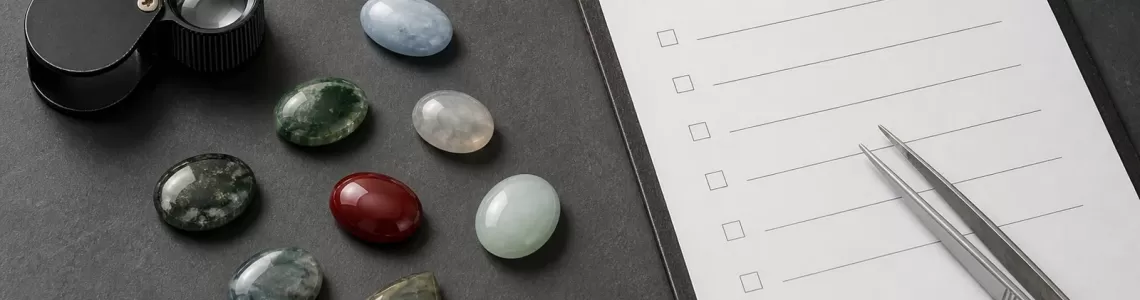
Answer first: A gemstone treatment is any process beyond routine cutting and polishing that changes a gem’s color, clarity, durability, or appearance. Treatment is not automatically bad, and an untreated stone is not automatically better. The buying risk is missing or vague disclosure. Before ordering gemstone jewelry online, look for the treatment in plain language, whether it is permanent, whether it changes care, and whether it materially affects value. A photograph, a color name, or the word “natural” cannot answer those questions by itself.
This gemstone treatment disclosure guide explains how to read terms such as heated, dyed, coated, filled, impregnated, stabilized, irradiated, and assembled. It is a research-based buying framework for jewelry consumers, not a laboratory identification. It does not determine whether any particular sunMYLOVE bead or product has been treated, and it does not add a certification or treatment claim that is absent from the product page.
Research question and scope
The research question is practical: What information should an online jewelry listing provide so that a buyer can make a treatment-aware decision? The scope covers colored gemstones, ornamental materials, beads, and finished jewelry. It does not cover diamond grading in detail, geographic-origin opinions, monetary appraisal, or medical effects. It also separates three questions that listings often blur: what the material is, whether it is natural or manufactured, and whether it has been treated.
What counts as a gemstone treatment?
GIA describes treatment as processing beyond traditional cutting and polishing that alters color, clarity, or sometimes durability. GIA also stresses that some treatments are difficult even for experts to detect and may be permanent, long-lasting, or short-lived in normal use. That is why seller disclosure matters more than a shopper’s visual guess. See GIA’s Introduction to Gem Treatments.
Treatment is different from identity. A natural mineral can be treated; a laboratory-grown material can also be treated; an imitation may only resemble another material. “Natural,” “genuine,” “treated,” “synthetic,” and “imitation” therefore answer different questions. A complete description should not use one word as a substitute for all the others.
In the United States, 16 CFR 23.24 says failing to disclose a gemstone treatment may be unfair or deceptive when the treatment is not permanent, creates special-care requirements, or has a significant effect on value. For online sales, the rule’s note says disclosure should appear in the solicitation or product description, rather than waiting until after purchase. See the current eCFR text for 16 CFR 23.24. This is a regulatory disclosure framework, not a promise that every treated stone is defective.
A plain-language treatment table
| Term | What the process generally does | Why a buyer should care | Question to ask |
|---|---|---|---|
| Heating | Uses controlled heat to alter color, clarity, or optical effects | Effects may be stable, but identification, value, and disclosure still matter | Was heat used alone, or with another process? |
| Dyeing | Introduces coloring matter to add, intensify, or even out color | Color may concentrate in pores or fractures and may have cleaning or stability limits | Is the color dyed, and what care avoids fading or damage? |
| Coating | Adds a surface layer, film, lacquer, foil, ink, or similar material | The effect may be surface-limited and vulnerable to abrasion, solvents, heat, or repolishing | Which surfaces are coated, and is the coating permanent? |
| Filling / infilling | Places glass, resin, polymer, or another substance in cavities or fractures | It can change appearance, weight, durability, repair options, and value | What filler was used, and are ultrasonic, steam, heat, or chemicals unsafe? |
| Oiling / resin infusion | Introduces oil or resin into surface-reaching fissures | The degree and stability can vary; future cleaning or maintenance may matter | Is the filler colorless, and can it dry out or be damaged? |
| Impregnation / stabilization | Introduces a substance into porous material to improve appearance or durability | The added material may be integral to performance and can affect care or value | What agent was used, and how much of the object is affected? |
| Irradiation | Uses radiation, sometimes followed by heating, to change color | Color stability and repair sensitivity depend on material and process | Was irradiation followed by heat, and are there special care limits? |
| Diffusion | Introduces coloring elements from an external source at high temperature | Color depth can affect repolishing or recutting decisions | Is the color surface-related or deeper, and how was it identified? |
| Bleaching | Uses chemical agents to lighten or remove color | It may be combined with dyeing or impregnation; the combined treatment matters | Was bleaching followed by polymer, dye, wax, or another process? |
| Assembled / composite | Joins two or more parts or materials | Identity, adhesive stability, cleaning, and durability depend on the construction | What are the layers, and how are they joined? |
The definitions above synthesize the terminology used by GIA, the American Gem Trade Association, the International Colored Gemstone Association, and CIBJO. The organizations do not make every commercial code interchangeable. A one-letter code can be useful shorthand, but ordinary words are safer for consumers because they show what actually happened.
Material-specific guides remain useful after the general code is decoded. For example, our jade terminology and treatment guide explains why jadeite, nephrite, color names, bleaching, and impregnation must be separated, while the moonstone types and care guide separates feldspar identity, optical appearance, and safe handling. Neither page turns a photograph into a laboratory result.
What authoritative disclosure systems agree on
The 2026 sixteenth edition of the AGTA Gemstone Information Manual provides enhancement codes and disclosure guidance for natural colored gemstones and cultured pearls. The ICA Common Disclosure Code likewise defines symbols for bleaching, coating, dyeing, filling, heating, impregnation, irradiation, oiling, stabilization, and other processes. These are industry systems: they help trade participants communicate, but a code is only useful when a buyer can find its definition.
The CIBJO Gemstone Book distinguishes natural materials, treated gemstones, and artificial products and sets out verbal and written disclosure principles. It calls for treatment information before a sale and in written presentations and promotional material. Together with the US rule, these sources support four simple expectations: disclose before purchase, use clear language, identify care consequences, and do not disguise treatments with reassuring but undefined marketing words.
A GIA legal review adds an important limit: treatment disclosure duties are not merely a gemological preference; misleading omissions can also interact with federal and state deceptive-practice rules and civil claims. The article is older than the current 2018 Jewelry Guides revision, so the current eCFR controls for present US federal wording. The review remains useful for explaining why documentation should travel through the supply chain. See Gem Treatment Disclosure and U.S. Law.
What a listing should say—and what vague language cannot prove
A strong online disclosure can be short: “Natural [material], dyed; avoid prolonged sunlight and harsh solvents,” or “Natural [material], fracture-filled with glass; no ultrasonic or steam cleaning.” It identifies the material claim, process, and care consequence. If the seller does not know, “treatment status unknown” is more honest than “untreated” based on appearance.
By contrast, these phrases are incomplete:
- “Natural stone” may address geological origin but not treatment.
- “Genuine” does not explain dye, coating, filling, stabilization, or assembly.
- “Enhanced” admits a change but does not name the process.
- “Premium grade” has no universal treatment meaning.
- “Lab tested” is incomplete without the laboratory, report, tested item, methods, and findings.
- “Colorfast” or “permanent” requires substantiation and does not erase special-care needs.
Natural-looking variation also cannot prove untreated status. Color zoning, inclusions, matrix, and bead-to-bead differences can occur naturally, but treatments can preserve, imitate, intensify, or exploit those features. Our natural stone bead variation guide explains what variation can and cannot establish.
Why photographs and home tests are not enough
Some treatments leave visual clues: dye may collect near fractures or drill holes; coatings can abrade at edges; assembled stones can show junction planes; fillings may display flashes under magnification. None of these clues is a universal test. Good treatment can be subtle, image processing can hide features, and untreated materials can show similar patterns.
Do not scratch, heat, soak, or apply solvents to finished jewelry to “test” it. Those experiments can damage a stone, coating, filler, adhesive, metal finish, or stringing material while still failing to identify the process. Hardness is only resistance to scratching; it does not measure toughness, stability, treatment, or string durability. See our hardness-versus-toughness guide.
Professional laboratories may combine microscopy, spectroscopy, fluorescence, refractive measurements, chemical analysis, and other methods. Even then, a report has a defined scope. It applies to the submitted item and the methods used; it does not automatically certify every visually similar bead or every unit in a future batch.
A seven-step online buying method
1. Separate identity, origin, and treatment
Write three lines: “claimed material,” “natural/laboratory-grown/imitation status,” and “treatment.” If the listing only answers one line, ask for the other two. Color names such as jade, moonstone, onyx, or aventurine should not be used to smuggle in unstated laboratory conclusions.
2. Decode every shorthand code
If a page uses H, D, C, F, I, O, R, or another code, find the seller’s legend and save it with the order record. Ask for plain-language confirmation when the code is absent, inconsistent, or ambiguous. Different manuals may group combined processes differently.
3. Ask what the treatment changes
The decision is not simply treated versus untreated. Ask whether the process changes color stability, impact resistance, cleaning, repair, restringing, repolishing, or resale documentation. Treatments can improve durability in one context and introduce vulnerability in another.
4. Inspect the whole construction
A bracelet or pendant is a system: stones, drill holes, string, knots, spacers, metal, coatings, adhesives, and closures. Start with the broader men’s beaded bracelet category, then review current descriptions—not unstated treatment claims—on the Black Hair Crystal, Ebony and Brass Bracelet, Yellow Jade, Bodhi Root and Brass Bracelet, Green Aventurine and Ebony Pendant, and Moonstone and Pearl Sterling Silver Bracelet.
5. Match evidence to price and consequence
For affordable fashion jewelry, clear description, representative photos, dimensions, care, and return terms may be proportionate. A large premium based on untreated status, rarity, origin, or exceptional quality should come with stronger independent evidence. A report number alone is not enough if it cannot be matched to the item.
6. Save the disclosure before checkout
Keep the product description, treatment legend, care instructions, and report images. Online content can change. A saved record helps if the received item differs materially from the description and makes later repair or professional testing safer.
7. Check the return window before testing or altering
Do not restring, polish, soak, scratch, or chemically test an item while deciding whether to return it. Compare the received item with the description and the site’s current return and refund policy first.
Care when treatment status is unknown
Unknown treatment status calls for conservative care, not a claim that every method is dangerous. Remove jewelry before swimming, showering, cleaning, exercise, and exposure to cosmetics or household chemicals. Wipe gently with a soft, slightly damp cloth, dry promptly, and store pieces separately. Avoid ultrasonic and steam cleaning unless the material, treatment, setting, and manufacturer guidance all support them. Avoid sudden heat, prolonged strong light, abrasive compounds, and solvent experiments.
For known treated stones, follow the treatment-specific instruction. A coating may be vulnerable to abrasion; a filler may react badly to heat or ultrasonics; dye can have light or solvent limits; assembled material can be sensitive to soaking; oil or resin in fissures may require specialist care. “Safe for the mineral” is not enough if it is unsafe for the treatment, adhesive, metal, or cord.
Common mistakes
- Assuming “natural” means untreated.
- Treating every enhancement code as universal.
- Believing a phone photo can rule out dye, coating, filling, or impregnation.
- Using destructive home tests on a returnable item.
- Applying one care method to every gem in a mixed-material piece.
- Paying an untreated premium without item-specific evidence.
- Confusing a seller’s general education page with a report for the exact product.
Frequently asked questions
Are treated gemstones fake?
No. A natural gemstone can remain natural while being treated. “Treated,” “laboratory-grown,” and “imitation” describe different facts. The treatment should still be disclosed when it affects permanence, care, value, or the accuracy of the sales description.
Does “natural gemstone” mean untreated?
No. Natural origin and treatment status are separate. Ask both questions.
Is heat treatment always permanent?
No universal answer covers every material and combined process. Some heat effects are stable in normal wear, while later heat or repair can affect other treatments or particular stones. Ask for material-specific guidance.
Can I detect dye at a bead’s drill hole?
Color concentration near a drill hole can be a clue, but it is not proof, and its absence does not prove untreated color. Professional testing may be needed when the claim materially affects price.
What is the difference between filling and impregnation?
Filling generally places a substance in cavities or fractures; impregnation introduces a substance into porous material. Trade manuals can use more specific subcategories, so ask what agent was used and where it is present.
Should every treated stone have a laboratory report?
Not necessarily. Evidence should be proportionate to price, rarity claims, and consequence. However, a significant premium for untreated status or origin deserves stronger item-specific documentation.
What if the seller does not know the treatment status?
“Unknown” is a valid uncertainty statement. Decide whether the price and return terms make that uncertainty acceptable; do not silently convert unknown into untreated.
Can treatment change how I clean jewelry?
Yes. Coatings, dyes, fillers, oils, resins, assembled layers, and some color processes may introduce limits involving heat, light, solvents, steam, ultrasonics, or prolonged soaking.
Method, references, and evidence scope
This guide compared the current US federal Jewelry Guides with gemological and trade disclosure systems, then checked the public accessibility of every cited source and every internal destination. It favors rules, professional manuals, and primary organizational guidance over retailer claims. Search-volume data was unavailable and is recorded as UNKNOWN; no demand figure was invented.
- Electronic Code of Federal Regulations, 16 CFR 23.24 — current US treatment-disclosure wording.
- Gemological Institute of America, An Introduction to Gem Treatments — treatment definitions, detectability, durability, and care scope.
- GIA Gems & Gemology, Gem Treatment Disclosure and U.S. Law — legal context; current eCFR wording takes precedence.
- American Gem Trade Association, Gemstone Information Manual, 16th edition — enhancement codes and trade disclosure guidance.
- International Colored Gemstone Association, Common Disclosure Code — treatment code definitions.
- CIBJO, The Gemstone Book — international nomenclature and treated-gemstone disclosure principles.
Evidence boundaries: These sources establish terminology, disclosure expectations, and common care implications. They do not identify a gemstone from a webpage photograph, prove the treatment status of a sunMYLOVE product, guarantee a treatment’s permanence in every material, or replace item-specific laboratory work. This article makes no health claim and no claim that treated or untreated gems improve the body.
Reviewed: August 18, 2026. sunMYLOVE editorial note: Product names and links are used to help readers ask better material and construction questions. Where a product page does not state a treatment or laboratory finding, this guide does not supply one.
Leave a Comment