
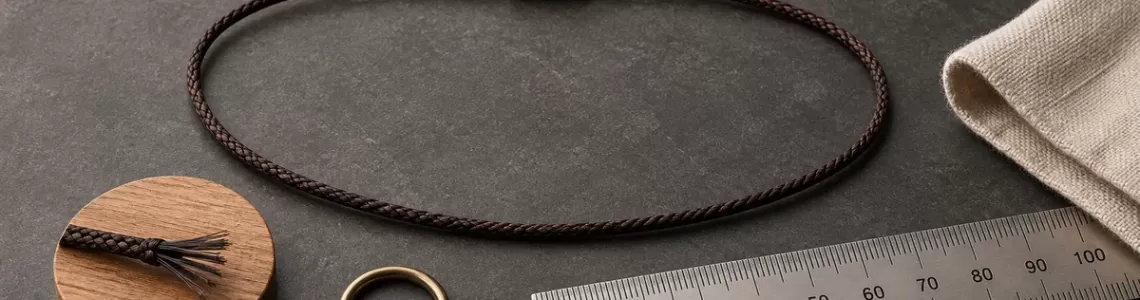
A waxed-cord necklace should be evaluated as a cord system, not as a vague promise that the necklace is waterproof, leather, cotton or maintenance-free. “Waxed” describes a surface treatment or finish; it does not, by itself, identify the underlying fiber, prove the amount or chemistry of the coating, or guarantee how the cord will respond to sweat, rain, friction or repeated adjustment. Before buying, confirm the cord material if stated, the approximate thickness, the maximum usable length, the adjustment method, the pendant opening and every metal or wooden component.
This guide explains what photographs and listing measurements can reasonably establish, what remains unknown without product-specific documentation, and how to inspect and care for an adjustable cord necklace without inventing fiber, finish or durability claims. It is general buyer education, not a laboratory identification, safety certification or warranty for a particular product.
What “waxed cord” tells you—and what it does not
Waxed cord generally means that a cord has a wax-like finish intended to change surface feel, appearance or handling. The phrase alone does not tell you whether the core is cotton, polyester, another manufactured fiber, a blend or something else. It also does not tell you whether the finish is natural wax, synthetic wax, a proprietary coating or only a seller’s appearance description.
The distinction matters because the core and finish can age differently. Fibers carry tension, while the surface finish experiences abrasion from knots, beads, bails, skin and storage. A cord may remain structurally intact even after its surface becomes polished, fuzzy, pale or uneven. Conversely, a cord can look dark and smooth while hidden fibers near a knot are already worn.
The federal Jewelry Guides principle reproduced by Cornell Legal Information Institute cautions against misrepresenting material aspects such as type, quality, size, durability and serviceability. It does not create a product-specific conclusion here, but it supports a useful buyer rule: treat “waxed,” “water-resistant,” “cotton,” “leather” and “strong” as separate claims that each need an accurate scope.
Do not upgrade “waxed cord” into “waterproof cord.” Water resistance is a performance claim, and the necklace also includes knots, cut ends, hardware and possibly wood or brass. Even if one surface sheds droplets initially, that observation does not prove long-term waterproofing or safe immersion for the assembled necklace.
Ask for the underlying fiber when it matters
A close photograph can show braid pattern, color and visible wear, but it usually cannot identify a fiber with confidence. Natural and manufactured fibers can be spun, braided and coated to look similar. The National Park Service’s curatorial guide to textile objects explains that textiles combine fibers, dyes and finishes and may also include non-textile materials such as metal, shell or bone. That layered construction is a good model for reading a necklace cord.
If a listing states a fiber, copy the exact wording. If it says only “waxed cord,” record the core as not stated. Do not infer cotton because the surface looks matte, polyester because the braid looks regular, or leather because the color is brown. If fiber choice affects allergies, ethics, cleaning or expected wear, ask the seller for a product-specific answer before purchase.
The FTC’s textile rules require fiber-content disclosures for certain covered textile products, but not every jewelry cord should be assumed to fall within that labeling scope. The practical lesson from the FTC Textile Fiber Rule summary is narrower: generic fiber names and percentages are meaningful evidence when a covered seller provides them. This article does not claim that a necklace cord must carry an apparel-style label.
When no fiber documentation exists, choose care that is conservative across plausible materials. Avoid soaking, solvents, bleach, aggressive brushing and heat. These precautions protect the unknown finish and adjacent components without pretending to identify them.
Measure cord thickness at the part that must pass through
Cord thickness is not the same as pendant size or necklace length. It matters most where the cord passes through a bail, hole, bead or adjustment channel. Measure the finished cord at its widest practical section, including a folded loop or sealed end if that is what must pass through the opening.
A flexible cord can flatten under pressure, but relying on forced compression is risky. A tight opening can scrape the finish, bunch fibers or make replacement difficult. Allow clearance for real-world movement instead of assuming that equal nominal dimensions will slide freely.
Use millimeters for small openings and cord diameters. The current NIST Handbook 44 measurement tables preserve the exact conversion of one inch to 2.54 centimeters. For buyer checks, conversion should not create false precision: a cord described as approximately 2 mm remains approximate after conversion.
Our pendant bail-size guide explains how to compare the narrowest usable opening with the largest part that has to pass through it. The companion pendant-size and cord-length guide keeps pendant dimensions, cord length and wearer fit separate. Use both checks when a pendant and cord are sold as interchangeable parts.
Maximum length is different from usable wearing length
An adjustable necklace can have several relevant lengths: end-to-end material length, maximum closed loop, minimum closed loop, wearable drop and the length lost inside knots or sliders. A listing that gives only “80 cm” may not explain which one was measured. Ask for the measurement method and whether the pendant is included.
Measure an existing necklace without pulling hard. Lay it in a natural shape, close or position the adjustment as intended, and measure the wearable loop or drop consistently. Do not stretch an elastic or flexible cord to obtain a larger number. Record whether the result is circumference, doubled flat length or total cord before knotting.
The verified record for the S664 carved ebony wood shield pendant necklace identifies an adjustable waxed cord with an approximate maximum length of 80 cm. That is a product-specific recorded value. The corresponding maximum length for the S586 handcrafted ebony wood and brass pendant necklace remains data not available in the verified local record, so this guide does not copy the S664 number onto S586.
That difference illustrates a basic evidence rule: similar appearance and shared materials do not prove identical length, knot construction or adjustment range. Each listing needs its own measurements.
Inspect a sliding knot as a wear point
A sliding knot should move with controlled friction. It should not be so loose that normal wear changes the length unintentionally, nor so tight that adjustment requires sharp pulling. Test slowly and close to the knot rather than yanking the free ends from a distance.
Look for localized fuzzing, flat spots, glaze loss, pale fibers, cracks in the finish and thinning where one cord crosses another. Compare both sides of the slider. Uneven wear can reveal that one strand takes most of the load or that grit has entered the knot.
Knots also hide cord. A necklace can look sound along its open length while damage is concentrated under the slider or at the pendant attachment. If the knot cannot be inspected without untying it, do not dismantle a new necklace merely to investigate. Ask the seller about repair or replacement options and preserve the original construction until a qualified repair decision is made.
A decorative end knot is not automatically a stopper engineered for every load. Check whether the free ends can pull through the slider during ordinary handling. If an end has begun to unravel, stop repeated adjustment; pulling can accelerate the damage.
Read the complete necklace as a mixed-material object
A cord necklace may combine fiber, surface finish, wood, brass, silver-colored connectors, adhesive and possibly a coating. Each material can have different moisture, abrasion and cleaning limits. The mixed-material necklace buyer guide shows how to assign every claim to the part it actually names rather than letting one familiar word describe the whole object.
The verified S592 ebony wood and brass circle pendant necklace record identifies black ebony wood, brass and an adjustable waxed cord of approximately 2 mm thickness. It does not establish the cord’s underlying fiber, the chemistry of its wax, a waterproof rating, an adhesive formula or a maximum cord length. Those unknowns remain unknown.
The S586 and S664 records similarly identify wood, brass and waxed cord, but their pendant dimensions and available cord-length evidence differ. These examples support component-level reading; they do not prove that every dark wooden pendant or brown cord on the market uses the same species, alloy, finish or construction.
Metal findings can also create abrasion points. Inspect where the cord bends around a ring or passes through a drilled hole. A smooth-looking brass surface may still have an edge that wears the cord under movement. Do not file or reshape the hardware unless the seller or a repair professional recommends a product-specific procedure.
Use a dry-first care routine
The Canadian Conservation Institute’s guidelines for caring for textiles and costumes describe textiles as fibrous, flexible and often absorbent materials affected by handling, dirt, light, humidity and physical forces. Museum guidance is more conservative than ordinary jewelry use, but it supports a sensible starting point: minimize avoidable moisture, soil and sharp stress.
After wear, use a clean, soft, dry cloth to blot the cord and wipe the pendant components separately. Do not scrub across the braid or pull the cloth through a tight slider. If the necklace is damp from weather or perspiration, open it into a relaxed shape and let it air-dry at room temperature away from direct heat and sunlight.
The CCI’s guidance on incorrect relative humidity notes that damp conditions can promote mould and corrosion across organic and metal materials. That does not set a household jewelry storage percentage, but it reinforces avoiding sealed storage while a cord is damp.
Do not apply oil, wax, leather conditioner, perfume, alcohol or metal polish to the cord unless the maker identifies the material and approves the treatment. An added product can darken fibers, soften a coating, trap soil or transfer onto wood and metal. Our wood pendant necklace care guide explains why mixed wood, brass and cord pieces should be cleaned component by component.
Store without sharp bends or trapped moisture
Release unnecessary tension before storage. Lay the necklace in a broad curve or loose loop, with the pendant supported so its weight does not pull continuously on the adjustment knot. Avoid tight coils, hard creases and wrapping the cord around a small hook.
The National Park Service textile guide notes that sharp folds and prolonged stress can contribute to distortion and fiber damage. A wearable cord is not a museum textile, but the mechanical principle remains useful: broad support is gentler than a tight bend.
Keep the cord away from rough metal edges, hook-and-loop fasteners and unfinished wood that can snag fibers. Separate it from chains that can wind around the slider. The necklace storage guide gives distinct storage methods for chains, wood pendants and beaded strands rather than treating every necklace alike.
Safety boundaries for cord necklaces
Cord necklaces are not suitable for infants. The U.S. Consumer Product Safety Commission warns that strings, cords and necklaces around an infant’s neck can become caught or tightly wrapped and create a strangulation hazard. See the CPSC’s strings, cords and necklaces safety guidance.
This warning should not be converted into a claim that an adult necklace is automatically safe for every activity. Remove jewelry when machinery, tools, sports equipment or workplace rules create snag or entanglement risk. A sliding knot is an adjustment feature, not certified breakaway hardware unless the product is specifically documented and tested as such.
Do not test breakaway behavior by pulling a necklace around a person’s neck. If a safety function is essential, choose a product with explicit, product-specific documentation for the intended use.
A five-minute pre-purchase checklist
- Fiber: Is the underlying cord material stated, or only the word “waxed”?
- Finish: Does the seller describe a coating, water resistance or care limit without turning it into an unsupported waterproof claim?
- Thickness: Is the cord diameter given at the section that must pass through the pendant opening?
- Length: Does the number mean maximum wearable loop, flat length, circumference or total cord before knotting?
- Adjustment: Is the slider shown clearly, and are the end stops and high-friction areas visible?
- Components: Are pendant, accent, connector and any coating identified separately?
- Care: Are cleaning instructions compatible with every named material rather than only the cord?
- Safety: Is the intended wearer and activity appropriate for a cord necklace?
Keep a copy of the listing and seller answers when a measurement or material claim affects your decision. If the received necklace differs, document it before altering knots, applying cleaners or attempting a repair.
FAQ
Does waxed cord mean the necklace is waterproof?
No. “Waxed” describes a finish or treatment but does not prove the core fiber, coating chemistry, coverage, durability or waterproof performance of the assembled necklace. Keep mixed-material pieces out of water unless the maker gives product-specific instructions.
Can I identify cotton or polyester cord from a photo?
Usually not with confidence. Braid, color and sheen can overlap across fibers and finishes. Use the seller’s documented material statement or record the core fiber as not stated.
How should I measure cord thickness?
Measure the finished cord at the widest part that must pass through a bail, hole or bead. Include a folded loop or sealed end if that section must pass through, and allow practical clearance rather than forcing equal nominal dimensions.
Why does an adjustable necklace’s stated length seem shorter in use?
Knots and sliders consume material, and listings may measure total cord, maximum loop, flat length or pendant-inclusive length differently. Ask how the number was taken and compare the same measurement type.
Can I add wax or oil when the cord looks dry?
Not without product-specific guidance. Added wax, oil or conditioner can change color, stiffness and soil retention and may transfer to wood or metal. Start with dry cleaning and ask the maker before applying a treatment.
When should I stop wearing the necklace?
Pause use if the cord is thinning, unraveling, cracking at a bend, slipping unexpectedly through the slider or exposing damaged fibers near hardware. Also remove it for infant contact and activities with snag or entanglement risk.
References and evidence boundaries
These sources support general measurement, description, textile-care and safety principles. They do not identify the fiber or wax chemistry of a specific necklace, set a universal service life, certify a breakaway function or replace maker instructions. Product examples are limited to the verified local facts ledger. The featured image is an original generic educational still life, not a store product or test certificate.
- 16 CFR § 23.1 via Cornell Legal Information Institute — general Jewelry Guides principle against misrepresenting material aspects of an industry product.
- Federal Trade Commission: Textile Fiber Rule — scope and meaning of generic fiber-content disclosures for covered textile products.
- National Institute of Standards and Technology: Handbook 44, current edition — units and exact inch-to-metric conversion reference.
- Canadian Conservation Institute: Caring for Textiles and Costumes — fiber structure, absorbency, handling and environmental deterioration.
- Canadian Conservation Institute: Incorrect Relative Humidity — damp, mould and corrosion boundaries for mixed materials.
- U.S. National Park Service Museum Handbook: Curatorial Care of Textile Objects — fibers, finishes, mixed components and mechanical care.
- U.S. Consumer Product Safety Commission: Babies Can Strangle on Strings, Cords and Necklaces — infant strangulation warning.
Leave a Comment