
How to Tell If a Silver Bracelet Is Really Sterling Silver
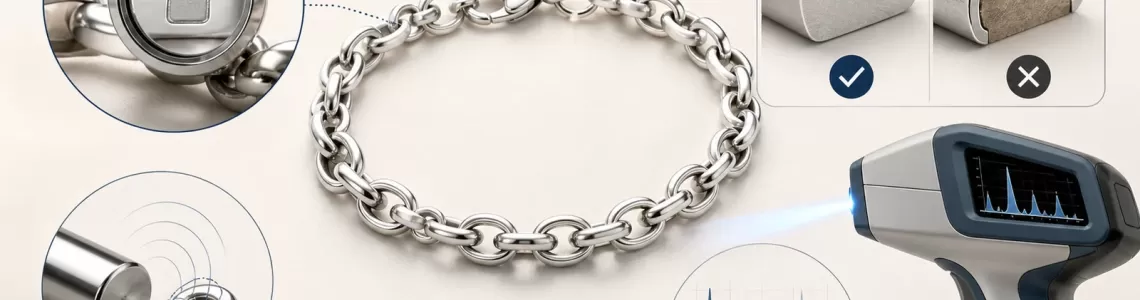
Answer first: to judge whether a silver bracelet is really sterling silver, combine several kinds of evidence. Read the complete product description; inspect the quality mark and any accompanying maker or sponsor information; check whether the construction is solid silver, silver plated, filled, mixed metal or merely silver-coloured; compare the seller’s dimensions, weight, photos, invoice and return terms; and use qualified testing when the value or uncertainty justifies it. A “925” stamp is useful evidence, but it is not a self-authenticating laboratory certificate. A magnet, tarnish, ice cube, smell or polishing cloth cannot prove 92.5% silver by itself.
This guide answers how to tell if a silver bracelet is real without turning a household trick into a verdict. It focuses on sterling-silver bracelets sold to U.S. and international buyers. Hallmarking law varies by country, product weight, age and sales destination, so a mark that is expected in one market may be optional or structured differently in another. The guide does not authenticate a particular bracelet from a photograph, estimate resale value, or replace an assay, laboratory report or local legal advice.
Research question, scope and evidence
The practical question is: What combination of information gives a buyer a reasonable basis for accepting—or questioning—a sterling-silver claim? The strongest evidence comes from official marketing rules, legally recognised hallmark systems, industry nomenclature, construction details and appropriately interpreted testing. Appearance is the weakest layer because many metals and coatings can look silver-coloured.
In the United States, 16 CFR 23.5 says it is unfair or deceptive to mark or describe an industry product as “silver,” “solid silver,” “sterling silver,” “sterling,” or with the abbreviation “Ster.” unless it is at least 925 parts per thousand pure silver. The rule governs representations; it does not mean every object stamped 925 has been independently tested.
Begin with a five-level evidence ladder
- Seller identity and written claim. Who is making the claim, exactly what does it cover, and is it preserved on the product page or invoice?
- Quality mark in context. Is the mark legible, plausible for the country and product, and accompanied by the marks expected in that system?
- Construction evidence. Do edges, wear points, joints and component disclosures support solid sterling rather than plating or mixed metal?
- Non-destructive screening. Do weight, dimensions and limited observations reveal a contradiction? Screening can reject some claims but rarely proves fineness.
- Qualified analysis. When stakes are high, use an assay office, precious-metal professional or laboratory method with appropriate calibration and interpretation.
No single layer is perfect. Confidence rises when independent layers agree. Conversely, one clear contradiction—such as exposed copper-coloured base metal beneath a claimed solid-sterling surface—deserves more weight than several vague “silver-like” signs.
Know what the words mean before testing
| Term | What it normally claims | What it does not tell you |
|---|---|---|
| Sterling silver / 925 | An alloy containing at least 925 parts silver per thousand under the cited U.S. guide | Which other metals form the balance, whether every component is sterling, or whether the stamp is genuine |
| Fine silver / 999 | A much higher silver fineness, commonly expressed as 999 parts per thousand | That it is automatically better for every bracelet design |
| Silver plated | A silver layer over a different underlying material | The thickness, durability or identity of the base metal unless disclosed |
| Silver tone / silver colour | An appearance or colour description | Any particular silver content |
| German silver / nickel silver | A traditional name for a copper-nickel-zinc type alloy | Actual elemental silver; the name should not be read as a purity claim |
| Mixed-material bracelet | Different parts may use different metals, cords, stones, wood or finishes | That a sterling charm makes the clasp, chain, spacers and core sterling |
For a focused comparison of the two common fineness labels, see sterling silver versus 999 fine silver bracelets. The present guide is different: it evaluates the evidence behind a material claim.
Step 1: read the entire product claim
A reliable listing should identify which components are sterling silver and which are not. “925 silver bracelet” can be ambiguous when a design includes beads, cord, plated findings, solder, stones or an inlay. Look for a component-level statement: bracelet body, bead caps, spacers, clasp, chain, charm, posts, pins and any coating. Ask whether the finish is oxidised, rhodium plated, gold plated, lacquered or intentionally antiqued.
Save the product page, order confirmation and invoice. A verbal assurance is harder to evaluate later. The FTC Jewelry Guides address representations about precious-metal content and coatings in the U.S.; they are a reason to prefer precise written descriptions over suggestive colour words.
Questions worth asking before purchase
- Which exact parts are represented as sterling silver?
- Is any part plated, filled, hollow, weighted or made from another metal?
- What quality mark appears, and where is it located?
- What are the bracelet’s weight, length or inner circumference, width and thickness?
- Are the photographs of the actual design and do they show the mark and construction details?
- What evidence and remedy are available if independent testing contradicts the description?
- Is the item custom-sized, and how does that change return eligibility?
Step 2: inspect a 925 mark without over-trusting it
A quality mark is an important clue because it states or suggests precious-metal content. 16 CFR 23.10 defines quality marks broadly and gives additional guidance for their use. Under this framework, 925 is meaningful—but the physical presence of three digits does not prove who applied them or whether the object matches them.
Use a loupe or a sharp close-up photograph. Check whether the mark is complete rather than a scratch that resembles numbers. Record its position. Look for a maker, trademark or sponsor mark rather than assuming the fineness number tells you the manufacturer. Do not grind, file or aggressively polish a mark to make it easier to read.
Why “no 925 stamp” is not an automatic failure
Marking systems differ. Very small, underweight, antique, repaired or jurisdiction-specific articles may be treated differently. Some markets use a complete independent hallmark; others rely more heavily on quality marks and business identification. Therefore, absence of 925 lowers the available evidence but is not universal proof that the bracelet contains no sterling silver.
Step 3: distinguish a U.S. quality mark from a UK hallmark
Do not apply one country’s checklist everywhere. A U.S. “925” quality mark and a complete UK hallmark are not the same kind of evidence.
| Feature | U.S. example | UK example |
|---|---|---|
| Core rule | FTC Jewelry Guides regulate deceptive silver-content representations | Hallmarking law requires qualifying precious-metal articles over stated weight thresholds to bear a legally recognised hallmark |
| 925 meaning | A sterling-silver fineness claim under 16 CFR 23.5 | A millesimal fineness mark can form part of a complete hallmark |
| Independent assay | A simple quality mark is not, by itself, proof of independent assay | A complete hallmark indicates independent testing in the hallmarking system |
| Compulsory elements | Rules should be read in the applicable U.S. marketing context | Sponsor, fineness and assay-office marks are compulsory parts of a complete current UK hallmark |
| Weight exemption | Do not import UK thresholds into U.S. claims | GOV.UK guidance lists 7.78 g as the silver hallmarking exemption threshold, subject to the law’s scope and exceptions |
The British Hallmarking Council’s practical summary explains the UK’s three compulsory marks and the 7.78 g silver threshold. The Sheffield Assay Office identifies the sponsor, fineness and assay-office marks as compulsory, while traditional symbols and date letters can be voluntary. This is why a lone 925 should not be described as a complete UK hallmark.
Step 4: examine construction and wear points
Construction can reveal a claim that deserves clarification. Inspect the inside edge, clasp, hinge, terminals, jump rings and areas that rub against a desk or wrist. A different-coloured substrate, flaking surface or sharply separated coating can indicate plating. That observation still does not identify the exact base metal or measure the remaining silver layer.
Mixed designs need component-level reasoning. For example, the freshwater pearl and 925 silver bracelet, the pearl, moonstone and 925 silver bracelet, the 925 silver red-cord bracelet and the multilayer bead-chain bracelet with silver medals visibly use different structures. Their links illustrate why a buyer should identify which elements a material statement covers; they are not laboratory certificates.
What common home tests can—and cannot—show
| Home check | What a result may suggest | Why it cannot prove 925 fineness |
|---|---|---|
| Magnet | Strong attraction can reveal a ferromagnetic component or core | Many non-silver metals are also non-magnetic; clasps and internal springs may differ from the bracelet body |
| Visual 925 mark | The seller or maker is making a fineness claim | Marks can be incomplete, copied, counterfeit or applied to only one component |
| Tarnish or black cloth residue | A surface is reacting or material is being removed during polishing | Silver plate can tarnish; polish can remove silver and other residues; absence of tarnish is also inconclusive |
| Ice, heat or conductivity trick | The object may transfer heat quickly | Geometry, mass, contact and other conductive metals affect the observation; it is not a calibrated composition measurement |
| Smell or sound | A subjective comparison may raise suspicion | No quantitative fineness result and poor repeatability |
| Acid spot test | A controlled reaction may help a trained tester screen exposed metal | Can damage the surface, involves chemicals, may sample plating or a local area, and requires interpretation |
The Canadian Conservation Institute advises examining hallmarks, construction, joins, hollow sections, gilding and plating before cleaning. It also warns that polishing and chemical tarnish removal affect the object and can be especially damaging to silver plate. That evidence contradicts the popular idea that rubbing or aggressive polishing is a harmless authentication test.
For ordinary shopping, use home checks to find contradictions, not to manufacture certainty. If a seller’s claim matters financially, the right next step is better documentation or qualified analysis—not repeating more internet tricks.
When professional testing is justified
Professional testing is reasonable when the bracelet is expensive, antique, insured, resold, disputed, heavily plated, structurally complex or important to someone with a known metal sensitivity. Ask the tester which method they use, what area is measured, whether the result is surface-sensitive, how the instrument is calibrated, and whether the report applies to the whole bracelet or only selected points.
GIA’s overview of chemical analysis describes handheld X-ray fluorescence instruments used for rapid precious-metal analysis. XRF is valuable, but “an XRF reading” is not a magic phrase. Plating, solder, curvature, geometry, heterogeneity, measurement depth and the chosen calibration can affect interpretation. NIST’s work on reference materials and XRF calibration illustrates the broader measurement principle: quantitative elemental analysis depends on suitable reference materials, calibration, homogeneity assessment and stated uncertainty.
A useful testing request
- Identify every materially different component before measuring.
- Test more than one representative location when construction varies.
- Record whether the surface is plated, coated, oxidised or recently polished.
- Request actual elemental or fineness results rather than only “pass/fail.”
- Ask what the method cannot establish and whether confirmatory testing is warranted.
An online buyer’s sterling-silver checklist
- Choose the exact product and save the material description.
- Confirm whether “925” applies to the body, components or decorative parts.
- Request a clear close-up of marks and high-wear construction points.
- Compare weight and dimensions with the exact size, not a generic sample.
- Look for plating, coating, hollow construction and mixed-material disclosures.
- Check the seller identity, contact path, invoice description and after-sale remedy.
- Read delivery information and returns and refund conditions, especially for custom-sized items.
- Use the sterling-silver bracelet collection to compare structures, not as proof that every component in every design is identical.
- Escalate to qualified testing when price, risk or contradictory evidence warrants it.
After purchase: preserve evidence before cleaning
Photograph the bracelet, marks, packaging and invoice before polishing. Do not use abrasive polish, chemical dip or an acid test merely to “see what happens.” Cleaning can alter surfaces, remove plating, erase useful wear evidence or make a later dispute harder to document. Follow the separate sterling-silver care and storage guide and the evidence-bounded guide to wearing sterling silver around water.
If skin irritation occurs, stop wearing the bracelet and seek appropriate medical advice when needed. A 925 label does not disclose every alloying element, solder, coating or component. The nickel-allergy jewelry buyer’s guide explains why composition and exposure should not be inferred from colour or marketing language.
Common mistakes
- Treating a 925 stamp as impossible to counterfeit.
- Calling every mark a hallmark, regardless of country or structure.
- Assuming no stamp always means fake silver.
- Using one magnet result as a purity test.
- Equating tarnish with solid sterling or lack of tarnish with fake metal.
- Ignoring clasps, solder, pins, beads and decorative components.
- Performing destructive tests before documenting the seller’s claim.
- Assuming an instrument reading is meaningful without calibration, location and uncertainty.
Frequently asked questions
Does a 925 stamp mean a bracelet is definitely real sterling silver?
No. It is an important quality claim, and U.S. guidance ties sterling representations to at least 925 parts silver per thousand. But the stamp itself can be copied, misapplied or limited to one component. Evaluate the mark with seller identity, construction, documentation and testing when needed.
Will real sterling silver stick to a magnet?
Silver is not strongly ferromagnetic, so strong attraction can reveal a non-silver component. Non-attraction does not prove sterling because many base metals are also non-magnetic. A clasp spring may also behave differently from the bracelet body.
Does tarnish prove a bracelet is solid silver?
No. Sterling silver can tarnish, but silver plating can also tarnish. Coatings, storage, pollution and cleaning history change the appearance. Tarnish is a surface observation, not a quantitative fineness result.
Is an unmarked silver bracelet always fake?
No. Marking requirements vary by jurisdiction, weight, age and article type. The lack of a mark reduces one useful evidence layer, so ask for stronger seller documentation or professional testing rather than guessing.
What is the difference between 925 silver and silver plate?
Sterling describes an alloy represented as at least 925 parts silver per thousand in the cited U.S. rule. Silver plate is a surface layer of silver over a different base. Wear can expose the substrate, and surface appearance alone may not distinguish them.
Is XRF enough to authenticate every part of a bracelet?
Not automatically. XRF is widely useful for rapid elemental analysis, but the result depends on instrument setup, calibration, measurement point, surface condition, plating and construction. Ask what was tested and what the result can and cannot establish.
What should I do if a test contradicts the listing?
Stop destructive testing, preserve the listing, invoice, photographs and written communications, and obtain a clear report from a qualified tester if the value justifies it. Contact the seller through the documented return or dispute process. Consumer remedies depend on the transaction and jurisdiction.
Method and evidence scope
This guide was prepared by comparing current U.S. regulatory text, UK government hallmark guidance, an official UK assay-office explanation, CIBJO nomenclature, Canadian conservation guidance, GIA’s analytical-method overview and NIST measurement references. Commercial home-test articles were reviewed as examples of common search advice but were not treated as primary proof. Search demand volume is UNKNOWN because current first-party GSC access is unavailable.
The evidence supports definitions, claim boundaries, hallmark structure, examination precautions and analytical limitations. It cannot establish the composition of an unseen bracelet, guarantee a seller, resolve every national rule or quantify the reliability of a test performed without a documented method.
References and evidence scope
- Electronic Code of Federal Regulations — 16 CFR 23.5, Misrepresentation as to silver content.
- Electronic Code of Federal Regulations — 16 CFR 23.10, Additional guidance for quality marks.
- Federal Trade Commission — Jewelry Guides.
- British Hallmarking Council / GOV.UK — Hallmarking practical guidance.
- Sheffield Assay Office — UK Hallmarks.
- CIBJO — Precious Metals Blue Book.
- Canadian Conservation Institute — Silver: Care and Tarnish Removal.
- GIA — Chemical Analysis in the Gemological Laboratory: XRF and LA-ICP-MS.
- NIST — Reference materials and XRF calibration.
Reviewed: 5 August 2026. Recheck regulations and destination-market requirements before relying on them for a transaction.
sunMYLOVE editorial note: our goal is to help buyers ask better questions and separate evidence from folklore. Product descriptions should be read at component level. A category name, photograph, colour or stamp is never presented here as a substitute for documented material information or qualified testing.
Leave a Comment