
EVIDENCE-BASED JEWELRY CARE GUIDE
The short answer
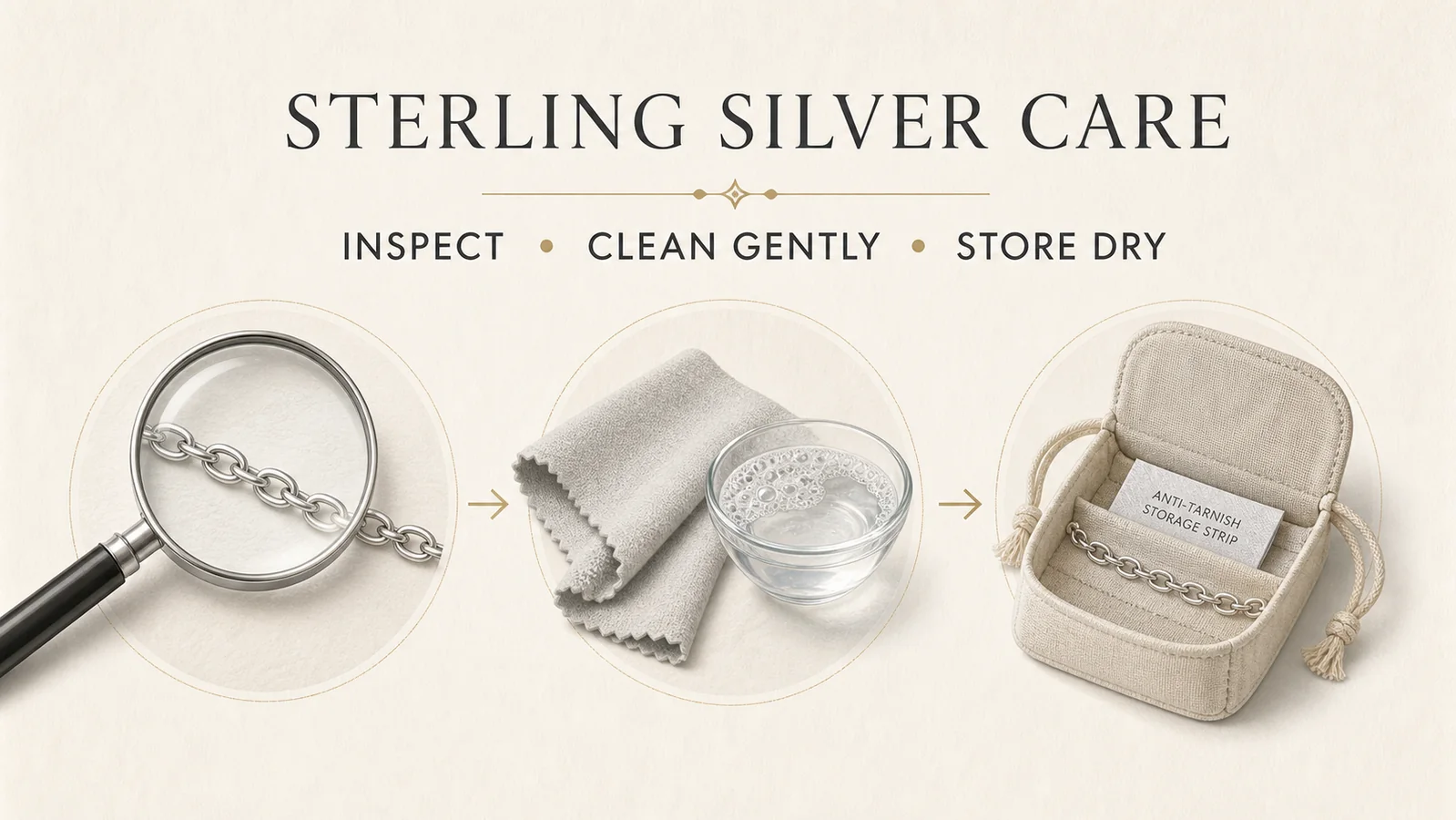
For most plain sterling silver bracelets, the lowest-risk routine is simple: inspect the piece first, wipe it after wear with a clean soft cloth, wash only when needed with lukewarm water and a small amount of mild detergent, rinse carefully, dry completely, and store it separately in a dry, low-sulfur enclosure. Light tarnish is a surface reaction, not proof that the silver is fake. However, every tarnish-removal method has a cost: polishing is abrasive, chemical dips can over-clean or pit silver, and electrochemical methods can leave a dull surface. Mixed-material bracelets, intentionally darkened details, plated surfaces, pearls, porous beads, adhesives and elastic cord need a more conservative plan.
If you are unsure whether a bracelet is solid sterling silver, plated, intentionally oxidized, hollow, repaired, or set with sensitive materials, stop before using a dip, abrasive paste, ultrasonic cleaner or boiling-water “hack.” A qualified jeweler or conservator can identify the construction and choose a treatment that does not erase finish, damage stringing material or loosen settings.
Research question and scope
This guide asks: What can a bracelet owner safely do at home to slow tarnish and remove ordinary soil without damaging the metal or the rest of the bracelet? It covers wearable sterling silver bracelets and silver components in beaded designs. Museum conservation guidance is used to explain mechanisms and risks, but an everyday bracelet is not a museum object. The practical routine below therefore translates conservative principles—inspect first, use the least aggressive method, and prevent re-tarnishing—into a home-care decision.
This article does not authenticate a particular bracelet, certify fineness, replace instructions supplied with a commercial cleaner, or prescribe treatment for antiques and valuable heritage objects. It also does not claim that wearing silver treats, prevents or improves any disease. Readers comparing styles can browse the sterling silver bracelet collection; material claims should still be checked on each individual product page.
Terms that change the care decision
- Sterling silver / 925 silver
- A silver alloy described at the 925 fineness level. In the United Kingdom’s statutory terminology, “sterling” corresponds to a standard of 925 parts per thousand silver. A “925” stamp is useful information, but a mark alone is not a laboratory test or a complete hallmark in every market.
- Fine silver
- A higher-fineness silver category, often described as 999. Higher fineness does not make a bracelet immune to surface change, nor does it tell you how clasps, solder, stringing or other components were made.
- Tarnish
- A surface corrosion layer. The Canadian Conservation Institute (CCI) explains that silver reacts with sulfur-containing gases and forms silver sulfide. Thin layers can appear yellow, blue or purple before becoming dark or black.
- Patina or intentional oxidation
- A deliberately darkened or visually aged surface used to emphasize texture and recesses. Aggressive polishing can remove the intended contrast and permanently change the design.
- Silver plate
- A thin silver layer over another material. Repeated abrasive cleaning can wear through that layer and expose the base metal.
For buying decisions, UK consumer-protection guidance explains that a recognized hallmark is intended to protect buyers by independently verifying precious-metal fineness, while the Hallmarking Act defines the legal use of terms including “sterling.” These rules vary by market, so do not treat every “925” mark as the same legal guarantee worldwide.
Why sterling silver tarnishes
Tarnish is not simply “dirt” sitting on the surface. According to CCI, sulfur-containing gases in the environment react with silver to form a silver-sulfide layer. Humidity can accelerate the process, and common storage materials may emit compounds that make control harder. Rubber, some paints, poor-quality paper and certain storage or display materials can be sulfur sources. This is why a bracelet may darken even while it is sitting unused.
The color is not a reliable purity test. A genuine silver alloy can tarnish, and a plated object can tarnish too. The speed and pattern depend on the alloy, surface finish, local environment, residues from wear and the way the piece was stored. Conversely, a bright surface does not prove that an item is solid sterling silver; it may be plated, coated or recently polished.
CCI also warns that each polishing cycle removes some surface material. On a solid everyday bracelet, occasional careful polishing may be acceptable, but the principle still matters: prevention is preferable to repeatedly stripping away tarnish. On plated, engraved or intentionally oxidized pieces, the visual and material cost can be much greater.
Step 1: inspect before you clean
Use good light and, if available, a magnifier. The goal is not to authenticate the bracelet at home; it is to identify reasons not to immerse, polish or apply chemicals.
- Read the product description and care card. Confirm whether the item is sterling, fine silver, plated, intentionally oxidized, lacquered or a mixed-material design.
- Check the construction. Look for loose links, stretched jump rings, cracked cord, lifting glue, hollow parts, repaired joins and moving stones.
- Identify non-metal components. Pearls, porous stones, wood, bone, dyed beads, fabric, leather and elastic may react differently from silver and may not tolerate soaking or silver cleaner.
- Locate deliberate dark areas. Recessed black or grey details may be part of the finish, not unwanted tarnish.
- Look for plating wear. A different metal color at edges or high points is a reason to avoid further abrasion and seek professional advice.
The decision is especially important for combined designs. For example, a freshwater pearl and 925 silver bracelet should not automatically be treated like a plain silver chain. A multi-component piece such as the multi-layer silver medal bead bracelet also has stringing and connection points that deserve inspection before moisture is introduced.
Step 2: use the least aggressive effective routine
After ordinary wear
- Remove the bracelet with clean, dry hands.
- Wipe the surface gently with a clean, non-scratch cloth. Do not grind visible dust against the metal.
- Check closures, knots, cord and settings before storing it.
- Let any moisture evaporate completely, then store the bracelet separately.
When plain, sound silver needs washing
- Place a towel over the work surface and close or cover the drain.
- Use lukewarm water with a very small amount of mild detergent. Avoid products containing bleach, ammonia, grit or unknown polishing additives.
- Clean gently with fingers or a very soft tool only where the design permits. Do not scrub fragile joints or intentional dark details.
- Rinse thoroughly so detergent does not remain in crevices.
- Blot and dry completely, including around clasps and between links. Trapped moisture is a reason to avoid immersion in the first place.
CCI’s museum guidance discusses distilled water and carefully selected detergents for appropriate silver objects. At home, the essential lesson is compatibility: an aqueous method is not suitable when attached organic material, adhesive, sealed hollow construction or fragile stringing can trap water or be damaged by it.
For light tarnish on compatible silver
Use a cloth or product specifically intended for silver and follow its label. Work slowly, with minimal pressure, and stop when the appearance is acceptable rather than chasing a uniformly mirror-bright finish. Do not polish across deliberate patina, gilding, plated high points or delicate adjacent materials. Black residue on a polishing cloth can occur during tarnish removal; it is not a signal to keep rubbing indefinitely.
Cleaning-method decision table
| Method | Reasonable use | Main limitation | Do not use without specific advice when |
|---|---|---|---|
| Dry soft cloth | Routine wipe after wear; loose fingerprints and light residue | Will not remove heavy tarnish | Loose settings, sharp broken parts or abrasive dust are present |
| Mild detergent and water | Sound, plain silver that can be fully rinsed and dried | Moisture can remain in joins or damage attached materials | The bracelet contains pearls, wood, bone, dyed/porous beads, adhesive, cord, leather or hollow sections |
| Silver polishing cloth/product | Controlled removal of light tarnish from compatible surfaces | Abrasive action removes surface material and may alter finish | The piece is plated, intentionally oxidized, engraved, coated or has delicate inlays |
| Chemical silver dip | Specialized use with full understanding of the construction and product instructions | Can over-clean, pit, discolor or become trapped; CCI recommends minimal exposure | The piece is composite, hollow, plated, repaired, intentionally darkened or cannot be rinsed completely |
| Aluminum/electrochemical method | A controlled conservation technique for compatible objects | CCI notes that it can leave rough particles and a dull, matte surface, and treated silver may tarnish faster | The bracelet has mixed materials, fragile construction, intentional patina or unknown finish |
| Ultrasonic cleaning | Only when a professional confirms every component is suitable | Vibration and solution compatibility vary by stone, adhesive, finish and construction | Any component is porous, glued, cracked, loose, treated or unidentified |
Why common “instant-clean” hacks deserve skepticism
Toothpaste is not a universal jewelry cleaner. Its abrasiveness and additives are not designed around an individual bracelet’s finish. A visible short-term shine does not prove that no metal or surface detail was removed.
Baking soda and aluminum foil are not automatically gentle. Electrochemical reduction can convert part of the tarnish rather than removing it by abrasion, but CCI reports practical limitations: the surface may become dull from rough particles, pitting can occur under unfavorable conditions, and the object must be rinsed thoroughly. A method suitable for a plain compatible object may be unsuitable for beads, pearls, cord, soldered hollows, coatings or deliberate oxidation.
Liquid dips trade control for speed. CCI explains that acidic, complexing dips dissolve tarnish faster than the underlying silver, yet can over-clean, pit the surface, damage other materials and become trapped inside hollow structures. “Faster” is therefore not the same as “safer.”
Boiling water adds unnecessary compatibility risk. Heat can affect adhesives, coatings, elastic and some stones. If the product maker has not approved heat and immersion, choose a lower-risk method.
Step 3: prevent tarnish with better storage
The most effective care routine is the one that reduces how often tarnish must be removed. CCI and museum guidance consistently prioritize a dry, clean, enclosed environment and control of sulfur-containing pollutants.
- Store the bracelet clean and fully dry. Residues and moisture left after wear or washing make future care harder.
- Separate pieces. Use individual, non-abrasive compartments or pouches so chains, beads and metal edges do not rub or tangle.
- Choose compatible storage materials. Avoid direct contact with rubber bands, sulfur-emitting materials, poor-quality paper and unknown treated fabrics.
- Limit air exchange where practical. A suitable sealed enclosure can reduce exposure to pollutants. Anti-tarnish materials may help, but they are consumable and should be replaced according to their instructions.
- Keep conditions stable and reasonably dry. Do not store fine jewelry in a steamy bathroom, direct sunlight, or an area with large temperature and humidity swings.
- Inspect periodically. Early light tarnish and a loose clasp are easier to address than heavy discoloration or a lost component.
A wearable bracelet is handled more often than a museum object, so clean cotton gloves are not a practical daily requirement. Still, the conservation finding is useful: skin oils and salts can leave marks, so a brief wipe after wear reduces residues before storage.
Care by bracelet construction
Plain sterling or fine-silver components
Start with a dry wipe. If the construction is sound and can be rinsed and dried completely, use mild detergent and lukewarm water when needed. Reserve polishing for visible tarnish rather than making it a calendar ritual.
Intentional oxidation or textured recesses
Clean raised surfaces conservatively and leave deliberate dark areas alone. A professional can help if you cannot distinguish design oxidation from unwanted tarnish.
Silver with pearls or porous beads
Do not assume a silver-safe solution is safe for every adjacent material. Work component by component, avoid soaking unless the maker specifically approves it, and protect stringing from unnecessary wetting. The same principle applies to the pearl, moonstone and 925 silver bracelet.
Silver beads on cord or elastic
Wipe metal locally and keep the cord as dry as practical. Inspect for fraying, loss of elasticity and movement at drilled bead edges. The 925 silver red-rope bead bracelet, for example, combines materials that should not automatically be immersed together.
Plated or unknown surfaces
Avoid repeated polishing. If an edge shows a different underlying color, abrasion may already have thinned the coating. Ask a professional whether cleaning, replating or leaving the surface as-is is the better choice.
When to stop and ask a professional
- A hallmark or material description is unclear and the result would change the cleaning method.
- The bracelet may be antique, plated, lacquered, intentionally oxidized or unusually valuable.
- There are loose stones, cracked beads, failing adhesive, frayed cord, open links or weak solder joints.
- Darkening returns unusually fast despite clean, dry storage.
- A dip or home remedy has left yellowing, pitting, a matte surface or residue in crevices.
- You want authentication or a fineness determination. Appearance, tarnish and a stamp are not conclusive tests by themselves.
If a sunMYLOVE item arrives with a material, construction or care question, use the contact page before experimenting. For purchase expectations, also review the current returns and refunds policy and delivery information.
A 60-second care checklist
- Is the bracelet solid silver, plated, intentionally oxidized or mixed-material?
- Are any links, settings, knots, cords or adhesives loose?
- Can every component safely get wet and be rinsed and dried completely?
- Will polishing erase a deliberate finish or wear through plating?
- Can a dry cloth solve the problem before you escalate?
- Is the storage enclosure clean, dry, non-abrasive and free of rubber or suspect paper?
- If uncertain, have you stopped before using heat, dips, abrasives or ultrasonic cleaning?
Common mistakes
- Treating tarnish as proof of poor quality. Tarnish is a surface reaction and must be interpreted with the alloy, finish and environment.
- Cleaning every bracelet as if it were plain silver. The least tolerant component controls the method.
- Polishing on a schedule. Clean because the condition requires it, not simply because a date arrived.
- Using more pressure when progress slows. Extra force increases abrasion and may flatten texture or expose plating.
- Putting a damp bracelet away. Drying includes hidden areas around clasps, beads and joins.
- Storing jewelry in one pile. Rubbing, tangling and transferred residues create avoidable damage.
- Assuming a viral before-and-after proves long-term safety. A bright photo does not show removed metal, altered patina, trapped chemicals or future re-tarnishing.
Frequently asked questions
Does real sterling silver tarnish?
Yes. Silver reacts with sulfur-containing gases and develops a silver-sulfide surface layer. Tarnish alone does not prove an item is fake or genuine.
Is a 925 stamp enough to authenticate a bracelet?
No. It is a claimed fineness mark, not a complete authentication by itself. Legal hallmark systems, seller disclosures and professional testing provide different levels of assurance depending on the market.
Can I wear sterling silver in the shower?
Water is only one variable. Soaps, residues, water chemistry and—most importantly—pearls, stones, cord, elastic, coatings, adhesives and hollow parts can change the answer. Removing the bracelet avoids unnecessary exposure when its full construction is unknown.
Can I use toothpaste to clean sterling silver?
It is not a controlled universal method. Abrasiveness and additives vary, and rubbing can alter polish, texture, plating or intentional darkening. A product made specifically for compatible silver is more predictable.
Is the aluminum-foil method safe?
Not for every bracelet. CCI describes electrochemical reduction as a real method but also records risks and after-effects, including dull rough particles, potential pitting and the need for thorough rinsing. Avoid it for composite or unknown pieces unless a professional confirms compatibility.
How often should I polish a silver bracelet?
There is no universal timetable. Wipe after wear and prevent tarnish through storage. Polish only when tarnish justifies it and when the surface and construction are compatible.
What is the safest way to store a sterling silver bracelet?
Store it clean, completely dry, separated from other pieces, in a suitable low-abrasion enclosure that limits pollutants and moisture. Keep rubber and suspect sulfur-emitting materials away from direct contact.
When should I use professional cleaning?
Choose professional help for antiques, plating, deliberate patina, valuable pieces, loose settings, mixed or unidentified materials, failed home treatments, or whenever the construction cannot be inspected confidently.
How this guide was prepared
sunMYLOVE reviewed government consumer-protection and hallmarking guidance together with preventive-conservation publications from national cultural institutions. We prioritized sources that explain why silver tarnishes, what cleaning methods physically or chemically do, and where those methods fail. Commercial jewelry-care pages and community discussions were used only to understand common search questions; they were not treated as primary evidence for the technical recommendations.
The recommendations are intentionally conservative. Museum publications deal with historically significant objects and therefore set a higher preservation threshold than many owners need for daily jewelry. We use those sources to identify mechanism and risk, then state separately what is a reasonable home-care inference. No source reviewed establishes a medical benefit from wearing silver.
References and evidence scope
- Canadian Conservation Institute — Silver: Care and Tarnish Removal. Supports tarnish mechanism, pre-cleaning examination, polishing, dip and electrochemical-method limitations, and storage principles.
- Canadian Conservation Institute — Understanding How Silver Objects Tarnish. Supports sulfur-gas and humidity effects and the priority of prevention over repeated polishing.
- Canadian Conservation Institute — Caring for Metal Objects. Supports storage enclosures, pollutant control, abrasion risk and monitoring.
- U.S. National Park Service — Conserve O Gram 10/2: Caring for Silver and Copper Alloy Objects. Supports preventive care and least-aggressive-treatment principles.
- UK Government / British Hallmarking Council — Hallmarking in the UK: Consumer Protection. Supports the buyer-protection purpose of independently verified precious-metal fineness.
- UK Government / British Hallmarking Council — Hallmarking Practical Guidance. Supports the difference between fineness descriptions and a legally recognized full hallmark in the UK.
- The Metropolitan Museum of Art — The Care and Handling of Art Objects. Supports pollutant-control and storage-material considerations for silver.
Evidence boundary: These sources support silver-tarnish chemistry, broad care risks, consumer-description principles and conservative storage practices. They do not prove the metal composition of any pictured or listed product, guarantee a specific cleaner’s compatibility, or establish clinical effects from wearing silver. Product-specific treatment must follow the actual item’s materials, finish and construction.
Leave a Comment