
Can Sterling Silver Go in a Pool? Chlorine, Bleach and Care
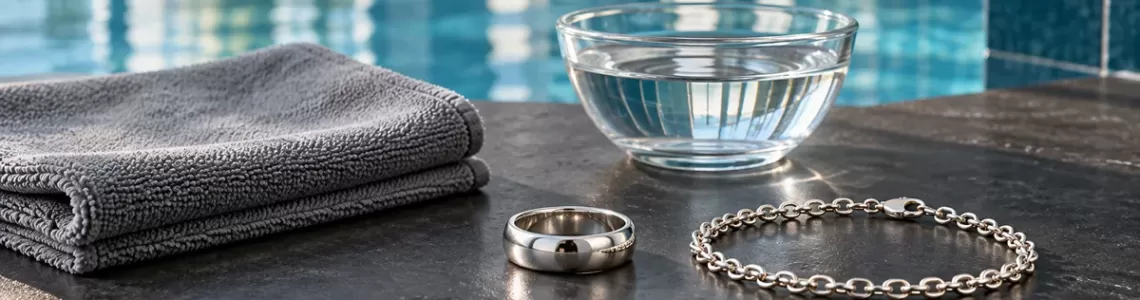
Quick answer: take sterling-silver jewelry off before entering a chlorinated swimming pool. Professional jewelry-care guidance treats pool chemicals as an avoidable risk to silver, solder, clasps, coatings and some gemstones. One accidental swim does not prove that an item is ruined, and maintained pool water is not the same exposure as concentrated household bleach. If silver jewelry has been in a pool, rinse it with clean lukewarm water, dry it thoroughly with a soft cloth, and inspect it before wearing or cleaning it further. Do not use bleach or mix cleaning chemicals to "neutralize" the exposure.
This guide answers a practical care question without turning it into a universal damage claim. The outcome depends on the finished item's construction, exposure time, pool chemistry, previous wear and the presence of stones, solder, plating, oxidized details, adhesives or non-silver findings. It does not authenticate a piece, promise restoration or replace a jeweler's inspection.
Why the safest answer is to remove sterling silver before swimming
The Gemological Institute of America advises removing fine jewelry before entering a chlorinated pool or using household cleaners. Its care guidance notes that chemicals can damage or discolor precious metals and some gems. The Sheffield Assay Office also recommends removing jewelry for swimming, bathing and housework as part of sensible tarnish and damage prevention.
That recommendation is stronger and more useful than trying to predict the exact result of a single swim. A ring that looks unchanged immediately after leaving the pool has not supplied a laboratory result for its silver, solder, plating or setting. A visibly darkened piece has not, by appearance alone, identified the exact reaction. Prevention avoids both uncertainties.
Sterling silver is normally described by fineness: 925 parts silver per thousand, with the remaining fraction used to improve practical properties. Copper is a common alloying metal, but a finished item may also contain solder, a clasp spring, pins, coatings, stones or other components. The silver hallmark guide explains why a 925 mark is useful but does not describe every component in an assembled design.
This component-by-component view matters around pool water. A sterling body can respond differently from a solder joint, spring, rhodium layer, deliberately oxidized recess or stone setting. Removing the whole item is simpler than assuming the most visible silver surface represents every hidden part.
Does chlorine damage sterling silver?
"Chlorine" is often used as a broad label for several different exposures. A maintained swimming pool contains a managed disinfectant system in a large body of water. Household chlorine bleach is typically a sodium-hypochlorite solution used for cleaning and disinfection. The Canadian Centre for Occupational Health and Safety describes household bleach as corrosive and capable of corroding metals. The CDC likewise identifies sodium hypochlorite as the active ingredient in many bleach products and emphasizes that bleach must not be mixed with other cleaners or disinfectants.
Those facts support caution, but they do not justify saying that a brief dip in a maintained pool is chemically identical to soaking jewelry in household bleach. Concentration, pH, temperature, contact time, replenishment, contamination and the construction of the item all differ. This guide therefore uses a prevention rule rather than a fictional universal threshold: do not deliberately wear sterling silver in a chlorinated pool, and do not clean silver with household bleach.
Silver chemistry also extends beyond the visible word "chlorine." Canadian Conservation Institute guidance for metal collections notes that chloride contamination, including sodium chloride left by fingerprints, can react with silver. Sheffield Assay Office explains that sulfur-containing compounds are a common driver of familiar silver tarnish and also discusses chloride-related silver compounds. Different agents and reaction products can produce different surface changes, so color alone cannot identify the entire mechanism.
The useful buyer conclusion is modest: chlorine- and chloride-containing environments are not a care benefit for silver jewelry. Avoiding them is low-cost and reversible; testing their effect on a valued item is not.
Pool water, household bleach and saltwater are not one category
- Maintained pool water
- A large, treated water system whose chemistry changes with maintenance, use and conditions. It is still an avoidable exposure for jewelry, but it should not be described as a bottle of household bleach.
- Household chlorine bleach
- A sodium-hypochlorite cleaning product that can be corrosive to metals. It is not a silver cleaner. Never mix it with acids, ammonia or other cleaners, even in an attempt to repair discoloration.
- Saltwater
- A chloride-rich environment that can leave deposits in links, clasps and settings. Seawater also carries sand and other material that may add abrasion. Rinse and dry after accidental exposure rather than assuming "natural" water is harmless.
- Fresh tap water
- Brief rinsing with clean lukewarm water is a conservative first response after pool exposure. That does not make prolonged soaking suitable for every stone, adhesive, cord or mixed-material construction.
A broad article titled "Can silver get wet?" can hide these distinctions. Water is a carrier; what is dissolved in it and what the jewelry is made from determine the care question. The same distinction appears in mixed-material cleaning: the safest method must suit the least tolerant component, not merely the metal named in the product title.
What can happen to silver jewelry in a pool?
Possible outcomes range from no immediately visible change to discoloration, loss of surface brightness, uneven finish or a problem concentrated around a joint, clasp or setting. A plated or coated surface can behave differently from unplated sterling. Deliberately oxidized details can be altered by an aggressive cleaning response even if the original pool exposure was limited.
The oxidized silver versus tarnish guide explains why a dark recess may be an intentional design finish rather than dirt to remove. Do not respond to pool exposure by polishing every dark area until it is bright. That can erase contrast that was part of the design.
Plating adds another boundary. Rhodium or another surface layer may change appearance and maintenance needs, but it is not permanent merely because it looks intact when new. Read the rhodium-plated silver buyer guide before selecting a polish or assuming the visible surface is bare sterling.
Stone-set jewelry deserves extra restraint. Pool chemicals may not be the only concern: heat, impact, abrasion, porous gems, treated gems, adhesives and trapped residue can matter. GIA advises using care methods appropriate to the specific gem and setting. If the product's construction is unknown, clean-water rinsing and a soft dry cloth are safer first steps than an improvised chemical treatment.
What to do if you accidentally wore silver in a pool
1. Remove the item when it is safe to do so. Do not handle jewelry in a way that creates a swimming hazard or risks losing it. Once out of the water, take it off over a stable surface.
2. Rinse with clean lukewarm water. The goal is to remove residual pool water, not to begin a long soak. Avoid very hot water, pressure jets and an unverified detergent when stones, coatings, adhesives, cord or mixed components are present.
3. Dry thoroughly. Blot with a clean, soft, lint-free cloth. Give water time to leave links, recesses, clasps and settings. Do not use high heat, a hair dryer or direct prolonged sunlight as a shortcut.
4. Inspect before polishing. Look for an uneven color change, dull patches, lifting coating, a loose stone, changed prongs, stiffness in a clasp or residue in crevices. Photograph the condition in neutral light if a warranty or seller question may follow.
5. Use only construction-compatible care. A plain uncoated sterling item and a plated, oxidized or stone-set item do not necessarily share a cleaning method. The mixed-material bracelet cleaning guide shows how to identify the most sensitive component first.
6. Stop if the item changed or feels insecure. A qualified jeweler can inspect a valuable item or a setting that appears loose. Avoid repeated experiments that remove surface material or make the original condition harder to document.
What not to do after chlorine exposure
- Do not soak the item in household bleach.
- Do not mix bleach with vinegar, acids, ammonia or another cleaner.
- Do not use a harsh abrasive, toothpaste or scouring pad.
- Do not assume baking soda, foil or another home remedy is compatible with plating, oxidized details or stones.
- Do not put an unknown assembled item into an ultrasonic cleaner merely because the main metal is silver.
- Do not continue wearing a piece with a loose stone, weakened clasp, sharp edge or active skin irritation.
The CDC and CCOHS safety guidance is especially clear on one point: bleach should not be mixed with other cleaners. A jewelry problem is never a reason to create a hazardous gas or corrosive mixture. If someone else has already applied an unknown chemical, ventilate the area, avoid adding anything, follow the product safety label and seek appropriate poison-control or emergency advice if exposure symptoms occur.
Ultrasonic cleaning is also not a universal reset button. Cavitation can be unsuitable for some gems, treatments, adhesives and weakened settings. Use the ultrasonic compatibility checklist before considering that method, and defer to a qualified jeweler when the construction is uncertain.
Does a 925 stamp make pool exposure safe?
No. A 925 mark is a silver-fineness representation, not a pool-resistance rating. It does not describe the exact pool, exposure time, solder, clasp spring, plating, deliberate oxidation, gemstones or care history. It also does not guarantee that an item sold as silver has been independently assayed under a particular hallmarking system.
If material identity is uncertain, avoid using a pool exposure as an informal test. The silver magnet test guide makes the same evidence point: one screening observation can flag a component, but it cannot prove 925 fineness or describe every layer. Keep the product description, photographs, invoice and any hallmark image if a discrepancy needs investigation.
How to plan jewelry around swimming
The simplest routine is to leave valuable jewelry in secure storage before going to the pool. Do not place a ring or bracelet loose on a towel, pool edge, locker-room bench or vehicle dashboard. Use a closed, dry container with separate soft compartments, and avoid sealing damp jewelry into a plastic bag for a long period.
Apply sunscreen and personal-care products before handling jewelry, allow them to settle as directed, and put jewelry on after swimming only when skin and the item are clean and dry. This reduces residue around links and settings without claiming that any routine eliminates all tarnish or wear.
When shopping the current sterling and fine silver bracelet collection, read each live product page independently. Check whether the selected design is plain sterling, plated, deliberately oxidized, stone-set or mixed with other materials. Do not transfer a construction or care statement from one design to another. If swimming is central to how an item will be worn, plan to remove and store it rather than asking the jewelry to serve as pool equipment.
When professional inspection is sensible
Ask a qualified jeweler to inspect the item if a stone moves, a prong changed, a clasp no longer closes normally, a coating appears to lift, discoloration is sharply localized at a joint, or the piece has financial or sentimental value that makes experimentation inappropriate. Bring the product description and explain the exposure accurately: pool water, approximate duration, any rinsing, and every cleaner already used.
An inspection can answer practical condition questions, but it should not be described as laboratory proof of the pool chemistry or alloy composition unless the jeweler performs or commissions the relevant analysis. Surface cleaning, precious-metal assay and failure analysis are different services.
FAQ
Can I wear a 925 silver ring in a swimming pool?
The preventive answer is no: remove it before entering a chlorinated pool. A 925 mark describes silver fineness, not resistance to pool chemicals or the behavior of every solder, coating, stone and finding.
Will one swim ruin sterling silver?
Not necessarily. One exposure does not prove permanent damage, but the absence of an immediate visible change is not proof that every component was unaffected. Rinse, dry and inspect the item, then use construction-specific care.
Is pool chlorine the same as household bleach?
No. Both can involve chlorine chemistry, but a maintained pool and a household sodium-hypochlorite cleaning product differ in concentration, formulation, pH and exposure conditions. Neither should be treated as a silver-cleaning method.
What should I do immediately after swimming with silver jewelry?
Rinse it with clean lukewarm water, blot it dry with a soft lint-free cloth, allow crevices to dry, and inspect the clasp, finish and settings. Do not add bleach, acid, ammonia or an unverified home remedy.
Can I use a silver dip after pool exposure?
Only if the manufacturer and the item's construction support it. Dips may be unsuitable for plated, oxidized, stone-set, adhesive-bonded or mixed-material pieces. When uncertain, stop after rinsing and drying and ask a jeweler.
Can sterling silver go in a saltwater pool?
Removal is still the safer choice. A saltwater pool is a treated pool system and can expose jewelry to chlorides and disinfectant conditions. Do not assume the word "saltwater" makes it jewelry-safe.
Should I polish a dark area immediately?
No. First determine whether the dark area is new tarnish, residue, an intentional oxidized finish, a plating change or a localized joint issue. Aggressive polishing can remove designed contrast or surface layers.
References
- Gemological Institute of America: Tips on Caring for Jewelry
- Canadian Conservation Institute: Care of Silver
- Canadian Conservation Institute: Metal Objects
- U.S. CDC: Cleaning and Disinfecting with Bleach
- Canadian Centre for Occupational Health and Safety: Bleach
- Sheffield Assay Office: Why Does Silver Tarnish?
Leave a Comment