
Answer first. An obsidian bracelet is described as containing beads made from natural volcanic glass. That name is a geological material claim, not something a dark color, glossy photograph, or golden flash can establish on its own. Obsidian forms when suitable lava cools rapidly enough that large crystals do not grow, as the U.S. Geological Survey explains for Yellowstone lava flows. A buyer should compare the exact listing with that definition, ask what is known about the beads and any treatments, inspect the assembly and return terms, and avoid destructive home authenticity tests. This guide does not certify any sunMYLOVE bead.
The research question is practical: when a bracelet is listed as black or golden obsidian, what can a buyer reasonably infer from the name and photographs, and what must be checked before purchase? The scope is ordinary finished bead jewelry, mainly black and sheen-type obsidian listings. It does not determine geological origin, laboratory identity, chemical composition, provenance, treatment, strength of cord, alloy of a spacer, or human health effects for any individual product. The editorial examples below link to real product pages; the links are not independent tests of those products.
Obsidian bracelet vs glass: the distinction starts with origin, not gloss
“Glass” describes a noncrystalline solid, not automatically a factory-made fake. Natural obsidian is a volcanic glass. The U.S. National Park Service describes obsidian as rapidly cooled volcanic glass, historically selected for toolmaking because of the way it fractures. The USGS describes the rapid cooling and viscous, often silica-rich melt that keep prominent crystals from growing in Yellowstone obsidian. Thus “obsidian is glass” and “obsidian can be natural” are compatible statements. Calling all glass beads obsidian would be a different, unsupported leap.
Manufactured glass is also a useful and legitimate jewelry material when represented honestly. GIA notes that manufactured glass has long been used to imitate gems and can be produced with varied color and appearance. It is therefore misleading to use shine alone as an origin test. The key buyer distinction is which material is being claimed, not whether the item is beautiful, affordable or worth wearing. A glass-bead bracelet described as glass should be evaluated on its actual design and assembly. A bracelet described as natural obsidian makes an additional origin claim that a product photo cannot settle.
The distinction also helps avoid a second confusion with “lava stone.” Some commercial lava-rock beads are porous and matte; obsidian is glassy volcanic material. Their shared volcanic association does not mean they have identical textures, cleaning needs or formation histories. Our volcanic-stone and lava-rock buyer guide takes the porous-bead question further, while the glass-bead guide addresses coatings and color claims. This article stays with the narrower obsidian-versus-lookalike decision.
What gold sheen can—and cannot—tell you
Some natural obsidian has a gold or silver sheen. A GIA review of optical effects describes sheen-type obsidian and reflections associated with aligned internal features, while explicitly noting limits in research on the precise mechanisms for these volcanic glasses. A separate GIA report on fire obsidian illustrates that natural obsidian can show striking optical variation. Neither source provides a rule that every golden-looking bead is natural obsidian, or that a particular shade proves a deposit, grade, durability or treatment status.
Photos are especially limited here. Directional lighting, camera exposure, background color and display settings can increase or suppress a subtle flash. Curved bead surfaces do not present the same optical window as a polished cabochon in a gemological study. Ask for an unfiltered image in ordinary diffuse light and, if possible, a short video turning the actual beads under one fixed light. Even then, the result is a better appearance record, not a scientific identification. Our guide to online jewelry color differences explains why screenshots and screens cannot be treated as color measurements.
For example, a shopper can compare the pictured design of the listed golden obsidian multi-strand bracelet with the listed black obsidian and brass 12 mm bracelet. These are actual catalog destinations, not specimens assessed in this article. The difference in presentation and strand count may affect fit and selection; it does not establish that either listing's geology, exact bead treatment, spacer alloy or remaining cord life was independently verified.
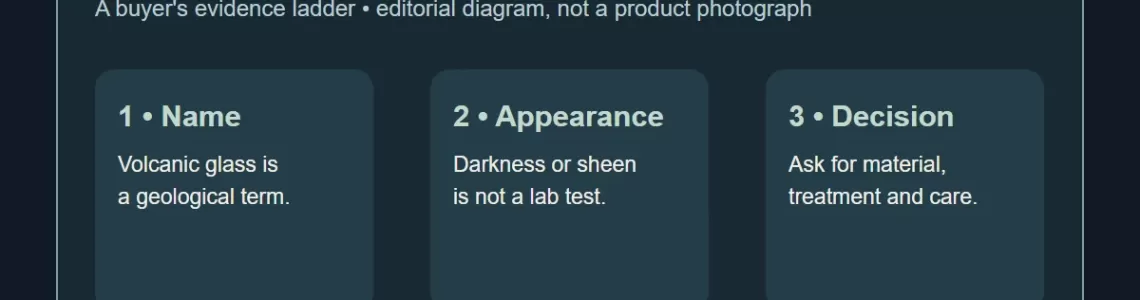
A buyer's evidence ladder
It helps to rank clues by what they can legitimately show. The table is an editorial framework derived from the geological, gemological and consumer sources above, not a validated scoring system or a substitute for a gem laboratory. It deliberately resists the common temptation to turn a photograph into a certificate.
| Evidence | What it may help with | What it does not establish | Next step |
|---|---|---|---|
| Dark glossy bead in a listing | General appearance and styling | Natural volcanic origin, treatment, source or stability | Ask for precise material wording |
| Golden flash under light | Whether the pictured look appeals to you | A natural sheen mechanism in that exact bead | Request consistent-light images, not a diagnosis |
| Seller's written material and treatment description | What the seller represents and what to keep on record | Independent laboratory proof by itself | Clarify ambiguity before payment |
| Clear size, strand, closure and care information | Fit and practical use decisions | Unmeasured tensile life, allergen absence or indestructibility | Compare the actual product's construction |
| Relevant independent gem-lab finding, if offered | Specific questions the report actually examined | Unreported findings or every other bead in a strand | Read its scope and specimen identity |
This hierarchy matters because FTC consumer guidance recommends understanding gemstone terms, asking about treatments, and keeping material and care statements in sales paperwork. It is consumer advice, not a finding that any linked product was misrepresented. If a seller cannot answer a particular question, mark that characteristic unknown and decide whether uncertainty is acceptable for the price and intended use.
Five non-destructive questions before buying
First, what exactly is being represented? Ask whether “obsidian” refers to every black bead, selected accent beads, or a visual style. A mixed-material bracelet can contain wood, brass and stone in separate positions. A name in the product title is a starting point, not a complete bill of materials. The listed ebony-and-obsidian bracelet is a useful example of why each component should be considered separately; this guide does not certify which listed component is what.
Second, is there a disclosed treatment or coating? Ask whether color, sheen or finish reflects natural material, applied surface treatment, or another process, and what special care the seller advises. The FTC's gemstone buying guidance explains that some treatments change appearance and may create special-care or value implications. Its discussion spans gems generally; it does not imply that all obsidian beads are treated. A negative answer from a seller should be recorded as a representation, not converted into a laboratory finding.
Third, what is the structure? Count the strands and compare the stated bead size with a ruler or an existing bracelet. Ask how the piece closes, whether the cord is elastic or fixed, what the metal accents are described as, and whether replacement cord service is offered. Larger beads and multi-strand forms can change how a bracelet feels and fits, but one cannot calculate durability from a photo. The bead construction guide explains how drilled holes, knots and cord are separate failure points. For a double-wrap design, use the double-wrap fit guide instead of assuming that two turns equal two standard bracelet lengths.
Fourth, what do the actual images show? Look for close views of bead edges, drill holes, closure and the back of any accent. Imperfections do not automatically prove natural origin, and a remarkably uniform batch does not prove manufacture. A photo can document visible condition, not microscopic inclusions, chemistry or origin. Do not ask a seller to deliberately chip a bead to demonstrate the curved fracture described by NPS: that damages merchandise and is a poor consumer authenticity method.
Fifth, what happens if it does not match the description? Save the listing language, material and treatment answers, dimensions, delivery promise and order documentation. Read the site's returns and refunds information before purchase. This is a decision-risk check, not a claim about refund eligibility in a specific jurisdiction. If evidence is inadequate for an expensive origin-dependent purchase, a gemologist's examination may be more appropriate than a home test or an online guess.
Care decisions for a finished obsidian bracelet
Obsidian's glassy structure does not make a finished bracelet a single uniform object. The jewelry may also include cord, knots, brass accents, wood, finishes or adhesive. The Canadian Conservation Institute notes that glass is hard yet brittle and can crack or break under impact. Its page concerns museum objects, not tested consumer bead bracelets. A prudent extrapolation is to avoid dropping beads onto hard surfaces and to separate pieces that can strike one another in storage. It does not justify a numeric “safe drop height” or a guarantee of damage prevention.
Before cleaning, identify the least tolerant component. If a piece is mixed with wood or a cord of unknown composition, do not assume a water-based procedure for an undecorated glass artifact applies to the whole bracelet. After normal wear, a clean dry soft cloth and careful inspection are a conservative starting point; ask the seller for model-specific instructions if there is residue, a coating, a loose bead or an unknown treatment. Do not use strong solvents, abrasives, heat, ultrasonic cleaning or deliberate immersion to test origin. Those methods may damage non-glass components even if an isolated mineral sample behaves differently. The CCI source is a preservation reference, not a universal recipe for wearable jewelry.
Inspect a chipped bead or rough drill-hole edge without rubbing it against skin. NPS discusses how obsidian fractures when deliberately worked as a tool stone. That fact is not proof that intact polished beads are dangerous in everyday wear, and it is not a medical hazard assessment. It does, however, explain why a visibly broken bead deserves careful handling and replacement advice rather than a casual “glass is tough enough” assumption. If cord, knot or closure looks worn, stop wearing until a competent repair can be assessed; the appearance cannot reveal the remaining strength.
Store the bracelet so the beads do not collide with hard clasps or other stones and so the cord is not stretched around a tight object. Dry a damp piece before enclosing it, subject to the seller's material-specific care advice. This risk-reduction recommendation follows general handling logic and the CCI impact cautions; it is not a controlled study of pouches or a promised lifespan. For travelers, our bracelet travel guide covers luggage and itinerary decisions without treating obsidian as uniquely travel-proof.
Common buying mistakes and the counter-evidence
“Natural means crystalline stone.” The USGS and NPS directly contradict that: obsidian is naturally occurring glass. A buyer who rejects every glass-like appearance as fake could miss the geological definition. Conversely, saying “it looks like glass” cannot resolve whether it is naturally formed or manufactured. The same visible word describes a structural state in one sentence and an industrial production route in another.
“Golden sheen verifies gold content.” GIA's optical-effects review discusses a sheen appearance, not precious-metal content. “Gold sheen” is a visual label; do not infer gold metal, a specific source deposit or rarity from it. A brass accent beside a bead is yet another component and should be evaluated by its own description. In particular, a whole-bracelet material claim must not be extrapolated from one photographed bead.
“An online trick proves authenticity.” Scratch, burn, hot-needle and drop tests can destroy an item and may not distinguish natural volcanic glass from manufactured glass. No cited authority endorses those consumer tests for finished obsidian bracelets. A photo-based AI guess is likewise not independent verification. Prefer a written seller answer and, where origin is materially important, a qualified gemological examination that actually states what it examined.
“Hardness equals whole-bracelet toughness.” Glassy beads can chip, while cords, knots and hardware can fail for unrelated reasons. Our hardness and toughness guide separates scratch resistance from breakage and assembly risk. The CCI's museum handling guidance supports caution around impact but cannot predict the failure rate of a particular 12 mm strand. Do not translate a gem reference property into a warranty.
“Obsidian protects health or changes mood.” Traditional or personal symbolic use may matter to a wearer, but the geological and consumer sources in this article provide no sufficient human evidence that an obsidian bracelet treats, prevents or improves disease, circulation, sleep, anxiety, immunity or pain. “Protection” in a motif or personal belief is not clinical protection. Choose a design for its documented materials, fit and visual appeal rather than a medical promise.
Frequently asked questions
Is obsidian a stone or glass?
It is naturally formed volcanic glass, usually discussed as a geological material. USGS and NPS describe rapid cooling and glassy structure. “Glass” by itself does not mean manufactured, and a vendor's use of “stone” is not a mineral classification. USGS geological explanation.
Can a photo prove a bracelet is natural obsidian?
No. A photo can show visible appearance, size cues and construction details, but it cannot independently establish geological origin or treatment. GIA notes how manufactured glass can imitate other gems; for an origin-dependent decision seek explicit seller documentation or fit-for-purpose examination. GIA imitation reference.
Is a gold sheen always natural or valuable?
No universal conclusion follows. GIA describes natural obsidian with sheen effects, but does not say that every shiny golden bead has that origin, is rare, contains gold, or deserves a particular price. Examine actual listing details and photographic conditions. GIA optical-effects review.
Are black obsidian and porous lava-rock beads the same?
No. Both labels may refer to volcanic contexts, but the USGS definition of obsidian involves natural glass; a porous lava bead may have a different texture and construction. Read each listing and our lava-rock buyer guide rather than merging the terms.
Should I test a bead by scratching or breaking it?
No. Such a test damages finished jewelry and would not be an adequate origin certificate. NPS discusses fracture as a geological and toolmaking feature, not an at-home verification method for a purchased bracelet. NPS context.
Can I soak an obsidian-and-brass bracelet to clean it?
Do not assume that an isolated-glass cleaning method is safe for an assembled bracelet with potentially unknown cord, finish, spacer or treatment. Start with the seller's precise care guidance and gentle dry handling; consult a professional about damaged pieces. CCI preservation scope.
Does obsidian jewelry have proven medical benefits?
There is not enough reliable human evidence in the sources reviewed to claim disease treatment, prevention or improvement. Geological formation, optical sheen and personal symbolism must not be presented as clinical results.
Method, references and evidence scope
sunMYLOVE compared catalog listings and existing article intents, reviewed the seven primary institutional or government sources below on 2026-09-14, and constructed a decision framework separating facts, reasonable inferences, organization advice, preference and unknowns. Each source must remain accessible in the prepublication link audit. No named product was laboratory examined; no sales, reviews, search volume, biological result, manufacturing process or treatment status was independently measured. U.S. FTC advice is jurisdiction-specific; Canadian museum guidance is not a consumer laboratory trial. GIA's discussion of sheen is not a certificate of our inventory. Last reviewed: 2026-09-14.
- USGS, Yellowstone's tool-making lava flows: formation, texture and absence of large crystals in a specific geological setting.
- U.S. National Park Service, Obsidian: The MVP of Yellowstone's Stones: natural glass and archaeological fracture context.
- GIA Gems & Gemology, Structures Behind the Spectacle: sheen mechanisms and research limits.
- GIA, An Introduction to Imitation Diamonds & Other Gems: manufactured glass as an imitation material.
- U.S. FTC, Buying Gemstones, Diamonds, and Pearls: treatment questions, terminology and written records.
- Canadian Conservation Institute, Caring for Ceramic and Glass Objects: impact and museum-handling cautions.
- GIA Gems & Gemology, Fire Obsidian's Beguiling Spectrum: a documented natural appearance example, not a universal identification rule.
sunMYLOVE editorial note: The linked catalog pages are live shopping examples, not authenticated research specimens. Select by written description, size, assembly, care and your own visual preference; mark unknowns as unknown. No medical effect or guaranteed durability is claimed.
Leave a Comment