
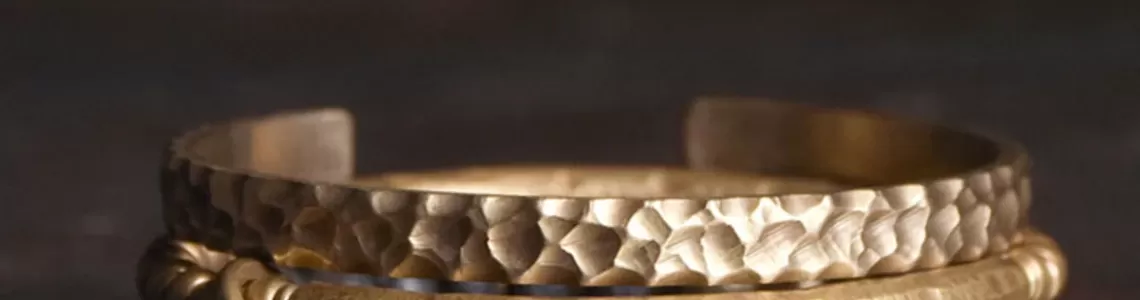
Answer first: a “volcanic stone bracelet” should be bought as a bracelet made with a seller-described volcanic rock, not as proof that every porous black bead is natural lava, scoria or basalt. Vesicles—the small cavities commonly seen in lava-rock beads—are consistent with gas bubbles trapped as volcanic material cooled, but a photograph cannot establish geological identity, treatment, origin or durability. Before buying, check the exact material wording, whether the beads are dyed or coated, the condition of drill holes and cord, fit, water and oil limits, and the return policy. Volcanic beads can be attractive and lightweight; they are not proven to detoxify, improve circulation, deliver minerals or provide medical treatment.
This research-based guide is for shoppers comparing sunMYLOVE’s Triple-Strand Volcanic Stone & Brass Bracelet and Volcanic Stone & Brass Texture Bracelet with other designs in the beaded-bracelet collection. It explains what geology sources support, where retail terminology becomes uncertain, and how to make a practical bracelet decision. It does not authenticate either product from photographs, verify a quarry or volcano of origin, test coatings, or replace the current product listing.
Research question and evidence scope
The research question is narrow: what can an online buyer responsibly infer from the words “volcanic stone,” the visible pores in a bead, and the bracelet’s construction? Geological authorities can define basalt, scoria, pumice and vesicles. Consumer-protection guidance can explain why material and treatment descriptions should be accurate. Neither kind of source can certify a finished commercial bead without direct examination and, where necessary, laboratory analysis.
The U.S. Geological Survey describes vesicles as small holes left after lava cools, while the National Park Service’s igneous-rock guide explains that vesicular texture records cavities formed by expanding gas. The Smithsonian’s vesicle overview similarly explains that pressure release allows dissolved gases to form bubbles and that rapid cooling can preserve a porous rock. These sources support the geological definition. They do not prove that a bead with holes is mined volcanic rock rather than manufactured glass, ceramic, resin, slag or another porous material.
Candidate topics and six-round selection
Today’s candidate pool contained: volcanic stone bracelet buyer checks; elastic cord wear and replacement; brass-bead edge and snag inspection; multi-strand bracelet fit; ebony-and-brass pendant weight; 990 silver bead construction; green Bodhi root storage; and aquatic agate trade-name boundaries. Volcanic stone won because two live products support the exact commercial task, the target intent does not duplicate the existing obsidian-authentication article, and at least five directly relevant authority sources are available.
The topic passed six filters. Product relevance is direct. Search demand is supported by an existing validated product keyword map, but current GSC query volume for this exact article intent is unavailable and is therefore UNKNOWN. Cannibalization is controlled by focusing on porous volcanic-rock terminology and bracelet construction rather than repeating the site’s obsidian, gemstone hardness or general treatment guides. Evidence is available from USGS, NPS, Smithsonian, Virginia Tech and FTC sources. Counterevidence is explicit: pores are not authentication, black color is not identity, and a retail name may be broader than a geological name. Commercial value is clear because the guide links two products, the beaded-bracelet category, two relevant guides and buyer-policy pages.
Key terms: volcanic stone, basalt, scoria, pumice and obsidian
| Term | Evidence-safe meaning | What the term alone does not prove |
|---|---|---|
| Volcanic stone | A broad retail phrase suggesting material associated with volcanic rock. | A precise rock type, volcano, country, treatment state or laboratory identity. |
| Basalt | A common, usually dark, mafic volcanic rock. Some basalt is vesicular. | That every dark volcanic bead is basalt or that every basalt bead is porous. |
| Scoria | A dark, highly vesicular volcanic ejecta, commonly basaltic or andesitic. | That a polished bead can be identified as scoria from a marketing photo. |
| Pumice | A highly vesicular, usually light-colored volcanic rock with thin cavity walls and low density. | That “lava rock,” pumice and scoria are interchangeable names. |
| Vesicle | A cavity formed when gas bubbles are trapped during cooling or solidification. | Natural origin by itself; manufactured materials can also contain bubbles or pores. |
| Obsidian | Volcanic glass, generally dense and glassy rather than the typical open-pored bead sold as lava rock. See the separate obsidian identification guide. | That every glossy black bead is obsidian. |
The distinctions matter because product care and buyer expectations follow the material. The NPS guide to pyroclasts describes scoria as dark, highly vesicular material and distinguishes it from usually lighter, lower-density pumice. An open Virginia Tech earth-science text likewise explains that trapped gas bubbles produce vesicular texture and uses scoria as a common example. Those definitions make “porous volcanic stone” plausible for a dark, cavity-rich bead, but plausibility is not authentication.
What visible pores can—and cannot—tell you
Irregular cavities distributed through a bead are consistent with a vesicular rock. The pores may differ in size and shape, and a cut or polished surface can expose cavities that originally formed inside the rock. The USGS and Smithsonian explanations support that mechanism. A buyer can reasonably record that the beads appear porous and compare whether the product description also says volcanic stone.
Pores cannot establish a volcanic source on their own. Bubbles can occur in glass; ceramic and resin can be manufactured with holes; industrial slag can be vesicular; coatings can hide or exaggerate texture. Uniform spherical pits, identical bead-to-bead color, a glossy film bridging cavities or pigment concentrated inside pores may justify asking about manufacture or treatment, but none is a conclusive home test. Do not use flame, solvents, scratch tests or destructive cutting on a bracelet. Those tests can damage the item, create sharp edges and still produce ambiguous results.
Material and treatment wording to request
The best listing identifies the material as precisely as the seller’s evidence allows. “Volcanic stone” is safer than an unsupported claim about a named volcano or geological specimen. If the beads were dyed, coated, stabilized, filled or manufactured, that information can affect color stability, cleaning and value. FTC consumer guidance advises buyers to ask whether gemstone material has been treated and whether treatment creates special-care requirements. The FTC’s business guidance further explains that dyeing can improve color uniformity and that treatments requiring special care should be disclosed.
For a volcanic stone bracelet, ask five direct questions:
- Is “volcanic stone” a verified material description or a design/trade term?
- Are the beads natural rock, manufactured material, or a mixture?
- Were the beads dyed, coated, sealed, stabilized or filled?
- Can water, alcohol, fragrance, essential oil or detergent change the finish?
- What should a buyer do if pigment transfers or a bead chips?
A seller may not have a geological report for every low-cost bead. That limitation should be stated rather than replaced with certainty. The practical buyer goal is an accurate written description and a return path—not a dramatic “real lava” demonstration.
Construction matters as much as the rock name
Porous beads can present rougher contact points than uniformly polished glass or metal beads. Inspect drill holes for sharp rims, cracks, flaking pigment and cord abrasion. Look for consistent spacing so adjacent brass parts are not acting like files against the bead edges. On a multi-strand bracelet, each strand should sit without twisting the others into a tight load. On a single-strand design, the cord should not be visible as a thin, frayed line at every hole.
Compare the triple-strand volcanic stone bracelet with the single-strand volcanic stone and brass bracelet. The product pages document different layouts and visual weight. They do not make one construction universally stronger. More strands add complexity and contact points; one strand concentrates tension in one loop. In both cases, fit, cord condition and careful handling determine service life.
Fit and sizing for porous bead bracelets
Use the site’s bracelet buying guide and measure the wrist where the bracelet will sit. A porous bead surface can feel more noticeable if the bracelet is compressed against skin. Too much looseness is also undesirable because the beads can strike a desk, watch, door frame or each other.
- Wrap a flexible tape around the bare wrist without squeezing.
- Record the actual wrist circumference before adding any comfort allowance.
- Follow the exact product page’s sizing convention; do not assume every option means finished inner circumference.
- Choose a closer fit for controlled movement and a looser fit only when the listing’s structure permits it.
- Roll an elastic bracelet over the hand rather than pulling one section hard.
- Stop wearing it if the cord frays, a bead develops a sharp edge, or the bracelet suddenly becomes loose.
Water, essential oils and “diffuser bracelet” claims
Open pores can retain liquid, but that does not mean every volcanic stone bracelet is designed as an essential-oil diffuser. Oil can darken porous surfaces, collect dust, affect dye or sealant, migrate to cord and skin, and create fragrance exposure for the wearer or nearby people. Unless the product specifically permits oil use and explains the material and cleaning limits, treat it as ordinary jewelry.
Avoid soaking. Remove the bracelet before showering, swimming, washing dishes, exercising heavily or using household cleaners. Water can move pigment, soften some coatings, keep cord damp and leave residue inside cavities. This is a conservative care inference from the open texture and mixed-material construction; the geological sources describe pores, not the proprietary finish of a commercial bracelet.
A conservative cleaning and storage method
- After wear, wipe the bracelet gently with a clean, dry, lint-free cloth.
- Use a soft dry brush only when loose dust is visible in pores; support the cord and avoid hard scrubbing.
- If the product page permits damp cleaning, use the least moisture possible and avoid soaking.
- Do not use vinegar, bleach, alcohol, acetone, toothpaste, ultrasonic cleaners or steam on the assembled bracelet.
- Dry at room temperature away from heaters and direct sun.
- Store separately so rough beads and brass accents do not scratch softer jewelry.
- Check cord, knots and drill holes before the next wear.
Mixed-material care follows the most vulnerable component. Brass can develop patina; cord can retain moisture; porous beads can hold residue. A method that brightens brass may lodge polish in cavities or alter a coating. Read the hardness-versus-toughness guide for the broader reason scratch resistance and impact resistance are not the same property.
Health, detox and energy claims: evidence boundary
Volcanic rock is geologically interesting, but geology does not establish a clinical effect from wearing beads. There is not enough reliable human evidence to claim that a volcanic stone bracelet detoxifies the body, improves circulation, relieves pain, reduces anxiety, supplies minerals through skin, balances hormones or treats disease. A bracelet may feel personally calming because the wearer likes its texture, weight, routine or symbolism; that is a preference or experience, not proof of a medical mechanism.
“Grounding,” protection and energy language may appear in personal or spiritual traditions. If used, it should be identified as belief or symbolism belonging to a particular practice, not as universal fact. Buy the bracelet for documented material wording, design, fit and care—not as a replacement for medical advice or treatment.
Decision table: which description is strongest?
| Listing evidence | Responsible conclusion | Buyer action |
|---|---|---|
| “Volcanic stone,” clear close-ups, care instructions and return terms | Useful retail description with practical ownership information. | Compare fit, construction and finish. |
| Only “lava color” or “volcanic style” | Appearance language, not a natural-rock claim. | Ask what the beads are made from. |
| Uniform black beads with no treatment statement | Natural, dyed, coated and manufactured possibilities remain open. | Ask about dye, coating and color transfer. |
| Named volcano or country of origin without documentation | Provenance is unverified. | Request written support or treat origin as UNKNOWN. |
| Healing, detox or circulation promise | Unsupported health marketing. | Do not use the claim as purchase evidence. |
| Sharp pores, cracked drill holes or frayed cord | Construction risk regardless of geology. | Stop wear and request service or return. |
Common mistakes
- Calling every porous black bead “lava.” Vesicles are consistent with volcanic rocks, but pores occur in other materials.
- Using a float test. Scoria, pumice and other porous materials vary; coatings, trapped air and absorbed water make a home float test unreliable for a finished bead.
- Assuming black means untreated. Color can be natural, oxidized, dyed, coated or produced in manufacture.
- Soaking to clean the pores. Water may remain in cavities and affect cord, pigment or finish.
- Adding essential oil without permission. A porous surface is not automatically a diffuser-safe product.
- Ignoring drill holes. Cord wear often starts where tension meets a rough bead edge.
- Buying for a health promise. The evidence does not support medical or detox claims.
Buyer checklist before ordering
- Confirm the exact written material and whether “volcanic stone” is a verified material or trade description.
- Ask about dye, coating, sealant, stabilization and special care.
- Inspect enlarged photos for pores, drill-hole edges, cracks, pigment concentration and cord condition.
- Measure the wrist and match the product’s exact sizing convention.
- Choose single- or multi-strand construction by comfort and movement, not by an assumed durability ranking.
- Read delivery information and returns and refunds before payment.
- Save the listing and seller answers with the order record.
Frequently asked questions
Are volcanic stone beads real lava?
They may be made from vesicular volcanic rock, but the retail phrase alone is not proof. Ask the seller for the material description and treatment information.
Why do lava-rock beads have holes?
In natural vesicular volcanic rock, holes can be vesicles left by gas bubbles as molten material cooled. Similar-looking pores can also occur in manufactured materials.
Is scoria the same as basalt?
Scoria is a highly vesicular volcanic material that is commonly basaltic or andesitic in composition. Basalt is a broader rock type and is not always highly porous.
Is volcanic stone the same as obsidian?
No. Obsidian is volcanic glass and is usually dense and glassy. Retail “lava stone” beads are more often described by their open, vesicular texture.
Can I put essential oil on a volcanic stone bracelet?
Only if the exact product permits it. Oil can affect dye, coating, cord, skin and clothing, and porous appearance alone does not make a bracelet diffuser-safe.
Can I shower or swim with it?
Avoid prolonged water unless the product instructions explicitly allow it. Water can remain in pores and may affect cord, pigment, coating and brass accents.
Does a volcanic stone bracelet have health benefits?
There is not enough reliable human evidence to claim detoxification, improved circulation, pain relief or disease treatment from wearing volcanic stone beads.
How can I tell if black beads are dyed?
Photos cannot confirm treatment. Pigment concentrated in pores or color transfer can raise a question, but the best evidence is written seller disclosure or professional examination.
Method
sunMYLOVE reviewed the live product catalog, existing and recent blog topics, the local keyword-to-URL map, public search results and directly relevant government, museum and university sources. The candidate pool was tested for product relevance, search intent, cannibalization, evidence availability, counterevidence and commercial usefulness. Every cited authority URL and internal link was checked for HTTP access on August 29, 2026. Search-volume data not available from the correct GSC property for this exact intent is reported as UNKNOWN rather than estimated.
References and evidence scope
- U.S. Geological Survey — Find-A-Feature: Vesicles: how cavities can remain after lava cools.
- National Park Service — Igneous Rocks: basalt, scoria, pumice and vesicular texture.
- National Park Service — Pyroclasts and Pyroclastic Rocks: differences and limits of scoria and pumice terminology.
- Smithsonian Q?rius — About Vesicles in Igneous Rocks: gas bubbles, pressure release and rapid cooling.
- Virginia Tech — Introduction to Earth Science: Igneous Processes and Volcanoes: open educational geology definitions for scoria, pumice and obsidian.
- Federal Trade Commission — Buying Gemstones, Diamonds, and Pearls: treatment, care and written-description questions.
- Federal Trade Commission — In the Loupe: truthful material and treatment disclosure.
Evidence limits: the geological sources define rock processes and textures; they do not authenticate the beads in a specific bracelet. FTC sources explain fair description and treatment disclosure; they do not certify sunMYLOVE products. Care steps are deliberately conservative because the exact finish, cord and treatment of each commercial piece may differ. Product-specific instructions take priority.
Last reviewed: August 29, 2026.
sunMYLOVE editorial note: Prepared and reviewed by the sunMYLOVE product content team as a research-led buyer guide. We separate verified facts, reasonable care inferences, seller descriptions, symbolism and unsupported health claims. We do not invent laboratory tests, origin records, certifications, professional credentials, customer outcomes or medical benefits.
Leave a Comment