
Bull Skull Jewelry Meaning: What the Motif Can and Cannot Prove
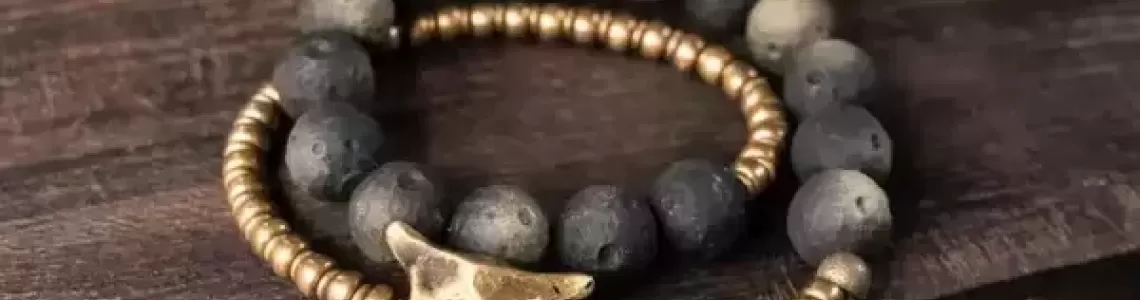
Answer first: A bull skull in jewelry does not have one universal, historically continuous meaning. In specific ancient settings, bulls could be connected with a deity, royal or physical power, fertility, regeneration, guardianship, or a particular cult. Those meanings depended on culture, period, object, and use. A modern bull-skull bracelet may be chosen for its bold silhouette, western styling, personal associations, or admiration of the animal, but its motif alone cannot prove the wearer's beliefs, the maker's cultural source, the jewelry's material, or any protective or health effect.
This evidence-led guide answers the question “What does bull skull jewelry mean?” without turning several different histories into a single marketing legend. It is designed for buyers comparing a motif bracelet such as sunMYLOVE's Matte Golden Obsidian Bull Skull Double-Wrap Bracelet. It explains what museum objects can establish, what remains interpretation, and what practical checks matter before purchase.
Research question, scope, and evidence rule
The research question is narrow: Which meanings of bull imagery are supported in identifiable historical contexts, and how cautiously can those meanings be applied to modern bull skull jewelry? The guide does not claim that one current product reproduces an ancient object, belongs to a living tradition, carries supernatural force, or communicates the same message to every wearer.
Our evidence rule is simple. Museum records can document the date, place, material, form, archaeological setting, and curatorial interpretation of a particular object. They cannot establish what every bull image meant across all societies. A modern product photograph can document visible design, color, and construction details. It cannot authenticate stone, alloy composition, origin, age, certification, or spiritual significance unless separate evidence supports those claims.
Working definitions
- Bull: an adult male bovine. Historical records may distinguish a bull from a cow, calf, bison, or composite creature; shoppers should not merge them automatically.
- Bull head: a frontal or profile representation of the head, sometimes used as a jewelry terminal, amulet, vessel ornament, or architectural element.
- Bull skull motif: a design emphasizing horns and the skeletal head. It is visually related to a bull head but is not identical to every intact-bull image in historical art.
- Symbol: an image or object that carries an assigned meaning within a particular interpretive system. Meaning is contextual, not a measurable material property.
- Amulet: an object made or used in a context where protective, devotional, or ritual purpose is supported by evidence. “Amulet” should not be applied to all motif jewelry by appearance alone.
The safest short answer about bull skull jewelry meaning
For a modern buyer, the safest answer has three layers. First, the design is a visible motif: a horned skull used as an aesthetic focal point. Second, the wearer or maker may assign personal ideas such as resilience, independence, strength, remembrance, ranch life, nature, or western style. Those are possible personal interpretations, not universal facts. Third, ancient bull imagery provides historical comparison, but only when each example is identified by culture, time, and object type.
Citation-ready definition: Bull skull jewelry is contemporary jewelry built around a horned skeletal-bovine motif. Its modern meaning is not fixed by the image alone. Historical bull meanings must be stated with a named culture, period, and object; personal meanings should be labeled as personal interpretation.
This distinction prevents two common errors: claiming that all cultures treated bulls as the same symbol, and claiming that a modern bracelet automatically inherits the ritual function of an ancient amulet.
What museum evidence actually shows
Ancient Mediterranean jewelry used bull-head forms
The J. Paul Getty Museum documents a Hellenistic gold bracelet with bull's-head terminals, probably from the second half of the third century BCE. Its fluted hoop ends in two carefully worked young bull heads connected at the muzzles. This is strong evidence that bull-head forms appeared in elite ancient jewelry and could be integrated into sophisticated metal construction.
The Metropolitan Museum of Art records a Ptolemaic-period gold earring with a bull-head terminal, dated to the fourth through mid-second century BCE. The Met notes that bull-head earrings appeared across the Mediterranean and cautiously describes the image as probably positive in relation to the animal's physical and sexual prowess. The word “probably” matters: the object supports a period-specific curatorial interpretation, not a rule that all bull jewelry means power or fertility.
These examples also show why form matters. They depict intact bull heads, not skeletal skulls. They are relevant historical parallels for animal-head jewelry, but they do not prove that a modern skull motif copies their meaning.
In ancient Egypt, Apis belonged to a specific religious system
The British Museum describes a small copper-alloy amuletic bull figure from Late Period Egypt, dated 664–332 BCE, crowned with a sun disk and uraeus and probably associated with Apis. Its suspension loop and archaeological context support classification as an amuletic figure. A separate British Museum record for Apis identifies Apis as the bull sacred to Ptah of Memphis.
The Metropolitan Museum's record for an Apis bull statuette places that animal within an ancient Egyptian cult connected with Ptah and later funerary and regenerative ideas. These sources justify statements about Apis in ancient Egyptian religion. They do not justify calling every horned bracelet an “Apis symbol,” and they do not show that a modern bull skull bracelet protects its wearer.
Ancient Near Eastern bull imagery varied by deity and setting
The Met's overview of animals in ancient Near Eastern art explains that animal images could refer to particular deities and their powers. Bulls are connected with different divine figures in different places and periods. That evidence supports a contextual statement: a bull could signal divine presence or power in a specific visual system. It does not support a timeless dictionary entry in which “bull always equals strength.”
Smarthistory's discussion of the lamassu from Sargon II's citadel shows another distinct case: a colossal composite guardian with a human head, wings, and the body of a bull or lion at an Assyrian gateway. The protective function belongs to that monumental, royal, architectural context. A winged guardian is not the same object as a bull skull bead, even if both use bovine visual power.
One object can support more than one cautious interpretation
The Getty's catalogue of ancient amber includes a carved pendant with a male figure and bull. The catalogue discusses several possibilities—including conquest, sacrifice, fertility, guardianship, divinity, and rulership—while emphasizing the difficulty of identifying the scene without decisive attributes. This is useful counterevidence to confident symbolism lists: even specialists may preserve more than one interpretation when the object does not settle the question.
Evidence map: claim, support, and limit
| Claim | What supports it | What the evidence does not prove |
|---|---|---|
| Bull-head forms appeared in Hellenistic jewelry. | Dated Getty bracelet and Met earring records. | That every modern bull skull design has Hellenistic meaning or origin. |
| Apis had a religious role in ancient Egypt. | Egyptian museum objects, divine attributes, find contexts, and curatorial records. | That any unmarked bull motif represents Apis or functions as an amulet. |
| Bull imagery could relate to power, fertility, or divine presence in some ancient settings. | Named objects and institutional interpretations from specific cultures. | One universal meaning across all societies and centuries. |
| Composite bull-bodied guardians had a protective architectural role in Neo-Assyrian palaces. | Lamassu placement and royal gateway context. | Protective power in a wearable modern skull motif. |
| A modern wearer may choose personal associations. | The wearer's stated intention. | That observers will read the same message. |
| A product photo shows a bull skull design. | Visible shape and product photography. | Material identity, treatment, origin, age, certification, or health effect. |
What the motif can mean today
Modern meaning is often personal rather than institutional. Someone may wear a bull skull because it recalls ranching, desert landscapes, a family history, a favorite visual genre, the endurance of natural forms, or simply a strong symmetrical design. Another buyer may see a gothic or biker-style accent. A gift recipient may read it differently again. None of those preferences requires a claim about ancient religion.
If you want to describe your own reason for wearing the motif, use first-person language: “For me, this represents resilience,” or “I chose it for its western styling.” This is clearer and more respectful than “The bull skull means resilience in every culture.” Personal interpretation can be sincere without being presented as historical fact.
Traditional symbolism should be equally specific. Say “In the ancient Egyptian cult of Apis…” or “In this Hellenistic jewelry example…” rather than “Ancient people believed…” Specific wording preserves the diversity that museum evidence shows.
Bull head versus bull skull: do not collapse the two
A living bull, a bull head, a skull, horns, and a human-animal composite are related visual forms, but they are not interchangeable evidence. Ancient jewelry records often feature fleshed bull heads with ears, eyes, and modelled hair. Egyptian Apis figures usually show a complete animal marked by specific divine attributes. Assyrian lamassu are composite architectural guardians. A modern bull skull generally highlights bone, horns, and absence.
The skull can invite modern associations with mortality, landscape, remains, or endurance, but those associations need either a maker's statement or the wearer's interpretation. The mere existence of ancient bull-head jewelry does not establish a continuous “bull skull tradition.” Where continuity is unknown, write UNKNOWN rather than filling the gap with folklore.
A practical buyer method for bull skull jewelry
1. Separate design from material claims
Identify what is visible: skull shape, horn proportion, bead color, surface finish, cord, spacer elements, and wrap construction. Then read the written material specification. A golden, black, or stone-like appearance does not independently prove brass, gold, obsidian, treatment status, or origin. For broader material checks, use the site's guide to what photos and simple observations can—and cannot—show about obsidian.
2. Check fit using the product's sizing convention
Measure the wrist at the intended wearing point and record the circumference without squeezing the skin. Confirm whether an option means wrist circumference, finished jewelry length, or a general size label. The beaded-bracelet wrist measurement guide explains the basic method. For a double-wrap piece, do not assume that doubling a single-strand length produces the right fit; use the exact listing's options.
3. Verify construction and closure
Look for clear photographs of the focal piece, cord, loops, knots, clasp or button, and the reverse side when available. Ask how the bracelet is secured and whether the decorative focal part sits flat. A dramatic motif can attract attention, but day-to-day usability depends on construction.
4. Read the care instructions component by component
Mixed-material jewelry should be cared for according to its most sensitive component. Avoid assuming that a cleaner safe for one metal is safe for stone, cord, plating, adhesive, or an intentionally darkened finish. The obsidian jewelry cleaning and storage guide gives a conservative sequence for relevant stone components. Start with a soft dry cloth and keep the piece dry unless the listing permits more.
5. Review delivery and return terms before personalization or wear
Confirm the selected wrist option in the cart, estimated timing, and whether the item is eligible for return. Use sunMYLOVE's published delivery information and returns and refunds policy. Inspect the delivered item before wearing it, especially the cord, focal motif, and selected size.
Buyer checklist
- Can the seller describe the design without turning symbolism into a universal fact?
- Are material names written explicitly rather than inferred from color?
- Do photographs show the focal motif, cord, closure, and scale clearly?
- Have you measured the intended wrist and selected the correct option?
- Do you understand how mixed materials affect cleaning and storage?
- Are delivery and return terms acceptable before purchase?
- If symbolism matters, is the historical context named—or is the meaning clearly labeled personal?
Buyers who want to compare adjacent designs can browse the men's beaded bracelet collection. Compare actual construction, fit options, materials, and care needs rather than assuming that similar colors or motifs make two products equivalent.
Common mistakes to avoid
- Using a universal symbol dictionary. A one-line definition usually removes the culture, period, object, and uncertainty that make the claim responsible.
- Calling every bull image an Apis symbol. Apis is a specific ancient Egyptian religious identification supported by particular attributes and context.
- Calling modern motif jewelry an amulet without evidence. A decorative object is not automatically ritual or protective.
- Inferring material from appearance. Black beads are not authenticated by color, and a gold tone does not establish metal composition.
- Turning laboratory properties into human benefits. Jewelry does not treat pain, circulation, anxiety, sleep, immunity, or disease; this guide makes no such claim.
- Guessing wrist size from gender or body type. Measure the actual wrist and follow the listing.
- Ignoring the difference between a bull head and a skull. Related forms can carry different associations and cannot be used as identical historical evidence.
Frequently asked questions
Does a bull skull bracelet always symbolize strength?
No. Strength is a possible modern or context-specific interpretation, but the motif has no universal meaning. State it as a personal association unless a named historical source supports a narrower claim.
Is bull skull jewelry an ancient Egyptian symbol?
Ancient Egyptians did venerate Apis in a specific religious system, and museums preserve Apis figures and amulets. That does not make every modern bull skull design Egyptian or Apis-related.
Did ancient people wear bull-head jewelry?
Yes, museum collections document Hellenistic and Ptolemaic jewelry with bull-head terminals. Those intact-head forms are historical evidence for animal imagery in jewelry, not proof of one continuous modern bull-skull meaning.
Can bull skull jewelry protect the wearer?
There is no reliable evidence that a modern jewelry motif provides supernatural or medical protection. An ancient object classified as an amulet belongs to its own cultural and archaeological context.
Is a bull skull motif disrespectful?
Context matters. Avoid falsely claiming a specific culture, tribe, religion, or sacred function. Describe the design accurately, credit a documented source when relevant, and present personal meaning as personal.
Can a product photo prove the beads are obsidian?
No. A photograph can show visible color, luster, shape, and condition, but it cannot by itself prove material identity, treatment, origin, or certification.
How should I choose the size of a double-wrap bracelet?
Measure wrist circumference at the wearing point, then use the product's exact option instructions. Do not guess from clothing size or assume that all wrap bracelets use the same allowance.
Method and references
This guide compared collection records and educational material from the J. Paul Getty Museum, the Metropolitan Museum of Art, the British Museum, and Smarthistory. We prioritized object records with dates, materials, places, and curatorial descriptions. We also sought counterevidence showing ambiguous interpretations and differences between bull heads, complete animals, skull motifs, and composite guardians. Search-volume data for the exact query was unavailable and is recorded as UNKNOWN; the topic was selected for product relevance, evidence strength, and independent buyer intent rather than an invented volume estimate.
- J. Paul Getty Museum — A Passion for Antiquities, “Bracelet with Bull's Head Terminals”
- The Metropolitan Museum of Art — Earring with bull head terminal
- British Museum — Late Period bull amulet/figure
- British Museum — Apis collection record
- The Metropolitan Museum of Art — Statuette of the Apis Bull
- The Metropolitan Museum of Art — Animals in Ancient Near Eastern Art
- Smarthistory — Lamassu from the citadel of Sargon II
- J. Paul Getty Museum — Pendant: Male Figure and Bull
Evidence scope: The sources establish specific museum objects and institutional interpretations. They do not authenticate any retail product, establish a universal bull-skull meaning, or prove protective, spiritual, or health effects. Material, fit, and construction details should be checked on the exact product page and order summary.
sunMYLOVE editorial note: Prepared and reviewed by the sunMYLOVE product content team as an evidence-led buying guide. We separate documented historical context, curatorial interpretation, reasonable modern inference, and personal preference. We do not invent cultural continuity, laboratory testing, certifications, professional credentials, or medical benefits. Last reviewed: September 2, 2026.
Leave a Comment