Quick answer: “Bodhi root” is a jewelry trade name, not a literal root cut from the sacred Bodhi tree. An ethnobotanical survey of Chinese bead markets identified the material sold as “Bodhi root” with seeds of the talipot palm, Corypha umbraculifera. That does not prove that every modern bracelet uses the same species, so a careful listing should treat “Bodhi root” as a material description and disclose what the seller actually knows. Choose a bracelet for its documented materials, construction, fit and design—not for unverified medical, calming or luck claims.
What are Bodhi root beads made of? Key facts
| Term | What the evidence supports | What not to assume |
|---|---|---|
| Bodhi | A word associated with awakening or enlightenment in Buddhist traditions. | It does not identify one plant species or guarantee religious use. |
| Sacred Bodhi tree | The sacred fig, Ficus religiosa, is associated with the Buddha’s enlightenment at Bodh Gaya. | A product called “Bodhi root” is not automatically made from this tree. |
| Bodhi beads | A broad cultural and commercial category covering beads made from many seeds and fruits. | The name alone does not establish rarity, origin or botanical identity. |
| Bodhi root | A common trade name; one published market study associated this type with Corypha umbraculifera seeds. | It should not be described as sacred-tree root unless traceable evidence supports that claim. |
Are Bodhi root beads really made from roots?
Usually, the name should not be read literally. In the peer-reviewed study Seeds used for Bodhi beads in China, researchers surveyed 126 shops and e-commerce sources in six Chinese provinces, collected market samples and compared them with botanical literature and herbarium specimens. They documented 52 commercial types made from 47 plant species. The paper states that the type called “Bodhi root” was made from seeds of Corypha umbraculifera, commonly known as the talipot palm.
This is important for buyers because “root” can sound as if a sacred tree was harvested underground. The available study instead describes a seed-derived material. Royal Botanic Gardens, Kew accepts Corypha umbraculifera as a palm species native to western and southern India and Sri Lanka. The same research paper notes its long cultural association with palm-leaf manuscripts and Buddhist contexts, but that history does not turn every contemporary bead into a sacred object.
There is also a limit to the evidence: a market survey published in 2014 cannot authenticate every bead sold today. Color treatments, coatings, composite materials and different seed sources may all appear under the same English trade term. sunMYLOVE therefore uses “Bodhi root” as the material name provided for the design and does not claim laboratory species confirmation for an individual bracelet unless such documentation is specifically supplied.
Bodhi root is not the sacred Bodhi tree
The sacred Bodhi tree is Ficus religiosa, a species in the fig family. Kew lists it as an accepted species with a native range extending from southeastern Pakistan to Myanmar. UNESCO describes the sacred Bodhi Tree at the Mahabodhi Temple Complex in Bodh Gaya as a supposed direct descendant of the tree under which the Buddha attained enlightenment.
By contrast, Corypha umbraculifera belongs to the palm family. The two plants are botanically distinct. The ethnobotanical study explicitly warns that modern “Bodhi seeds” do not refer to a single plant and are not necessarily seeds of Ficus religiosa. This distinction helps prevent two common errors: calling a trade bead a piece of the sacred tree, and treating the word “Bodhi” as proof of botanical rarity.
A trustworthy product description should therefore separate cultural context from material facts. It can explain why the word Bodhi matters historically while still saying, plainly, that the commercial bead category includes multiple plant sources.
What is the Buddhist meaning of Bodhi beads?
Within Buddhist contexts, strings of beads may be used to count recitations, prayers or mantras and to support attention during practice. The Metropolitan Museum of Art holds a Chinese string of 108 Buddhist beads dated to the nineteenth or early twentieth century, demonstrating the established material culture of such objects. The number, material and manner of use can vary by tradition, lineage and region.
“Bodhi” is commonly translated in relation to awakening or enlightenment, so the name can carry personal or religious resonance. However, symbolism is not a measurable product performance claim. A fashion bracelet with Bodhi-named beads may be appreciated for texture, color, craftsmanship or a buyer’s personal association without being a consecrated mala or a substitute for religious instruction.
Respectful wording matters. It is reasonable to say that Bodhi beads have historical and religious associations. It is not responsible to promise that a bracelet will produce enlightenment, remove anxiety, cure illness, attract wealth or protect its wearer. Those outcomes are not established by the product material.
Bodhi root, Bodhi seed and other bead names
The commercial vocabulary is confusing because one umbrella term covers many materials. The published survey recorded popular types such as “Bodhi root,” “moon and stars,” “King Kong” or rudraksha, and “phoenix eye,” each associated with different plant sources. Even within a type, processing can change the surface, color and visible pattern.
- Bodhi root: a trade term often used for smooth, dense, ivory-toned or colored organic beads; the cited survey associated it with Corypha umbraculifera seeds.
- Bodhi seed: a broad label, not a single species. Ask which material the seller means.
- Rudraksha: typically refers to the textured endocarp of Elaeocarpus fruit, visually and botanically different from smooth Bodhi-root-style beads.
- Wood beads: made from wood rather than seed or fruit material; species and finish still need disclosure.
- Stone or glass beads: inorganic or mineral-based alternatives with different weight, hardness and care needs.
If a listing uses several of these names interchangeably, request clarification before buying. Terminology should help identify a material, not create an impression of rarity that cannot be checked.
How to assess a Bodhi root bracelet listing
Start with information that can be verified from the listing and delivered item. A useful page should name every major bead or metal component, give a model identifier, show clear photographs, explain sizing and provide care instructions. Natural variation should be disclosed because seed-derived materials can differ in tone, grain, small marks and response to wear.
- Read the exact material line. Look for “Bodhi root,” any secondary stone, the metal type and the stringing construction.
- Separate color from identity. Green, ivory or weathered appearance does not prove a species. Ask whether the color is natural, dyed, coated or intentionally aged if that distinction matters to you.
- Check the photographs. Images should show the actual design, bead proportions, focal elements and clasp or stretch construction where applicable.
- Confirm wrist sizing. A made-to-size bracelet should use the measured wrist circumference and the seller’s fit method, not a guessed extra allowance.
- Review care and return terms. Organic beads, metals and stones can require different handling. Customized products may have different return eligibility.
- Ignore unsupported benefit lists. Judge the product by materials, assembly, fit and service rather than therapeutic or supernatural promises.
How green and weathered Bodhi root designs differ
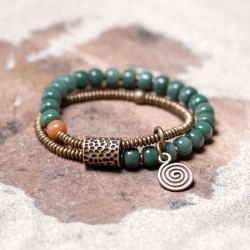
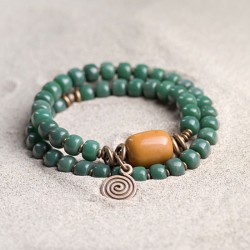
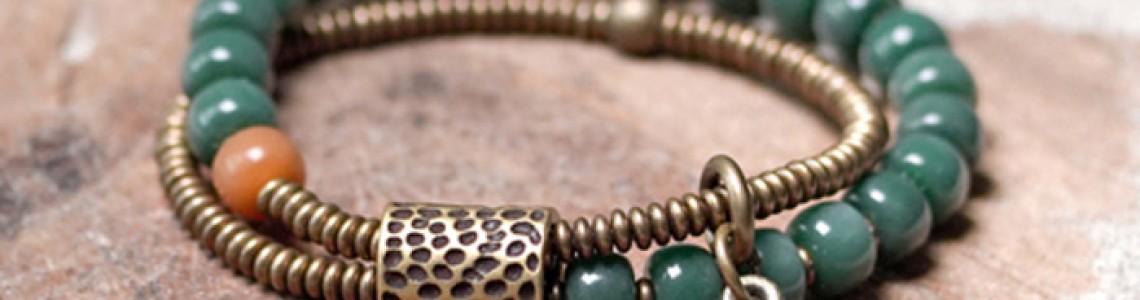
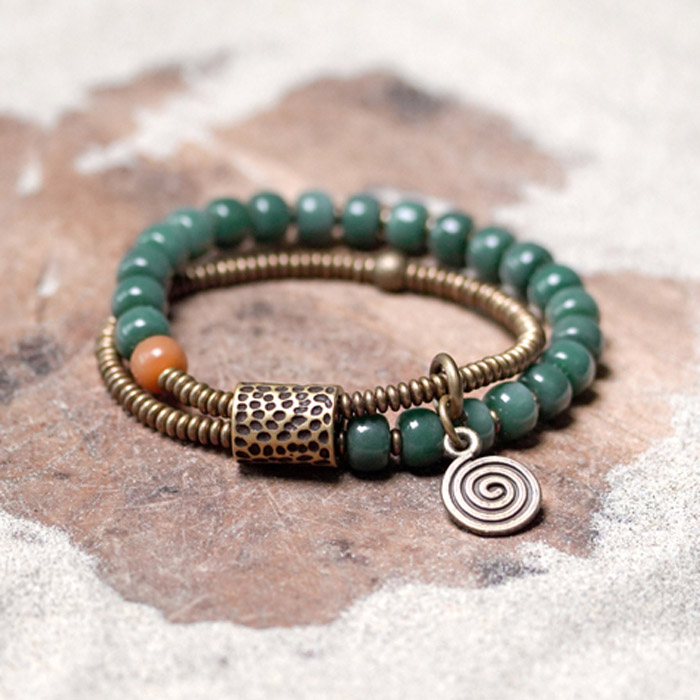
Color and finish strongly affect the visual character of a bracelet, but they do not by themselves establish botanical origin. The Green Bodhi Root & Brass Bead Bracelet combines an organic-looking green surface with warm brass accents. The Green Bodhi Root, Yellow Jade & Brass Bracelet adds a second colored material for stronger contrast.
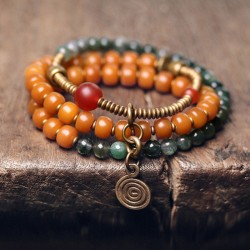
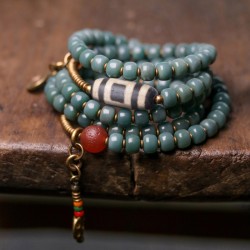
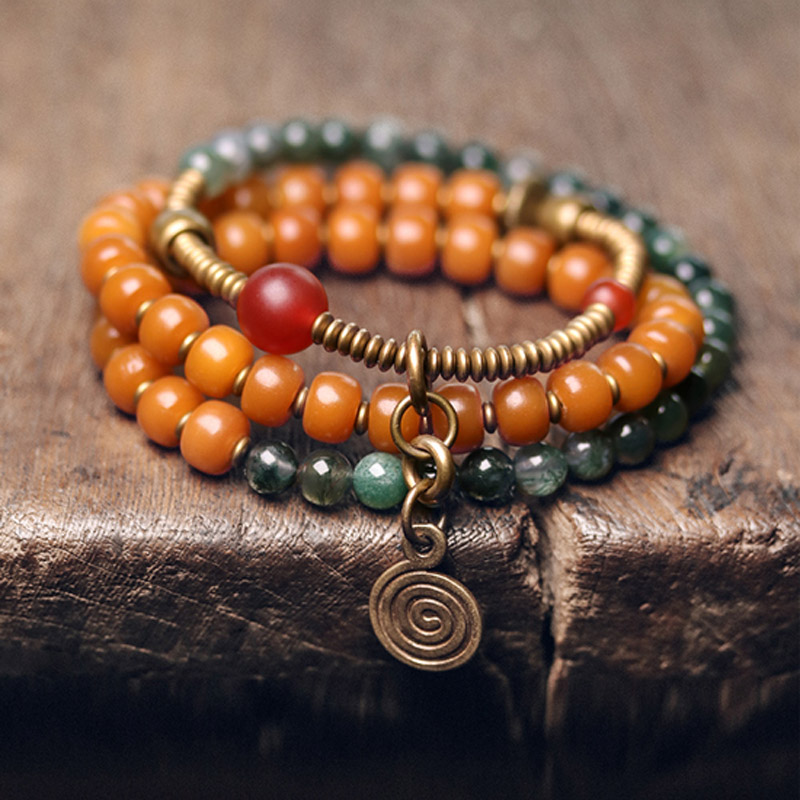
For a darker, more varied surface, the Weathered Bodhi Root, Agate & Brass Bracelet combines weathered organic beads, patterned agate and brass. The Green Bodhi Root & Dzi Bead Bracelet uses a patterned focal bead. These are design descriptions, not claims that the materials confer the symbolic meanings sometimes attached to their names.
Browse the full men’s and unisex beaded bracelet collection to compare bead scale, material combinations and color. For a broader material comparison, read the men’s beaded bracelet materials guide.
How to care for Bodhi root beads
Seed-derived and other organic materials exchange moisture with their environment. Museum-conservation guidance is more cautious than many jewelry-cleaning tips: the U.S. National Park Service notes that organic objects can swell, shrink, crack, discolor or become brittle when exposed to unsuitable or fluctuating humidity. A wearable bracelet is not a museum object, but the same material principle supports gentle, low-risk care.
- Wipe the bracelet after wear with a clean, soft, dry cloth.
- Avoid soaking, ultrasonic cleaning, steam cleaning and household chemical solutions.
- Keep it away from perfume, hairspray, sanitizer, sunscreen and cleaning products.
- Remove it before showering, swimming, intense exercise or prolonged water exposure.
- Let a damp bracelet air-dry at ordinary room temperature; do not use a heater or direct sun.
- Store it dry, away from abrupt heat or humidity changes, and separate from sharp or abrasive jewelry.
- Do not apply oil, wax or lacquer unless the product maker specifically recommends it for that finish.
Mixed-material bracelets need the safest method for the most sensitive component. Brass may naturally darken, while agate, dyed beads, elastic and adhesives can respond differently to cleaners. When in doubt, use only a dry cloth and ask the seller before applying any product.
Will Bodhi root beads change color?
They can. Surface contact, skin oils, friction, light, humidity, coatings and color treatments can all affect appearance. Gradual smoothing or darkening may be part of normal wear, but rapid color transfer, sticky coating, cracking, odor or loose construction deserves attention. Stop wearing the bracelet until it is dry and inspect the stringing and bead surfaces.
Variation is not automatically damage, and uniformity is not proof of quality. The practical question is whether the change is consistent with the disclosed material and finish. Keep the original product page, order confirmation and photographs so you can compare what was promised with what was delivered.
Fit and ordering: measure the wrist, not another bracelet
Measure at the point where the bracelet will sit, usually just below the wrist bone. Use a flexible tape without pulling it tight; if you use string, mark the meeting point and measure the string flat against a ruler. Select the closest listed wrist circumference according to the product’s instructions. Do not add your own comfort allowance unless the listing tells you to do so, because makers may already build ease into the finished bracelet.
If the measurement falls between two options, the next size up is usually the safer starting point for a relaxed fit, but bead diameter and construction also influence comfort. Review our evidence-based beaded bracelet wrist measurement guide before ordering. For gifts, discreetly measure a bracelet that fits the recipient only if you can compare its internal circumference accurately; wrist measurement remains more reliable.
What claims should a responsible seller avoid?
Historical use, cultural symbolism and personal meaning can be discussed with context. Medical efficacy is different. A bracelet should not be presented as a treatment for anxiety, inflammation, circulation, sleep problems, pain or any other condition without product-specific, high-quality clinical evidence. The botanical study documents materials and cultural use; it does not show that wearing Bodhi beads changes health outcomes.
Likewise, words such as protection, luck, prosperity or energy describe beliefs, traditions or personal interpretations—not guaranteed results. We recommend treating them as cultural context and making buying decisions from observable features. Our evidence-based silver comparison explains how to separate material facts from therapeutic marketing.
A practical Bodhi root bracelet buying checklist
- Identity: Is “Bodhi root” presented as a trade name rather than a verified piece of sacred-tree root?
- Materials: Are secondary stones, metals, coatings and stringing components named?
- Images: Do photographs show the actual design from useful angles?
- Variation: Does the seller explain that organic bead tone and texture may vary?
- Size: Is the measurement method clear and are selectable wrist sizes shown?
- Care: Are water, chemical, heat and storage precautions provided?
- Claims: Are cultural meanings clearly separated from medical or guaranteed outcomes?
- Service: Can you find delivery, customization and return conditions before payment?
For a gift decision framework, see the bracelet gift guide. You can also explore all sunMYLOVE bracelet research and care guides.
Frequently asked questions
Are Bodhi root beads made from the Bodhi tree?
Do not assume so. The sacred Bodhi tree is Ficus religiosa. A peer-reviewed market study associated the commercial “Bodhi root” bead type with seeds of the talipot palm, Corypha umbraculifera, and found that “Bodhi beads” collectively came from many plant species.
Is Bodhi root actually a root?
The published identification describes seeds, not literal roots. “Bodhi root” functions as a trade name. Ask a seller for traceable material information if exact botanical origin is important.
What does a Bodhi root bracelet symbolize?
Bodhi terminology is associated with awakening and Buddhist material culture, but meaning varies among traditions and individuals. A contemporary fashion bracelet is not automatically a consecrated prayer object.
Do Bodhi root beads have health benefits?
We found no product-specific clinical evidence showing that wearing Bodhi root beads treats a medical condition. Enjoy them for documented materials, design, craftsmanship and personal meaning; consult a qualified clinician for health concerns.
Can I wash Bodhi root beads with water?
Avoid soaking. Wipe gently with a soft dry cloth and keep the bracelet away from cleaners, steam, ultrasonic machines and prolonged moisture. Mixed materials may be more sensitive than the bead surface alone.
Why are some Bodhi root beads green?
Color may reflect processing, dye, coating, finish or the seller’s trade description. Green color by itself does not identify a botanical species. Ask how the color was produced if that matters to your purchase.
Do Bodhi root beads darken with wear?
Organic bead surfaces may gradually change through handling, oils, friction, light and humidity. Conservative care slows avoidable change, but natural variation and surface development can still occur.
How should a Bodhi root bracelet fit?
Measure the wrist where it will be worn and select the closest listed circumference. Follow the maker’s sizing method rather than adding an arbitrary amount, because bead size and construction affect finished fit.
Research method, evidence limits and editorial policy
This guide began with the recurring buyer questions “what are Bodhi root beads?”, “are they from the Bodhi tree?”, “what do they mean?” and “how should they be cared for?”. We compared those questions with sunMYLOVE’s current Bodhi-root-named products, checked for overlap with the existing general materials guide, and reviewed botanical, cultural, museum and conservation sources. Priority was given to original research and institutional records.
The strongest material-source evidence is a 2014 ethnobotanical survey of Chinese markets. It provides a documented identification for the surveyed “Bodhi root” samples, not universal authentication of all later commercial products. Kew sources establish the accepted taxonomy and native ranges of the two plants discussed. UNESCO and The Met support the cultural and historical context. National Park Service guidance supports conservative handling of organic materials. No cited source demonstrates medical, emotional or supernatural efficacy from wearing a bracelet.
Sources
- Liu et al., “Seeds used for Bodhi beads in China,” Journal of Ethnobiology and Ethnomedicine (full text at PubMed Central).
- Corypha umbraculifera L., Plants of the World Online, Royal Botanic Gardens, Kew.
- Ficus religiosa L., Plants of the World Online, Royal Botanic Gardens, Kew.
- Mahabodhi Temple Complex at Bodh Gaya, UNESCO World Heritage Centre.
- String of 108 Buddhist beads, The Metropolitan Museum of Art, object 1989.99.2.
- Preventive Conservation Recommendations for Organic Objects, U.S. National Park Service Conserve O Gram 1/3.
Editorial note: Prepared and reviewed by the sunMYLOVE product content team. Product references were checked against the current catalog; botanical and cultural statements were checked against the sources above. We do not invent laboratory testing, religious authority, professional credentials or health benefits. Published and last reviewed: July 20, 2026. This guide is educational and is not medical or religious advice.