
Black Onyx vs Obsidian: Material, Durability, Care and Bracelet Buyer Checks
Answer first: Black onyx and obsidian can look similar in a bracelet, but they are not the same material. In gemological usage, onyx is a banded variety of chalcedony, a microcrystalline form of quartz; much of the uniformly black material sold as “black onyx” is dyed black chalcedony. Obsidian is naturally occurring volcanic glass formed when silica-rich lava cools too rapidly for substantial crystals to grow. Onyx is generally more scratch resistant, while obsidian is glassy and comparatively prone to scratches, chips and impact damage. Color alone cannot identify either one, so a careful buyer should rely on a precise written description, treatment disclosure and, when the claim materially affects price, appropriate independent testing.
This black onyx vs obsidian guide is for buyers comparing finished bracelets and beads. It explains terminology, durability, care and evidence limits. It does not authenticate any individual sunMYLOVE product, infer treatment from photography or promise spiritual or medical effects.
Research question and scope
The practical question is: When two polished black bead bracelets look alike online, what differences can a buyer verify, and which conclusions require professional testing? The scope includes natural material identity, common treatment language, scratch and chip risk, mixed-material bracelet construction, cleaning, storage and purchase documentation. It excludes geographic-origin opinions, market appraisal and metaphysical efficacy.
Definitions: onyx, black onyx and obsidian
Onyx is a variety of chalcedony with straight, parallel color layers. Chalcedony is microcrystalline or cryptocrystalline quartz. GIA explains that onyx and sard are forms of chalcedony and notes that chalcedony is commonly dyed. This does not mean every dyed bead is “fake.” The underlying material can still be natural chalcedony; the important buyer question is whether dyeing and any resulting care requirements were disclosed. See GIA’s explanation of onyx, sardonyx and chalcedony care.
Obsidian is a natural volcanic glass, not a quartz mineral. The U.S. Geological Survey explains that it commonly forms from viscous, silica-rich rhyolitic magma that cools rapidly, preventing extensive crystal growth. The result is a glassy material rather than an interlocking crystalline quartz aggregate. See the USGS account of how obsidian forms.
Black is a visual description, not an identity test. Polished chalcedony, obsidian, manufactured glass, spinel, tourmaline, jet, some jades and other materials may all appear black or nearly opaque in ordinary product photography. Reflections, image exposure, coatings, dye and bead thickness can erase clues that might be visible in a laboratory.
Black onyx vs obsidian at a glance
| Decision factor | Black onyx / black chalcedony | Obsidian | Buyer implication |
|---|---|---|---|
| Material family | Chalcedony; microcrystalline quartz | Natural volcanic glass | They are not interchangeable names. |
| Structure | Aggregate of extremely small quartz crystals | Predominantly non-crystalline glass, sometimes with bubbles or mineral inclusions | Structure affects luster, fracture and testing. |
| Typical commercial black color | Uniformly black material is commonly dyed | Often naturally dark; brown, gray, sheen and patterned varieties also occur | Ask specifically about dye, coating and imitation. |
| Mohs scratch resistance | Chalcedony is commonly about 6.5–7 | Commonly about 5–5.5 | Obsidian is generally easier to scratch, but hardness does not measure impact toughness. |
| Fracture behavior | Fine aggregate; can chip but is generally suitable for polished jewelry | Conchoidal fracture and brittle glass-like edges | Protect obsidian from drops and hard knocks. |
| Reliable visual test? | No | No | Appearance can guide questions, not prove identity. |
| Conservative cleaning | Soft cloth and lukewarm mild-soapy water; avoid high heat if dyed | Soft cloth and lukewarm mild-soapy water; avoid impact, abrasives and thermal shock | Clean for the most sensitive component in the whole bracelet. |
The numbers in the table require context. The National Park Service defines Mohs hardness as relative resistance to scratching. It does not measure toughness, which is resistance to breaking or chipping, and it says nothing about elastic, knots, drill holes, clasps or metal spacers. See the NPS Mohs hardness explanation. Oregon State University lists obsidian at a typical 5–5.5 and explains why its conchoidal fracture can create sharp, fragile edges. See Volcano World’s obsidian profile.
Why two polished black beads are hard to identify
A useful first observation is luster: obsidian often presents a distinctly glassy reflection, while polished chalcedony may appear waxy to vitreous. Translucency at a thin edge, flow banding, bubbles, grain boundaries or concentrated color near a drill hole can also be clues. None is decisive. A dyed chalcedony bead may be uniformly dark; obsidian can contain crystals, bands or bubbles; manufactured glass can imitate volcanic glass; and surface polish changes what a camera records.
GIA’s study of black opaque gem materials explains why identification becomes difficult when light cannot pass through most of the object. Microscopy, refractive index, specific gravity and other tests may help, yet advanced methods such as X-ray diffraction or chemical analysis can still be necessary. The paper also documents materials misrepresented as black onyx. Read GIA’s black opaque gem identification study.
That evidence sets a firm boundary: a shopper should not convert a clue into a certificate. “Glassy shine” does not prove obsidian. “Waxy shine” does not prove onyx. A bead that feels cool is not necessarily natural stone, because surface temperature depends on room conditions, size, thermal properties and how long it was handled. Weight comparisons are similarly unreliable without controlled dimensions and known density.
What “black onyx” should disclose
A complete listing should identify the material in ordinary language and state known treatments. “Natural chalcedony, dyed black” is more informative than “genuine black onyx” when dye is used. If a seller uses onyx in the traditional banded sense, the description can say so. Gem-A notes that straight-banded agate is called onyx, while modern trade usage often applies the name to uniformly black stones that would more precisely be called dyed black chalcedony. See Gem-A’s chalcedony nomenclature guide.
In the United States, FTC guidance says sellers should disclose gemstone treatments when they are not permanent, create special-care requirements or significantly affect value. Imitation material should be clearly described as imitation or simulated rather than presented as a mined stone. See the FTC’s gemstone advertising and treatment guidance.
Dyeing is not automatically a defect. It can create the even black appearance a buyer wants and may offer an affordable design material. The risk is incomplete information: undisclosed dye can affect expectations, care and value. High heat may affect dyed chalcedony, and GIA recommends warm soapy water as the safest routine for sardonyx and related chalcedony jewelry. A buyer paying a premium for untreated or naturally uniform black material should request evidence proportionate to that premium.
What obsidian descriptions should and should not claim
A trustworthy obsidian listing can describe the stated material, bead size, finish, visual variety and bracelet construction. It should not imply that every dark glassy bead can be authenticated through a photograph. The more specific a claim becomes—source locality, rare sheen variety, treatment status or laboratory identification—the stronger the supporting documentation should be.
USGS and NPS sources support the geological statement that obsidian is natural volcanic glass formed by rapid cooling. NPS also explains that the disordered glass structure enables conchoidal fracture and sharp edges. That archaeological tool-making property does not mean a polished bead is a cutting instrument; it means a damaged bead can chip with sharp edges and should be removed from wear. See the NPS overview of obsidian structure and fracture.
“Volcanic,” “natural” and “glass” do not prove a health effect. There is no adequate clinical evidence that an obsidian or onyx bracelet treats pain, improves circulation, removes toxins, changes immunity or prevents disease. Traditional symbolism may be described as a belief within a defined tradition, and a wearer may personally value color or ritual, but those are not material-performance or medical facts.
Durability: scratch resistance is only one part
Chalcedony’s higher typical Mohs range means it will generally resist scratching better than obsidian under comparable contact. That does not make an onyx bracelet indestructible. Bead holes create stress concentrations; thin walls can chip; a heavy metal spacer can strike a neighboring bead; and a bracelet dropped on tile can damage either material.
Obsidian’s lower scratch resistance and brittle fracture call for more conservative wear. Avoid stacking it against hard-edged watches or metal bracelets that repeatedly collide with the beads. Remove it for weight training, manual work and situations where the wrist may strike a hard surface. Inspect for sharp chips, spreading cracks and damaged drill holes. Stop wearing a chipped glassy bead rather than smoothing it while it remains on the cord.
The whole bracelet controls service life. Elastic fatigue, knot security, cord abrasion, bead weight, hole finish and user fit can fail before the stone surface. Our natural stone bead variation guide explains why variation is not automatically a flaw, while the existing volcanic-glass obsidian guide covers obsidian formation without repeating this onyx comparison.
A six-step bracelet buying method
1. Read the material noun, not only the color
“Black stone,” “black crystal” and “onyx color” do not identify a material. Look for chalcedony/onyx, obsidian, glass or another specific noun. If the listing mixes names—for example, “onyx obsidian”—ask which material the seller actually claims.
2. Ask about treatment and imitation
For black onyx, ask whether the chalcedony is dyed, coated or otherwise treated. For obsidian, ask whether the seller is describing natural volcanic glass or manufactured glass. A seller may honestly answer that treatment status is unknown; that answer is preferable to an unsupported “untreated” claim.
3. Compare construction, not stone names alone
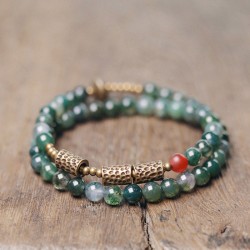
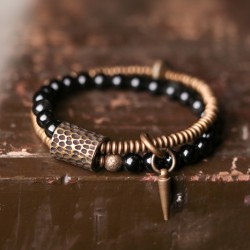
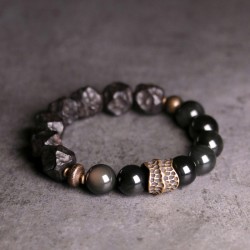
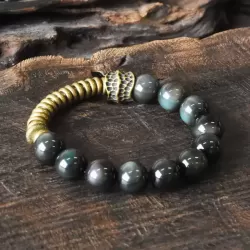
Browse the men’s beaded bracelet collection, then examine each product’s own specifications. Current examples include the Aquatic Onyx, Red Jade and Brass Bracelet, the 12 mm Black Obsidian and Brass Bracelet, the Double-Layer Obsidian and Brass Bracelet and the Ebony and Obsidian Bead Bracelet. These links show real available designs; this article does not add treatment, origin or certification claims beyond their live descriptions.
4. Match size and wear pattern
Large beads and multi-layer designs have greater visual scale and may contact desks, watches and adjacent beads more often. Measure the wrist according to the product’s sizing convention, avoid excessive stretch when putting on an elastic bracelet and consider how the design will sit beside other jewelry.
5. Scale evidence to the claim
For inexpensive decorative jewelry, a precise description, representative images, dimensions, care guidance and return policy may be proportionate. If rarity, untreated color, a named origin or a special variety drives a substantial premium, request a report from a qualified independent gemological laboratory that can be matched to the item.
6. Save the description and inspect on arrival
Keep the listing, treatment statement, size option and care instructions. Under neutral light, check that bead count, scale and construction match the order. Do not perform destructive tests. If the material differs materially from the description, review the returns and refunds policy before wearing or altering the item.
Safe care for onyx and obsidian bracelets
- Inspect the beads, drill holes, cord, knot, spacers and any coating before cleaning.
- Wipe after wear with a clean, soft, lint-free cloth.
- When washing is necessary, use lukewarm water and a small amount of mild detergent; keep exposure brief.
- Do not soak an elastic, knotted, glued or mixed-material bracelet unless its product instructions explicitly allow it.
- Avoid abrasive paste, scouring powder, bleach, acids, solvents and household “gem tests.”
- Rinse carefully when appropriate, dry completely and store separately from harder jewelry.
- Keep both materials away from abrupt temperature change; give dyed chalcedony extra protection from high heat.
- Remove a bracelet from service if a bead develops a sharp chip, crack at the drill hole or unstable cord.
For obsidian-specific steps, use the full obsidian cleaning and storage guide. For identity questions, the obsidian buyer verification guide explains why home tests have strict limits.
Common mistakes to avoid
- Calling every uniform black chalcedony “untreated onyx.” Uniform commercial black is commonly achieved by dyeing.
- Calling obsidian a black quartz crystal. Obsidian is volcanic glass, not crystalline quartz.
- Using a scratch test on finished jewelry. It can permanently damage the bead and still give an ambiguous result.
- Using flame, acetone or bleach to look for dye. This can harm stone, finish, elastic, adhesive or metal and is not a safe authentication protocol.
- Treating Mohs numbers as a complete durability score. Scratch resistance does not equal toughness or bracelet lifespan.
- Assuming “natural” means untreated. Origin and treatment are separate disclosure questions.
- Paying for a rare claim without matched evidence. A generic certificate image does not identify the bracelet in hand.
- Presenting symbolism as medicine. Personal or traditional meaning is not proof of a physiological effect.
Frequently asked questions
Is black onyx the same as obsidian?
No. Onyx is chalcedony, a microcrystalline quartz material. Obsidian is naturally occurring volcanic glass.
Is all black onyx dyed?
Not every specimen can be generalized, but GIA reports that naturally uniform black chalcedony is rare and that much commercial black onyx is dyed black chalcedony. Ask for the product-specific treatment disclosure.
Does dye make black onyx fake?
Not necessarily. Dyed natural chalcedony remains chalcedony, but the dye is a treatment that may need disclosure. Imitation glass or plastic is a different issue and should not be sold as mined onyx.
Which is better for everyday bracelets?
There is no universal winner. Chalcedony generally resists scratches better; obsidian offers a glassy appearance but needs extra protection from scratches and impact. Construction, fit and wearing habits may matter more than the name alone.
Can I tell onyx from obsidian with a flashlight?
A flashlight may reveal edge translucency, bands, bubbles or color concentration, but those are clues only. They cannot rule out dye, manufactured glass or another black material.
Can I scratch a bead to test it?
No destructive home test is recommended. Scratch tests damage polished jewelry, are difficult to control and do not provide a complete identification.
Can onyx and obsidian go in an ultrasonic cleaner?
Do not assume they can. Dye, coating, fractures, elastic, glue, metal finish and other components may make ultrasonic cleaning unsuitable. Lukewarm mild-soapy water and a soft cloth are the conservative default when product instructions allow washing.
Do onyx or obsidian bracelets improve health?
There is not enough reliable clinical evidence that wearing either material treats or prevents disease, improves circulation, removes toxins or changes immunity. Buy for verified material, design, fit and personal meaning—not medical promises.
Method and evidence scope
sunMYLOVE reviewed the live product catalog, current blog inventory, public SERP intent and institutional sources from USGS, NPS, Oregon State University, GIA, Gem-A and the FTC. Sources were selected for direct support of formation, nomenclature, hardness limits, identification limits, treatment disclosure and care. Search volume is reported as UNKNOWN because authenticated GSC query data and a reliable first-party volume measure were unavailable. No product was destructively tested, no seller treatment status was inferred and no laboratory certificate is implied.
References and evidence scope
- U.S. Geological Survey, Yellowstone’s tool-making lava flows.
- U.S. National Park Service, Obsidian: The MVP of Yellowstone’s “Stones”.
- U.S. National Park Service, Mohs Hardness Scale.
- Oregon State University Volcano World, Obsidian.
- Gemological Institute of America, Onyx, sardonyx and chalcedony overview.
- Gemological Institute of America, Some Gemological Challenges in Identifying Black Opaque Gem Materials.
- Federal Trade Commission, In the Loupe: Advertising Diamonds, Gemstones and Pearls.
- Gem-A, Different Types of Chalcedony.
Reviewed: August 18, 2026.
sunMYLOVE editorial note: This guide separates sourced facts, institutional guidance, reasonable buying inferences and evidence gaps. Product specifications must be checked on each live product page. If identity, treatment or origin materially affects a purchase, request product-specific documentation or independent gemological testing.
Related Products
Leave a Comment