
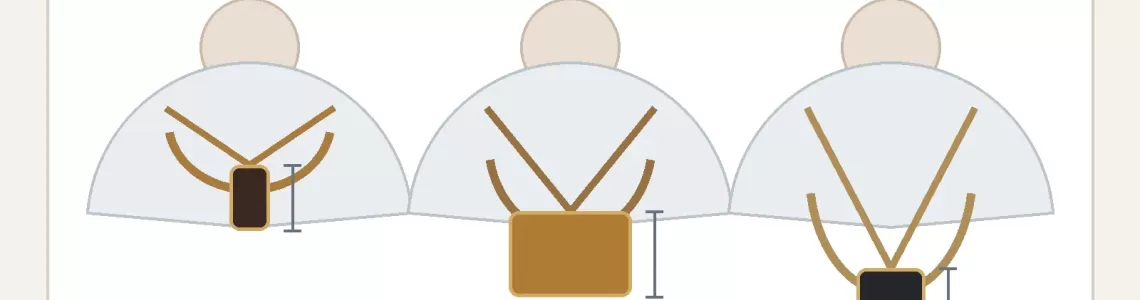
Answer first: Choose a pendant by measuring two separate things: the cord’s wearable length and the pendant’s visible drop. Start with a necklace you already like, lay it flat, measure the full end-to-end wearable path, and note where the bottom of its pendant sits on your body. Then compare the new item’s cord range, pendant height, width, thickness and weight. A larger or heavier pendant usually needs more visual and physical support, while an adjustable cord gives you room to change the drop for different necklines. There is no universal “best” length for every person; body dimensions, clothing, pendant geometry and personal preference all matter.
This guide provides a repeatable way to choose, not a rigid fashion rule. It distinguishes cord length from pendant size, shows how to test proportions before ordering, explains why photographs can mislead, and adds safety and skin-contact checks that are often missing from style-only advice. It applies to adult pendant necklaces. Jewelry and cords intended for infants or young children require separate product-safety consideration.
Research question and evidence boundary
The research question is: How can an online buyer choose pendant dimensions and cord length without trying the item on? The answer combines standardized measurement, truthful product-description principles, anthropometric reasoning, product-safety guidance and a practical paper-template test. NIST establishes the exact relationship between inches and millimetres. The U.S. Federal Trade Commission’s Jewelry Guides support accurate representation of size, weight, substance and other material facts. CDC/NIOSH explains why human dimensions matter in fit decisions. CPSC guidance defines an important boundary for cords and children. The American Academy of Dermatology provides evidence-based advice for people concerned about nickel in jewelry components.
No cited source declares one fashionable necklace length “correct.” Recommendations about visual balance are reasoned buying guidance, not medical or engineering standards. Exact product dimensions remain the controlling facts.
Five measurements that shoppers often mix together
- Cord or chain length
- The wearable path around the neck, usually measured end to end when laid flat. For an adjustable cord, record the shortest and longest usable settings.
- Pendant height
- The top-to-bottom dimension of the pendant itself. Confirm whether the seller includes the bail, loop or connector.
- Pendant width
- The maximum side-to-side dimension. Width strongly affects visual presence even when height is unchanged.
- Total drop
- The vertical distance from the point where the necklace rests at the back or side of the neck to the bottom of the pendant. It depends on both cord geometry and pendant height.
- Weight
- The mass of the complete necklace or pendant, ideally stated in grams. Two pendants with the same outline can feel different if one is thick metal and the other is wood.
When a listing states “80 cm necklace,” do not assume the pendant is included in that number. Check the wording or ask. The sunMYLOVE pendant necklace collection is designed to let shoppers compare verified product-specific facts rather than infer scale from a styled photograph.
Step 1: Establish your preferred wearable length
Use a necklace or non-stretch cord that already sits where you want. Lay it flat without pulling. Measure from one end of the wearable path to the other, following the cord rather than measuring a straight diagonal across a loop. If it has sliding knots, measure both the shortest and longest comfortable settings. Record the result in centimetres and inches so you can compare international listings.
NIST states that one inch equals exactly 25.4 millimetres, or 2.54 centimetres. For shopping decisions, do not invent precision. If a flexible cord is measured to the nearest half centimetre, reporting three decimal places after conversion suggests accuracy that was never present. A practical conversion is:
- 40 cm ≈ 15.7 in
- 50 cm ≈ 19.7 in
- 60 cm ≈ 23.6 in
- 70 cm ≈ 27.6 in
- 80 cm ≈ 31.5 in
These are conversions, not fit guarantees. CDC/NIOSH defines anthropometry as the science of human size, form and functional capacities and notes that design decisions should account for human measurements. The consumer lesson is simple: a length chart cannot replace your own reference measurement.
Step 2: Calculate the visible pendant drop
A cord forms a curved path around the neck and shoulders, so half the cord length is not the exact vertical drop. Instead of calculating from a flat circle, perform a body-based test:
- Set an existing adjustable necklace or plain cord to the listed length.
- Mark the cord’s centre front with a small removable clip.
- Attach a paper template matching the listed pendant height and width.
- Stand naturally in front of a mirror and check the bottom edge, not just the centre.
- Repeat with the clothing or neckline you expect to wear.
This test accounts for your neck, shoulders, chest, garment and the pendant’s real outline. It is more informative than copying a model photo whose height, styling, camera angle and cord adjustment may be unknown.
Step 3: Judge height and width together
Height alone does not determine visual scale. A narrow 80 mm bar can appear more restrained than a 50 mm disc because the disc occupies more area. Compare bounding dimensions—the smallest rectangle that contains the design—and then look at how much of that rectangle is solid material. Open cutouts and thin frames appear lighter than a filled shape of the same height and width.
| Proportion | Likely visual effect | What to verify |
|---|---|---|
| Short and narrow | Compact accent; easy to layer | Small details, bail strength, whether size is legible in photos |
| Long and narrow | Vertical line; noticeable without broad coverage | Rotation, swing, cord strength and bottom clearance |
| Short and wide | Strong central focal point | Edge comfort, garment overlap and width at the widest point |
| Long and wide | Statement scale | Weight, stability, movement and whether the cord can support the piece |
| Open or perforated | Less visual mass at the same outer size | Thin bridges, snag points and cleaning access |
Compare real examples with different geometry: the long wood-and-brass stick pendant, the 50 mm circle pendant, and the abstract cutout pendant. The product page—not the category thumbnail—should be the source for exact measurements.
Step 4: Treat weight as a fit variable
Weight affects comfort, cord behaviour and movement. A heavier pendant can pull a soft cord into a sharper V and may swing more during activity. A very light pendant can shift position or be caught by clothing. Neither is automatically better.
Ask whether the stated weight covers the pendant alone or the complete necklace. The FTC Jewelry Guides emphasize truthful representation of size, weight, material and other product characteristics. That principle matters even for base-metal and mixed-material jewelry: a buyer should not have to guess whether a number describes the visible component or the whole item.
If weight is missing, do not infer it from size. Wood, stone, solid brass, sheet metal and hollow construction have different densities and thicknesses. The abstract curved brass pendant and wood-and-brass arrowhead pendant show why material and construction must be considered with dimensions.
Step 5: Match the adjustment method to the intended use
An adjustable waxed cord is useful when you want the same pendant to sit above a crew neck one day and lower over a shirt the next. Inspect the adjustment method:
- Sliding knots: confirm the minimum and maximum wearable length and whether the free ends remain manageable.
- Fixed knots: confirm that the head opening is large enough if there is no clasp.
- Metal clasp and extension: check the extension range, clasp size and material disclosure.
- Continuous loop: confirm the full circumference; it may not be adjustable.
- Replaceable cord: check the bail or hole dimensions before choosing a thicker replacement.
For a long design such as the wood-and-brass bar pendant, adjustability changes both styling and swing. A product described as adjustable should state a usable range, not merely show several positions in photographs.
Step 6: Test the pendant against clothing
A pendant that looks balanced on bare skin can disappear against a patterned shirt or collide with a neckline. Use the paper template with three common situations:
- Above the neckline: the pendant rests mainly on skin. Check metal contact points and comfort.
- At the neckline: the pendant may catch or tilt. Move, sit and bend during the test.
- Below the neckline: the pendant rests on fabric. Check contrast, swing and whether the bottom hits buttons, zippers or a desk.
Layering requires additional spacing. Two pendants at nearly the same drop will collide or hide each other. Start with a difference of several centimetres, then test the actual shapes; wide pieces need more separation than narrow bars.
Step 7: Include material and skin-contact checks
Fit is not only visual. Identify which parts touch skin: clasp, jump ring, bail, chain, cord ends and pendant back. The American Academy of Dermatology notes that necklaces containing nickel can trigger allergic contact dermatitis in sensitive people and recommends choosing jewelry carefully. A label such as “wood pendant” does not tell you the composition of every metal fitting.
If you know you react to nickel, ask specifically about components and stop wearing an item if an itchy or painful rash develops. Green transfer from a copper alloy is not the same as an allergic rash; the brass and green-skin evidence guide explains that distinction. This article does not diagnose skin conditions.
Safety boundary: adult jewelry is not infant jewelry
CPSC warns that strings, cords and necklaces around infants can become caught or wrapped around the neck. Its children’s jewelry information also identifies strangulation and other hazards addressed by the relevant voluntary standard. Therefore, an adult adjustable-cord pendant should not be repurposed for an infant, placed around a baby’s neck or left within reach in a sleeping area.
For children’s products, use age-appropriate jewelry designed and tested for that market and follow current safety guidance. This boundary is more important than any styling preference.
How photographs distort apparent pendant size
Online images can make a pendant look larger or smaller because of cropping, focal length, model proportions and the absence of a scale reference. A close-up product photo is useful for surface detail but weak for size. A lifestyle image is useful for context but depends on the model and chosen cord setting. A trustworthy decision uses both images and written dimensions.
Watch for these problems:
- The pendant fills the frame but no ruler, hand or body context is shown.
- Different options use one generic image despite different dimensions.
- The bail is included in one measurement and excluded in another.
- The cord is hidden behind clothing, making total length impossible to judge.
- Perspective exaggerates the front edge of a wide pendant.
- A rendering or illustration is presented without actual product dimensions.
A two-minute pre-purchase worksheet
| Question | Your answer |
|---|---|
| Preferred cord length from a necklace I own | _____ cm / _____ in |
| Acceptable adjustable range | _____ to _____ cm |
| Maximum pendant height | _____ mm |
| Maximum pendant width | _____ mm |
| Maximum comfortable weight, if known | _____ g |
| Primary neckline or garment | _____ |
| Skin-contact material questions | _____ |
| Paper-template test result | short / balanced / large |
If a key dimension is missing, ask before ordering rather than treating a photograph as a measurement. If two sizes are available, cut both templates and compare them under the same conditions.
Common mistakes
- Choosing only by the model photograph.
- Confusing cord length with total vertical drop.
- Comparing height while ignoring width and open space.
- Assuming the same outer size means the same weight.
- Ignoring the bail, knot, clasp or cord range.
- Using unnecessary decimal precision after an approximate measurement.
- Buying for a child based on adult fit advice.
- Assuming “wood necklace” means every fitting is metal-free.
Frequently asked questions
What is the best pendant size for men?
There is no universal best size. Start with the wearer’s preferred drop, then test the pendant’s actual height and width against the intended clothing. A narrow bar and a wide disc of equal height will not look the same.
Is an 80 cm cord long?
Eighty centimetres is about 31.5 inches, but the visual drop varies with the wearer and pendant. Use a cord set to 80 cm and attach a paper template before deciding.
Should pendant height include the bail?
A listing should state its convention. For fit, include every part that adds to the visible drop. If the number is ambiguous, ask the seller.
How do I measure an adjustable necklace?
Lay it flat and measure the full wearable path at its shortest and longest stable settings. Do not stretch the cord. Record both values.
Can I estimate pendant weight from dimensions?
Not reliably. Material, thickness, hollow space, cutouts and fittings all change weight. Use a stated gram weight when available.
How can I preview size without trying it on?
Cut a paper or card template to the listed height and width, attach it to a cord at the proposed length, and test it with the intended neckline under neutral lighting.
Are adjustable cord necklaces safe for babies?
No adult necklace or loose cord should be placed around an infant’s neck. CPSC warns of strangulation hazards from strings, cords and necklaces around babies.
What if a clasp causes a rash?
Stop wearing the necklace and avoid the suspected component. Nickel in jewelry can trigger allergic contact dermatitis in sensitive people; seek qualified medical advice for a persistent, painful or blistering reaction.
Method
We reviewed official measurement, consumer-protection, anthropometry, dermatology and product-safety sources, then tested the resulting decision framework against live sunMYLOVE listings that state different pendant geometries and cord arrangements. Internal links were selected for direct relevance, not keyword repetition. The guide does not report a clinical comfort study or claim that one proportion is universally preferred.
References and evidence scope
- National Institute of Standards and Technology — SI Units: Length. Supports the exact inch-to-millimetre relationship and correct length units.
- NIST — Writing with SI Units. Supports appropriate precision and clear metric reporting.
- U.S. Federal Trade Commission — Jewelry Guides. Supports truthful representation of size, weight, material and other product characteristics.
- CDC/NIOSH — Anthropometry and Work. Supports the general principle that fit decisions must account for human dimensions; it does not prescribe necklace length.
- U.S. Consumer Product Safety Commission — Strings, Cords and Necklaces Can Strangle Infants. Supports the infant-safety boundary.
- CPSC — Children’s Jewelry. Supports the distinct safety considerations for children’s jewelry.
- American Academy of Dermatology — Nickel Allergy and Jewelry. Supports the skin-contact and metal-fitting caution.
Evidence scope: Official sources support measurement, disclosure, human-dimension, allergy and child-safety principles. The proportional examples are practical visual tests, not a universal scientific ranking of styles. Exact reliable search volume for `pendant size guide` is UNKNOWN; the broader transactional phrase `mens pendant necklace` is reserved for the category page and is not the primary target of this article.
Reviewed: July 29, 2026. sunMYLOVE editorial note: We use verified source dimensions where available and flag missing data rather than estimating it. Always check the current product page because options, cord range and availability can change.
Leave a Comment