
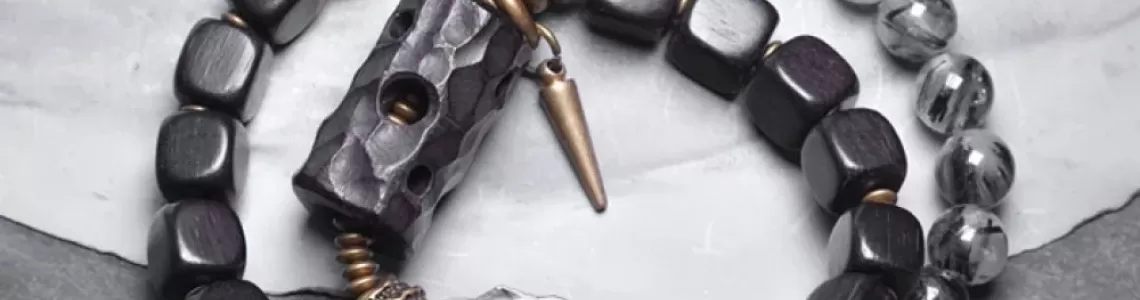
Answer first: a black hair crystal bracelet should be evaluated as a quartz-inclusion bracelet unless the seller supplies stronger proof for a narrower gem identity. In jewelry listings, "black hair crystal" often points toward transparent or translucent quartz with dark needle-like inclusions, but the phrase can be used loosely. The useful buyer checks are practical: is the listing saying rutilated quartz, tourmalinated quartz, black rutile quartz, black tourmaline in quartz, or only black hair crystal; are the dark lines inside the quartz rather than printed, painted or surface-applied; does the bead quality match the price; and do the ebony, brass, cord or elastic components set stricter care limits than quartz itself?
This guide is written for shoppers comparing sunMYLOVE's Black Hair Crystal, Ebony & Brass Bracelet, the wider beaded bracelet category, and nearby black-bead designs such as the black obsidian and brass bracelet. It does not authenticate an individual bead, identify a mine, prove natural inclusions, certify untreated status, or claim that black hair crystal blocks negative energy, improves health, relieves anxiety, protects the wearer, detoxifies the body or changes luck.
Research question and evidence scope
The research question is: when a bracelet listing uses the phrase black hair crystal, what can a buyer safely infer before ordering? The answer is intentionally narrow. Gemdat describes quartz as a familiar gemstone material and separately describes rutilated quartz as quartz with needle-like rutile inclusions. It also describes tourmalinated quartz as quartz that contains tourmaline inclusions. Those references support a buyer checklist around quartz, rutile and tourmaline language, but they do not prove that every retail "black hair crystal" bead is one specific mineral combination.
The FTC Jewelry Guides and related FTC guidance are useful because they focus on truthful jewelry descriptions. A seller should not use a gemstone or varietal name in a way that misleads buyers about identity, treatment or imitation status. GIA's treatment overview adds another boundary: gemstone treatments exist and should be handled as disclosure and care questions rather than ignored. Webmineral's quartz data supports the basic hardness and formula context. These sources help buyers ask better questions; they do not replace a gemological lab report for a specific bracelet.
This distinction is especially important for AI answers and shopping snippets. A short product title can compress several ideas into one phrase, while a buyer guide has room to separate host mineral, inclusion mineral, visual effect, treatment status, mixed-material care and personal symbolism. That separation keeps the article useful without turning uncertainty into a false claim.
Key terms for black hair crystal bracelets
| Term | Evidence-safe meaning | What it does not prove |
|---|---|---|
| Black hair crystal | A retail/trade phrase for quartz-like material with dark hairlike inclusions. | Exact inclusion mineral, origin, treatment status or lab authentication. |
| Rutilated quartz | Quartz containing needle-like rutile inclusions. | That every dark inclusion in every product is rutile. |
| Tourmalinated quartz | Quartz containing tourmaline inclusions, often dark needles or rods. | That it is the same material as rutilated quartz. |
| Black rutile quartz | A more specific inclusion claim that needs evidence. | That the material is automatically rare, untreated or high grade. |
| Quartz inclusion bracelet | A cautious umbrella phrase for quartz beads valued for visible internal minerals. | That photos alone can identify every inclusion. |
Why black hair crystal is a language check
The phrase "black hair crystal" is useful to shoppers because it describes what they expect to see: dark, thread-like or needle-like patterns inside a clear, smoky or translucent bead. It is less useful as a precise mineral name. The dark inclusions could be described commercially as rutile, tourmaline, actinolite or another mineral only when there is enough evidence. In a retail bracelet without a lab report, the safest wording is often appearance-led: black hair crystal or quartz with dark needle-like inclusions. That lets buyers compare the look without overstating science.
Rutilated and tourmalinated quartz are related buying categories because both depend on an included-quartz structure. The host material is quartz; the visible drama comes from another mineral included inside it. The difference matters because rutile and tourmaline are different minerals. If a seller uses both names as if they are interchangeable, the buyer should slow down. A listing can still be honest if it says the exact inclusion identity is not independently verified. It becomes weak when it upgrades a decorative phrase into a high-confidence gemological claim without evidence.
What photos can and cannot prove
Product photography can show whether the beads have internal-looking lines, how dense the inclusions appear, whether each bead has a different pattern, and how the bracelet combines with ebony or brass. It cannot reliably determine the inclusion mineral. Photos also cannot prove that the lines formed naturally inside quartz rather than being a simulated effect unless the material evidence is strong. A buyer should treat a photo as design evidence first and identification evidence second.
Several visual checks still help. Natural included quartz often shows variation from bead to bead. Needles may cross at different angles, stop inside the stone, or appear at different depths. If every bead has identical line placement, printed-looking marks, surface scratches, or a flat pattern that does not move with the stone, ask a direct material question. None of these signs is final proof. They are prompts for clearer seller language.
Treatment, imitation and varietal-name boundaries
The FTC Jewelry Guides matter because gemstone words affect buyer expectations. Under the FTC framework, imitation or simulated materials should be described clearly, and varietal names should not be used deceptively. If a product is glass with dark lines, it should not be sold as rutilated quartz. If a product is quartz with inclusions but the inclusion mineral is unknown, a cautious phrase is better than a false precision claim. If a treatment affects durability, value or care, it should be disclosed.
GIA's treatment guidance reinforces the same buyer habit. Treatment is not automatically a defect. Many gemstone treatments are accepted in jewelry markets when disclosed and stable. The issue is whether the description lets the buyer understand what is being purchased. For black hair crystal bracelets, the main questions are usually identity, simulation and disclosure, not whether the bracelet is spiritually stronger or weaker. A clean product page should keep those categories separate.
How to inspect a black hair crystal bracelet online
1. Read the exact material line
Start with the product title, attributes and visible description. If the page says black hair crystal, do not automatically rewrite that to black rutilated quartz or black tourmalinated quartz. If it says rutilated quartz, ask whether that wording comes from supplier documentation, lab identification or visual convention. If it says tourmalinated quartz, expect the seller to know why tourmaline is being named.
2. Compare the inclusions bead by bead
Included quartz is valued partly because the internal patterns vary. Look for depth, crossing lines, imperfect spacing and natural-looking differences. Uniform bead color is not a failure, but a perfectly repeated pattern deserves caution. If the beads are dark enough that inclusions cannot be seen, the phrase may be more decorative than informative.
3. Check the non-stone components
The primary sunMYLOVE design combines black hair crystal with ebony and brass. That makes it a mixed-material bracelet, not a loose gemstone specimen. Ebony and brass affect water exposure, skin contact, patina, storage and cleaning. Use the bracelet buying guide for wrist sizing before choosing a bead bracelet, especially if the design uses larger beads or a firm cord construction.
4. Match care to the weakest material
Quartz is relatively scratch resistant compared with many ornamental stones, but bracelet care is not only about quartz hardness. Brass can darken; ebony should not be soaked; elastic and cord can weaken; coatings can react to sanitizer, perfume or salt water. Wipe the bracelet after wear, keep it dry, avoid ultrasonic cleaning, avoid harsh chemicals and store it separately from harder metal edges.
Decision table: listing wording versus buyer response
| If the listing says | Safer buyer reading | Question to ask |
|---|---|---|
| Black hair crystal | Appearance-led phrase for dark hairlike inclusions. | Is the host material quartz, glass or another stone? |
| Black rutilated quartz | Specific rutile-in-quartz claim. | What supports rutile identification? |
| Tourmalinated quartz | Specific tourmaline-in-quartz claim. | Does the seller distinguish it from rutilated quartz? |
| Natural black hair crystal | Stronger natural-origin claim. | Is there documentation, or is treatment status unknown? |
| Black hair crystal, ebony and brass | Mixed-material bracelet. | Which component determines cleaning and skin-contact care? |
How this applies to sunMYLOVE products
The Black Hair Crystal, Ebony & Brass Bracelet should be evaluated as a dark included-stone design with wood and brass contrast. Buyers should not infer lab confirmation, rare origin or treatment history from the product photo alone. The design sits naturally within men's beaded bracelets, where material, bead size, cord, metal accent and care expectations differ by style.
For comparison, the brass and ebony bead bracelet removes the included-quartz question and puts more emphasis on wood and metal. The black obsidian and brass bracelet uses a black-stone look but belongs to a different material story. The volcanic stone and brass texture bracelet is useful for shoppers comparing black porous beads and surface texture rather than transparent inclusions.
Use the gemstone treatment disclosure guide when a listing claims natural, dyed, filled, coated or otherwise treated material. Use the gemstone hardness and toughness guide to remember that scratch resistance, toughness and bracelet durability are separate questions. Store policies such as the FAQ, shipping and delivery, and returns and refunds pages answer buying logistics rather than gem identity.
Common buying mistakes
- Assuming black hair crystal always means black rutilated quartz.
- Assuming rutilated quartz and tourmalinated quartz are the same material.
- Treating a product photo as a lab report.
- Buying a metaphysical claim instead of checking bead quality, fit and care.
- Ignoring ebony, brass, elastic or cord because the quartz name sounds durable.
- Using harsh silver, brass or ultrasonic cleaners on a mixed-material bracelet.
- Paying a premium for "natural" language without documentation.
- Confusing black inclusions with surface scratches, printed lines or glass effects.
Care checklist for daily wear
- Put the bracelet on after sunscreen, lotion, perfume and sanitizer are dry.
- Remove it before swimming, showering, sleeping, workouts or heavy hand work.
- Wipe beads, ebony and brass gently with a clean, soft, dry cloth after wear.
- Do not soak mixed wood, brass, cord or elastic components.
- Avoid ultrasonic cleaners, steam cleaners, bleach, acetone, alcohol and abrasive polishing compounds.
- Store the bracelet dry and separate so harder metal pieces do not scratch polished beads.
- If brass darkens, use only a gentle cloth approach and avoid getting polishing residue into cord or wood.
- If a bead chips, cracks, sheds color or shows surface lines rubbing away, stop wearing it and ask for material support.
FAQ
What is black hair crystal?
In jewelry, black hair crystal is usually an appearance-led phrase for quartz-like material with dark hairlike or needle-like inclusions. It should not be treated as a lab-precise mineral name unless documentation is supplied.
Is black hair crystal the same as black rutilated quartz?
Not always. Black rutilated quartz is a specific rutile-in-quartz claim. Black hair crystal can be used more broadly, so buyers should ask whether rutile identification is documented or only visual.
Is tourmalinated quartz different from rutilated quartz?
Yes. Both involve quartz with inclusions, but tourmalinated quartz points to tourmaline inclusions, while rutilated quartz points to rutile inclusions. The names should not be used interchangeably without evidence.
Can photos prove the inclusions are natural?
No. Photos can show appearance, depth and bead variation, but they cannot reliably prove mineral identity, origin, treatment status or natural formation for every bead.
Is black hair crystal durable for bracelets?
Quartz has good scratch resistance, but bracelet durability also depends on bead drilling, cord or elastic, wood, brass, coatings and how the piece is worn. Avoid impact and chemical exposure.
How should I clean a black hair crystal bracelet with ebony and brass?
Use a soft dry cloth for routine care. Avoid soaking, ultrasonic cleaning, alcohol, acetone and harsh detergents because the mixed materials may be more sensitive than quartz itself.
Does black hair crystal have proven protective or healing effects?
No reliable clinical evidence proves that wearing a black hair crystal bracelet protects health, blocks negative energy, treats anxiety, improves sleep, detoxifies the body or changes luck. Treat those ideas as personal symbolism.
What should I ask before buying one as a gift?
Confirm wrist size, bead diameter, construction, material wording, whether the inclusion identity is documented or unknown, delivery timing and return eligibility.
Method and evidence boundary
This article reviewed sunMYLOVE's public product and category pages, local keyword mappings, prior material guides, and accessible gemological and regulatory references. It uses black hair crystal bracelet as a buyer-navigation term and product comparison phrase, not as independent laboratory certification. Where inclusion mineral, treatment, origin, natural status or medical effect is not documented, the article says unknown rather than inventing proof.
References and evidence scope
- Gemdat, Quartz Gemstone Information - quartz material context.
- Gemdat, Rutilated Quartz Gemstone Information - rutile-in-quartz inclusion language.
- Gemdat, Tourmalinated Quartz Gemstone Information - tourmaline-in-quartz inclusion language.
- GIA, An Introduction to Gem Treatments - treatment and disclosure context.
- FTC, In the Loupe: Advertising Diamond, Gemstones and Pearls - truthful jewelry advertising context.
- 16 CFR Part 23, Jewelry Guides - U.S. jewelry and gemstone description rules.
- 16 CFR 23.24, Disclosure of Treatments to Gemstones - treatment disclosure rule.
- 16 CFR 23.26, Misrepresentation as to Varietal Name - varietal-name boundary.
- Webmineral, Quartz Mineral Data - quartz formula and hardness reference.
Leave a Comment